


Agriculture has been described as the lifeblood of Africa. This industry employs some 70 percent of the workforce and generates, on average, 30 percent of Africa’s gross domestic product (GDP).
Agriculture has great potential in Africa. Not only can yields be increased, but more land can be cultivated. Currently, much attention is directed toward the capacity of Africa to alleviate the growing insecurity of global food supplies. If the potential of agriculture was unlocked, Africa will be dramatically different.
Despite the fact that urbanization and industrialization are continuing to grow, agriculture still remains to be the principal employer and producer across the continent. It is a matter of embracing other agricultural sectors that include aquaculture, fisheries, forestry and livestock.


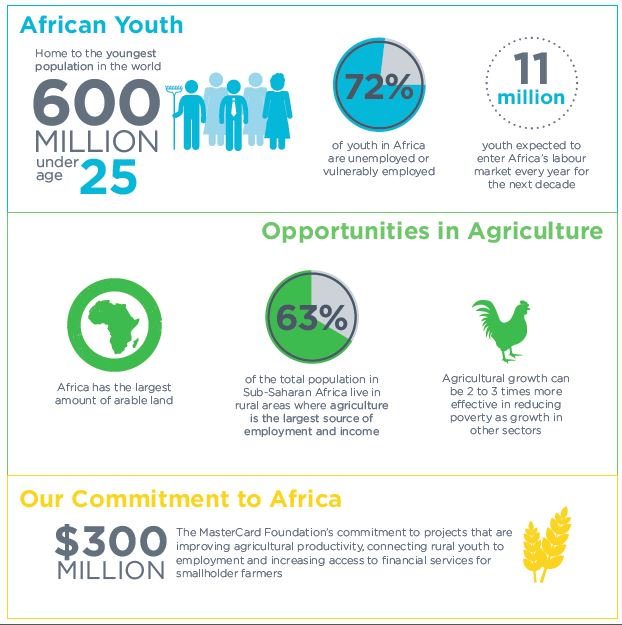
Sub-Saharan Africa is said to be the home to the youngest population in the world as statistics show that a total of 600 million youth in Africa are below the age of 25 years. This is the population that is energetic enough to boost the agricultural sector. Out of this population, 72 percent suffer unemployment or are vulnerably employed. For the next decade, 11 million youths are expected to enter the African labor market every year.
The only way out to the unemployment menace that the young people are facing is embracing agriculture to its best. This is because Africa has the largest amount of arable land. Africa has the potential not only to feed itself, but also to become a major food supplier for the rest of the world.
More to this, 63 percent of the total population in Sub-Saharan Africa live in the rural area where agriculture is the largest source of employment and income. Young people need to change their mindset that they have to acquire white collar jobs after clearing school. Most young people tend to move from the rural areas to urban areas in the name of looking for employment without knowing that they can be self-employed through agriculture.
Note that, agricultural growth can be 2 to 3 times more effective in terms of reducing poverty and increasing growth in other sectors.
One area in the agricultural sector that need to be exploited it the aquaculture sector. This sector needs to leverage by the young African as it has great potential. Statistics have shown that in 2000, a total of 55,690 tons of aquaculture production was recorded for Sub-Saharan Africa. In 2005, aquaculture provided 244,435 direct jobs and 342,209 indirect jobs throughout the continent. By 2010, the total production of aquaculture in Africa had increased to 359,790 tons.

Nigeria is said to be the largest producer of aquaculture as it produces 55 percent of the total aquaculture produced in Africa followed by Madagascar. A lot of job opportunities are created in this sector. In Egypt, for every 100 tons of fish produced, 14 full time jobs are created which leads to a 60 percent job creation in the country.
On the other hand, for every 100 tons produced, a total of 150 jobs are created.
How are Youth Involved in Aquaculture?
Young men are often involved as casual part-time employees who may be involved in pond construction and harvesting while young women play a large role in the post-harvesting process.