


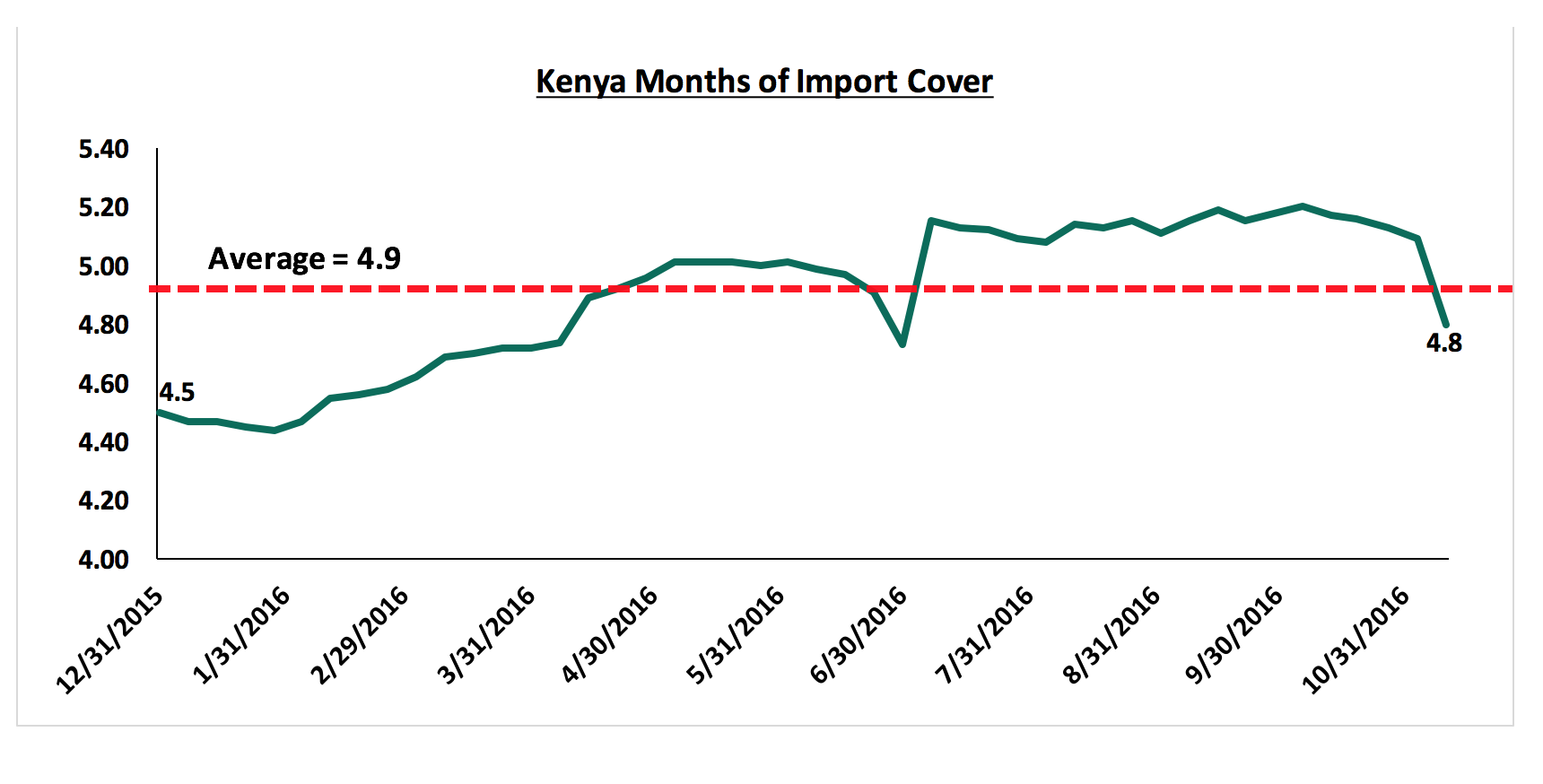
Kenya’s import cover has declined signalling a worrying trend for the Kenyan Shilling says currently below the 1-year average of 4.9 months.
According to Cytonn Investments, “The recent decline in the months of import cover is worrying, as 1-month ago on 6th October 2016, there was 5.20 months of import cover, and the months of import cover is now below the 1-year average of 4.9 months.”
The Analysts point out that the shilling is being artificially propped-up and may result into a short term weakening with “with increased dollar demand from oil importers as well as corporates to meet their foreign dividend obligations, alongside the global market volatility.”


The import cover serves as an important indicator of the stability of a currency.
However, the Kenyan Shilling has remained relatively stable against the dollar, closing the week at Kshs 101.8, from Kshs 101.6 the previous week.
Subsequently, after the US elections, the Central Bank of Kenya (CBK) said they will move in to protect the shilling against short-term fluctuations owing to the volatility and they will actively support the currency, with the forex reserves reducing by USD 92 mn in support of the shilling, leading to a decline in the months of import cover from 5.1 last week to 4.8 this week.
An import coverage ratio is the share (or percentage) of a country’s own imports that is subject to a particular non-tariff barrier, or any one of a specified group of non-tariff barriers. They are calculated by attaching actual values to bilateral trade flows between various exporters and the importing country.