


The cost of living in Kenya has gone up in the past few months and most households have been forced to dig dipper into their pockets and to stretch their budgets in order to meet basic needs.
The Economic Survey 2017 from the Kenya National Bureau of Statistics (KNBS) revealed that GDP is estimated to have grown by 5.8 percent in 2016 from 5.7 percent in 2015.
The agricultural sector has been key in enabling the growth of the Kenyan economy for a long period of time, but the sector’s contribution to GDP declined by 0.4 percent to 21.8 percent and its weighted y/y growth rate slowed down to 4.0 percent from 5.5 percent in 2015. This was attributed to the drought experienced from the 2nd half of the year that rendered the weather conditions unfavorable for agricultural activities.


The growth of the financial sector also slowed down, growing by 6.9 percent in 2016 from 9.4 percent in 2015 driven by slow private sector money supply growth of 3.6 percent in 2016 from 14.1 percent in 2015, and a slump in domestic credit growth to 6.4 percent from 20.8 percent in 2015.
These two prevailing conditions have had an effect on the cost of living. In the country according to the weekly report from Cytonn Investments Company. Cost of living is simply what one needs to sustain their daily needs and is a function of one’s disposable income and one’s expenses.
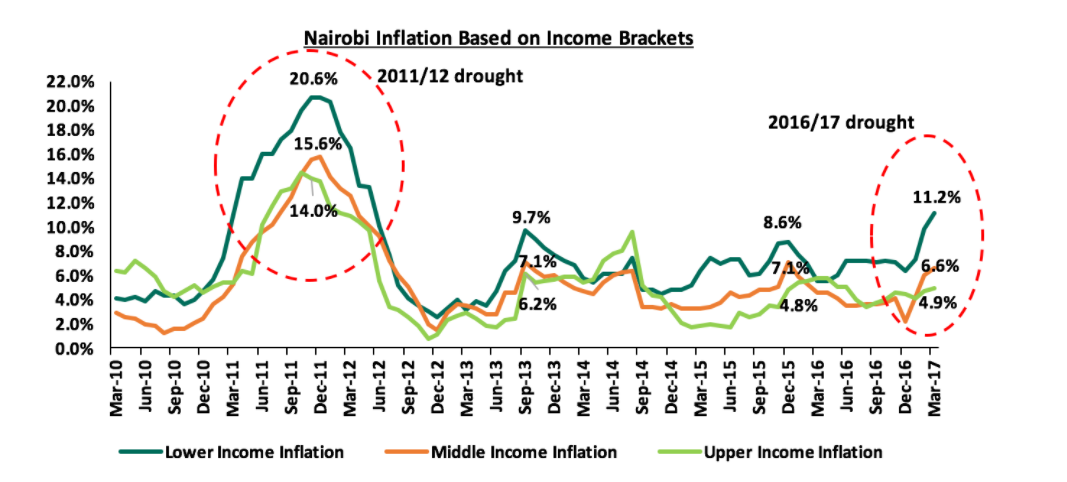
The report noted that inflationary pressure has been felt more by the low middle-income people given that they spend most of their incomes on basic necessities like food whose inflation has been quite high as shown in the chart below:
To help curb recurrence of the situation at hand, Cytonn suggested some long-term solutions that included:
- Developing irrigation schemes to reduce dependence on rain-fed agriculture and ensure food security in low rainfall seasons,
- Encouraging a culture change in the population to embrace all food types and enable us to depend on drought resistant crops, such as sorghum and millet, in times that we have to,
- Better budgetary disaster management allocation,
- Diversifying sources of electricity to reduce dependence on HEP which is reliant on good rainfall,
- Investing in water reservoirs across the country to harvest rainwater and ensure water is stored for use in times of low rainfall,
- Doing more to preserve water catchment areas especially forests,
- Investing in proper national food storage facilities to enable us to store enough food for drought seasons, and
- Improving the food distribution and reservations channels in the country to ensure food moves swiftly from areas with a surplus to areas with a deficit.