


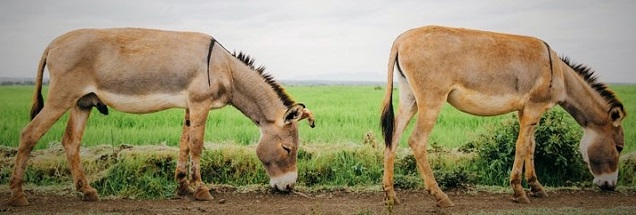
July this year, USA Today reported that, ‘China is in the grip of a massive donkey shortage caused by soaring demand for e’jiao’ — a traditional medicine made by boiling donkey skin.
“Demand for e’jiao has doubled since 2010, hitting nearly 15 million pounds a year in 2015, according to the national e’jiao association. The substance was once affordable only by royalty, because one donkey yields 2.2 pounds of e’jiao.”
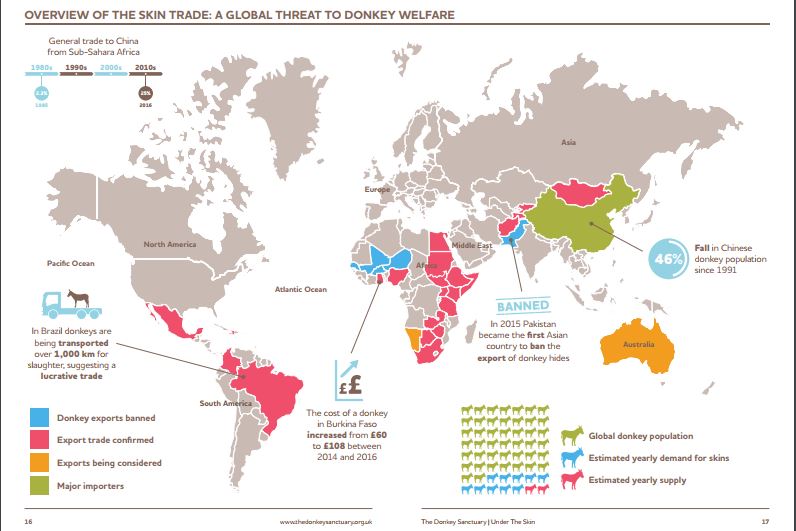
Currently, China’s demand is outstripping supply and to satisfy it, it is importing donkeys from around the world, mainly Africa.
However, in Africa, Tanzania, Ethiopia, Niger, Burkina Faso, Mali, Senegal and Gambia have banned donkey skin trade.
Uganda, become the latest country banning the trade in donkey skins. Uganda’s decision to ban the trade was made due to the “…negative consequences..” that the trade was having “.. mainly on the poor households, the women and the youth that depend on the donkey for transporting water, firewood, construction materials, people, farm produce, livestock feed, and for transporting harvests to the market.”
Uganda’s Permanent Secretary, Pius Kasajja, at the Ministry of Agriculture, Animal Industry and Fisheries said the ban would “…protect and preserve the donkey for the benefit of the communities that depend on it.”
“Virtually all countries with significant donkey populations are reporting an increase in donkey slaughter for this market,” according to the U.K.-based charity, The Donkey Sanctuary.
Alex Mayers, a program manager at The Donkey Sanctuary – U.K.-based charity says, “In Kenya, the net economic value of a working donkey is 2,300 US Dollars a year. If you sell it for slaughter, you get a fraction of that: it will give you an income for a single month.”
Quartz Africa reported that as African countries ban the trade, “Kenya doubles down to meet Chinese demand”. Consequently, “The price of an adult donkey in the country (Kenya) has soared to between $90 and $130 from $40 in less than two years.”
KSh350 million has been ploughed into the Mogotio abattoir by Chinese investors, and the Naivasha donkey slaughterhouse by a local investor where it is reported that approximately 400 donkeys are slaughtered daily. Recently,a third abbottoir -Goldox Kenya Ltd was established in Chemogoch in Baringo County at a cost of KSh300 million.
The Kenya National Bureau of Statistics 2009 livestock population indicated that Kenya had a donkey population of 1,832,519 (57 percent).
Samuel Theuri, Advocacy Officer from Brooke East Africa reported that that almost 1000 donkeys have been stolen across Kenya between December 2016 and April 2017.
Theuri says the demand for donkeys have doubled in price, from 7,000 Kenyan Shillings in 2014 to 15, 000 in 2017 making them unaffordable to those who lose their donkey.
What next for the donkey population in Kenya?
According to The Veterinary Policy 2015, specifies key challenges facing the animal resource industry and provides direction in addressing each of them.
The policy states that, “Despite their valuable contributions to human society, research and development into donkey use has been minimal.”
“A number of factors explain why donkeys have low status. They are usually the cheapest, often the only affordable, work animals and therefore tend to be associated with the poor,” reads part of the policy.
Photo Courtesy of https://www.thebrooke.org