


During the week, T-bills were oversubscribed for the first time in 8 weeks with the overall subscription rate coming in at 106.1 percent compared to 69.7 percent recorded the previous week despite relatively tight liquidity in the money market.
According to a report released by Cytonn Investments Limited, the subscription rates for the 91, 182 and 364-day papers came in at 171.3, 58.2, and 127.9 percent respectively compared to 109.4, 42.1 and 81.4 percent respectively the previous week.
Yields on the 91 and 364-day papers remained unchanged at 8.0 percent and 11.0 percent respectively while the yield on the 182-day paper rose to 10.5 percent from 10.4 percent the previous week.


The overall acceptance rate came in at 93.7 percent compared to 95.5 percent the previous week with the government accepting a total of 23.9 billion shillings of the 25.5 billion worth of bids received against the 24.0 billion shillings on offer in this auction.
Domestic Borrowing
The government is still behind its domestic borrowing target for the current fiscal year, having borrowed 59.3 billion shillings against a target of 149.9 billion shillings (assuming a pro-rated borrowing target throughout the financial year of 410.2 billion shillings budgeted for the full financial year as per the Cabinet-approved 2017 Budget Review and Outlook Paper (BROP)).
5-year and 10-year Eurobonds
According to Bloomberg, yields on the 5-year and 10-year Eurobonds increased by 50 bps and 30 bps, respectively, during the week to close at 4.3 percent and 6.3 percent from 3.8 percent and 6.0 percent the previous week respectively.
This is the first time in since September that the Kenyan Eurobonds have recorded an increase in yields. Since the mid-January 2016 peak, yields on the Kenya Eurobonds have declined by 4.9 percent points and 3.6 percent points for the 5-year and 10-year Eurobonds respectively due to the relatively stable macroeconomic conditions in the country.
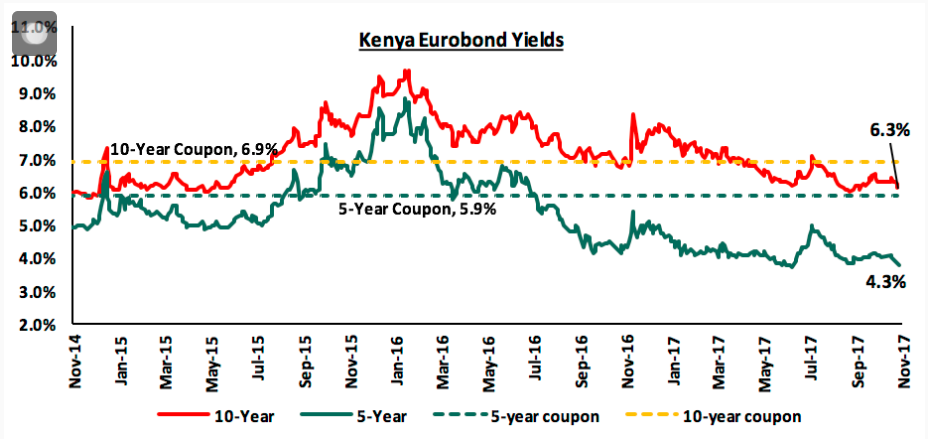

The declining Eurobond yields and stable rating by Standard & Poor (S&P), in spite of the political uncertainty around the presidential poll re-run, are indications that Kenya’s macroeconomic environment remains stable and hence an attractive investment destination. However, concerns from Moody’s around Kenya’s rising debt to GDP levels may see Kenya receive a downgraded sovereign credit rating.