


Kenya is ailing. The economy is on its knees. Those in power have refused to see the reality. They have refused to acknowledge that our motherland is moving at a terrific speed towards the land of no return.
The king is naked but those around him are telling him that he has the most expensive clothes on. Those with the courage of telling him that he is naked are ignored and even some shut from the surface of the earth.
Economists say that numbers don’t lie. Kenyan leaders have been shown the numbers but they are busy trying to convince Kenyans that somehow, the numbers are ‘lying’. The numbers available are dangerous and there is the reason for each one of us to take to the streets and mourn.


Public Debt
Kenya used to be a working nation, graduated downwards to a walking nation and now it is a borrowing nation. Our leaders are borrowing left, right and center without giving a damn of the consequences the massive borrowing has to the economy.
Kenya’s appetite for borrowing is just on another level. The country has reached the level where we are taking a loan to pay off another loan. We are now slaves to our lenders but those in power don’t want to think of this, because, after all, it is not them paying, but the common taxpayer in the streets.
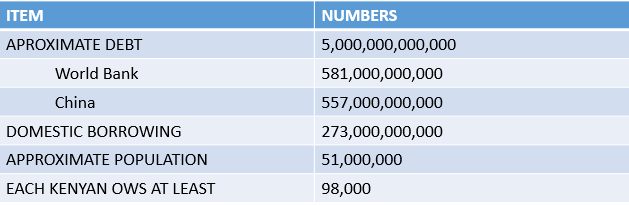
The country’s debt now stands at approximately 5 trillion shillings or about 56.4 percent of the country’s Gross Domestic Product (GDP). Bringing this closer home, Kenya currently has a population of 51 million and dividing this number with the total debt means that every Kenya owes creditors at least 98,000 shillings.
Kenya’s largest lenders are the Chinese and the World Bank. These two have been competing on who should lend more to us. Initially, China was leading at 72 percent of all the loans Kenya owed but the World Bank has since overtaken them.
Stats released by the Treasury during the month of August indicated that in a period of three months from March, the country had borrowed 54 billion shillings from the World Bank. This raised the money that the country owes the World Bank to 581 billion shillings slightly above the Chinese who we now owe 557 billion shillings. (This is without the additional loans that President Uhuru Kenyatta went to look for in Beijing. The loans from China are set to increase.)
At the end of June 2018, Kenya’s domestic debt had hit 273.7 billion shillings, 25 billion shillings more than what the Treasury had targeted to borrow. Initially, the Treasury had targeted to borrow 248.7 billion shillings from the domestic market after revising it downwards from 279.5 billion shillings.

Already the same World Bank that has continuously given us loans has raised concerns over the country’s roaring appetite for borrowing. The International Monetary Fund (IMF) also raised concerns and even spelled out a number of measures the government had to adopt, including raising of taxes, in order to cut down on borrowing. Until recently, the National Treasury insisted that we were still the ‘borrowing range’ and now that the reality is dawning on them, they want Kenyans to carry the cross.
The fact is massive borrowing does more harm to the economy than those borrowing might think. Given the fact that the debt is already becoming unmanageable, creditors would soon be on our neck demanding for their cash. The country might even be forced to secede control of strategic national assets to foreign creditors. If we are not careful, which it is clear we are not, the port of Mombasa might be going to the Chinese. They are known for taking over ports in the event that those who owe them fail to pay. They might also take over full control of the Standard Gauge Railway (Rumor has it that they are already doing it) so that they can channel all the revenue to themselves.
Overburdening Kenyans With Taxes to Pay Off the Debts
In order to sustain its appetite for borrowing and avoid defaulting the numerous loans it already has, the Kenyan government has resolved into taxing the already heavily taxed Kenyans.
Some of the notable taxes include the implementation of the 16 percent Value Added Tax (VAT) on petroleum products. The move has seen super petrol, diesel, and kerosene move up by between 11 and 13 shillings.
The 16 percent VAT was introduced in 2013, given a grace period of three years and was supposed to come into effect in 2016 but was suspended for two years to 1st of September 2018. The National Assembly has since voted to suspend the same for further two years to 1st of September 2020.
The increase in fuel prices will have adverse effects on the economy and the cost of living is set to rise tremendously. Already millers have warned Kenyans to prepare for increased maize and wheat flour prices if the government will not suspend the 16 VAT on fuel.
During the reading of 2018/2019 budget, Treasury CS Henry Rotich moved bottled water, fish processors, raw materials used in hospitals’ clothing and pharmaceutical manufacturing, milk, maize flour among others from zero-rated to VAT exempt.
There was also the increase in excise duty from 10 to 12 percent on mobile money transactions. Although the court suspended it, the directive from the Treasury still stands. Before the court suspended the same, mobile operators had already made the directive effective and it is not clear where the collected funds went.
Small Medium Enterprises (SME) were hit hard when the presumptive tax by county government, initially at 3 percent was increased to 15 percent.
Why the Economy is not sound
Although Kenya is a hub for various economic activities with major agricultural, tourism, and other sectors, several factors have adversely affected most of the sectors. The government is no longer investment friendly and its regulatory systems are slowly becoming unfavorable.
Despite the well-developed social and physical infrastructure, the economic prospects that were once positive are somehow tumbling. A look at the several sectors of the economy shows positive prospects for some companies where others are making losses.
A comprehensive review of the financials of the various sectors of the economy shows anything but the certainty of the markets. The economy is ailing. Almost every sector is feeling the heat and this can be seen from the financial reports of various companies for the year 2017.
The financials for the year 2017 across the various firms listed on the NSE shows that 15 companies in the key sectors of the economy made millions of losses. The banking sector, for instance, was the hardest hit where of the 10 listed banks, 6 of them made losses, with some having tremendous declines in profits.
Most sectors have had to send home employees in an effort to try and cut down on costs. In a country where the unemployment rate is said to be at 39.1 percent, if it is anything to go by, we should be creating employment opportunities and not joblessness.
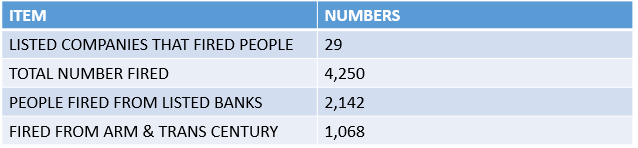

To get a better bearing on the financials of these companies, here is a focus on the sectors.
Investment Sector
Of the NSE companies listed underinvestment, three of them made losses. Trans-Century Ltd made a net loss of 4.3 billion shillings in 2017. The figure was a 403.49 percent increase in losses compared to the loss of 863.89 million shillings in 2016.
Kurwitu Ventures also made a loss after tax of 10.78 million in 2017, a 25.23 percent decrease from the 2016 loss of 14.49 million shillings.
Another company in the investment sector that realized a loss in 2017 is Home Afrika Ltd with an increase in losses from the previous year of 7.7 percent to 181.43 million shillings.
Olympia Capital Holdings Ltd and Centum Investments Co. Ltd are the only firms listed under Investment in NSE that made profits. The former realized a 162.42 percent in net profits to make 38.93 million in 2017. Centum, on the other hand, achieved a net profit of 2.79 billion shillings, a growth of 66.40 percent in profits.
Construction and Allied
The profits the E.A Portland Cement Ltd stood at 1.4 billion shillings representing a decline of 135.5 percent compared to the previous year.
At the same time, Bamburi Cement Ltd made a profit of 1.97 billion, a 66.55 percent decrease in profits compared to the previous year.
Consequently, Crown Paints Kenya PLC realized a 70.22 percent growth in net profits to 2.23 million shillings in 2017 from 1.31 million shillings in profits in the previous year.
During the 2017 financials, Athi River Mining made a loss of 6.54 billion shillings. The losses further sunk from the 2016 figure by 133.91 percent.
With 662.8 million shillings loss, 2017 wasn’t a good year for E.A. Cables Ltd as it also realized a 13.77 percent increase in losses.
Real Estate Investment Trust
Here, Stanlib Fahari I-REIT achieved a 61.32 percent growth in net profits to stand at 171.13 million shillings for the year ended 31st December 2017.
Commercial and Services
Nation Media Group was among the losers in this category with a decline of 378.1 million shillings, a 22.38 percent decrease in net profits. Uchumi Supermarket Ltd also had to contend with a loss of 1.68 billion shillings. Falling under the firms that also made losses in the category is Deacons (East Africa) Plc with a loss after tax of 841.4 million shillings, an increase in losses of 204.45 percent.
The Standard Group Ltd registered 210.84 million shillings with a 206.20 percent decline in profits.
Longhorn Publishers posited positive results with a net profit of 183.60 million shillings for the year ended 30th June 2018.
Insurance
In the insurance sector, Sanlam profits decreased by 17.6 million shillings, which was a 24.89 percent decline after taxes.
Jubilee Holdings Ltd realized a growth of 15.08 percent in profits at 4.23 billion shillings in 2017. Kenya Re-Insurance Corporation also achieved an 8.10 percent growth profit to stand at 3.58 billion shillings.
Liberty Kenya Holdings Ltd made a profit of 845.7 million shillings in 2017, a 34.70 growth compared to the previous year.
Britam Holdings Ltd realized a 78.73 percent decline in profits to make 527.5 million shillings after tax deductions compared to 2.48 billion shillings profit in 2016.
CIC Insurance Group Ltd achieved a growth of 154.25 percent in profits at 478.5 million shillings in 2017.
Telecommunication and Technology
Safaricom PLC is listed under this category and it made a profit of 55.29 billion shillings. The figure was a 27.3 percent growth from the previous year.
Banking
Barclays Bank Ltd and Stanbic Holdings PLC made profits but with declines. Barclays registered 6.93 billion net profits with a decrease of 6.93 percent. Stanbic, on the other hand, posited a 2.50 percent decline in profits at 4.31 billion shillings in 2017 compared to 4.42 billion in 2016.
Equity Group Holdings made a profit of 18.87 billion shillings, a 12.31 growth compared to the previous year. National Bank of Kenya Ltd also made a profit growth of 82.9 percent to stand at 410 million shillings in 2017.
I&M Holdings PLC, Diamond Trust Bank Kenya Ltd, HF Group Ltd, and the Standard Chartered Bank Ltd registered declines in net profits of 6.39 percent, 10.6 percent, 86 percent, 23.6 percent to stand at 7.26 billion, 6.9 million, 126.22 million, and 6.9 billion shillings respectively.
There was a 1.42 billion shillings difference between the 2016 and the 2017 financials for Co-operative Bank of Kenya, which registered a 10.58 percent decline in net profits.
KCB Group Ltd was no better in the same year as it stood to make a profit of 19 million shillings with a marginal 0.096 decline in profits compared to the 2016 results.
Some of the reasons why these companies playing an important role in the economy is largely attributed to the prolonged electioneering period. Clearly, at the rate at which these, and other firms not listed are gradually making losses shows just how much the future is bleak for Kenya’s economy.