


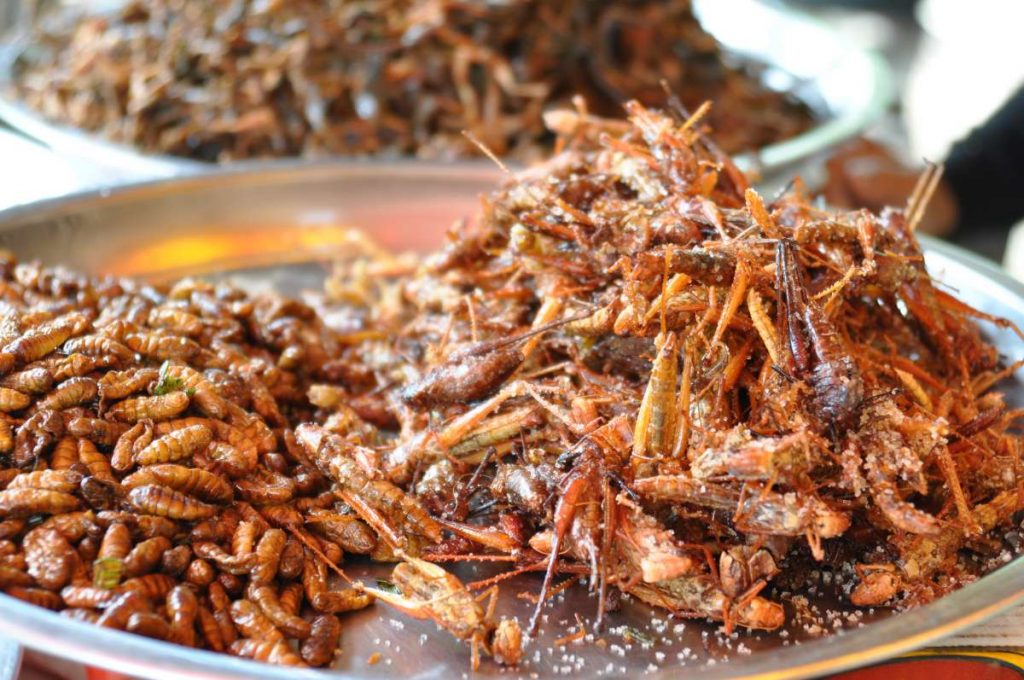
In many parts of the world, eating insects has turned out to be part of the daily delicacies enjoyed by people from different countries.
Globally, a total of 2 billion people consume insects, a practice is known as entomophagy.
Edible insects are often portrayed as something of a sustainable superfood, an environmentally friendly alternative to livestock.


They are great alternatives to conventional sources of meat as they’re cheap, plentiful and excellent sources of protein and fat, as well as vitamins and minerals. Analyses of insects also show huge variation in nutritional value and composition – between species, their stages of development and even due to the insects’ diet.
Around the world and mainly in Asia, insects are a key part of the diet of up to two billion people. Farming insects is a fraction of the cost of producing beef, pork, and poultry.
According to the United Nations’ Food & Agriculture Organization (FAO), producing a kilogram of crickets requires less than a fifth of the feed that a cow would eat to produce the same amount of beef.
Insects also negate the need for antibiotics, growth hormones and require far less water than conventional livestock. As a result, insect farming has become more common and with nearly 2,000 different species edible, expect them to come to a menu near you in the not too distant future.
By 2023, the value of the global edible insect market is expected to triple and its value will climb from $44 million to $154 million in the U.S. alone by 2023.
FAO projected that the world population is approaching 9 billion by 2050. As the numbers continue to increase natural resources such as land and water are being rapidly degraded. Edible insects, with their high feed conversion efficiency and fecundity, as well as their minimal space for rearing, certainly represent as an advantageous solution for present and future food insecurity.
Insect-eating is common practice in Africa than anywhere else in the world. The continent is home to the richest diversity of edible insects, more than 500 species ranging from caterpillars to termites, locusts, grasshoppers, crickets, ants and bees, scorpions, bugs and beetles.
The dominant insect-eating countries in Africa are the Democratic Republic of the Congo, Congo, the Central African Republic, Cameroon, Uganda, Zambia, Zimbabwe, Nigeria and South Africa and the most commonly eaten insects include caterpillars, termites, crickets and palm weevils.
As insect-eating gains wider acceptance, especially in Europe, USA and Canada, there is a huge opportunity for Africa to exploit the growing global demand for healthy insect products.
The major challenge, however, is perception. To uncover the real value of insects, strong education programmes are needed. This can be done through a structured framework covering both inventory, technology upscaling, safety, processing, and legislation.
Fun Facts About Edible Insects
- Entomophagy is the name for eating insects
- Most insects are 100 percent edible, compared with about 40 percent of a cow
- Mealworms produce only between 1 percent and 10 percent of the greenhouse gas per kilogram produced by pigs
- Many insects are high in calcium, zinc, iron, and protein
- Beetles make up 40 percent of all recorded edible insect species