


By Rahab Mbiriti
Kenya’s balance of trade deficit widened by 10.2 percent in the second quarter of 2018 to 302.4 billion shillings from 274.5 billion shillings in the corresponding quarter of 2017. This is according to the 2018 Economic Survey by the Kenya National Bureau of Statistics. (KNBS)
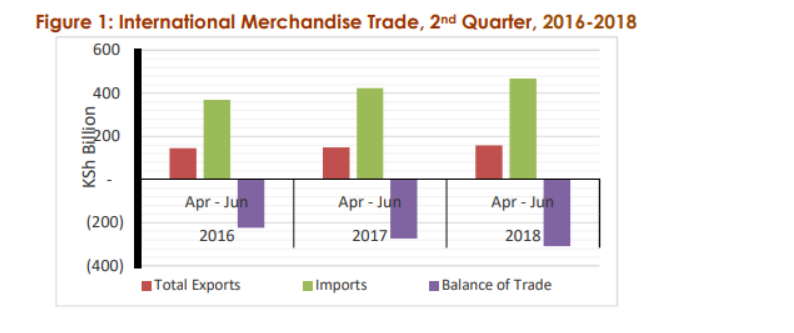



Source; KNBS
According to the survey, the growth in the trade deficit was largely driven by both a faster rate of growth and magnitude of imports as compared to exports. This means that there is a higher influx of imports into the country as compared to the number of exports.
During the quarter under review, Imports grew by 8.8 percent to 460.6 billion shillings from 423.5 billion shillings in the corresponding quarter of 2017 while exports increased at a smaller rate of 6.2 percent to 158.2 billion shillings over the same period.
Implications of a Trade Deficit
A trade deficit raises a country’s standard of living, Kenyans, in this case, have a wider variety of goods and services to choose from at different prices. It also reduces the rates of inflation since prices are lowered due to the numerous varieties of goods in the market.
However, a trade deficit could create problems in its stock markets. Investors start to notice the decline on purchase and spending of domestically produced goods and services which consequently hurt domestic companies and their stock prices.
Accordingly, investors shift their attention to foreign stock markets as there are better prospects elsewhere. This lowers the stock market demand causing it to decline.
Solutions
Proponents of free markets (supply and demand) insist that any negative effects of trade deficits will eventually correct themselves through exchange rate adjustments. Large trade deficits may simply reflect consumer preferences and may not really matter much at all in the long run.