


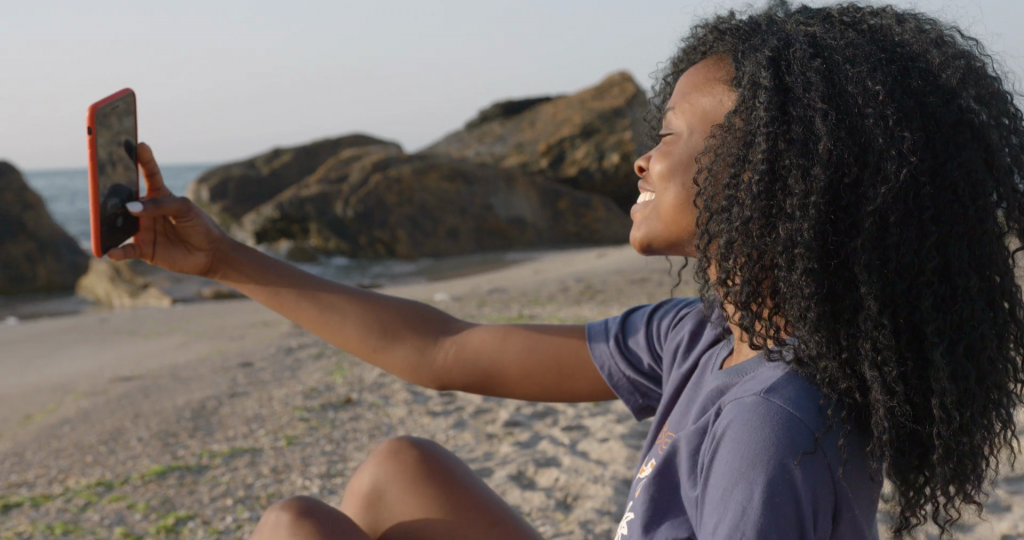
Wherever you go nowadays, you will not fail to notice someone trying to take a selfie. Well, nailing a perfect selfie in itself isn’t an easy task and people keep trying, again and again, moving to fidget from one position to another.
The world as we know it is characterized by a vain bunch of individuals obsessed with how good they look on camera before posting to the social media. Everywhere they visit is worthy of taking a selfie, be it at the top of a cliff or at the edge of a rooftop, even in coffee shops! In fact, as Google reports, users uploaded 13.7 petabytes worth of pictures to its Photos app and the analysis showed that 24 billion of the pictures were selfies!
While there is no problem in taking selfies, what people do in the process is a cause for concern. A study published by the Journal of Family Medicine and Primary Care sought to establish how social media addicts have died as a result of taking selfies.


The findings showed that between 2011 and 2017, the number of people who have died taking selfies stood at 259 worldwide. Only five of the instances occurred between 2011 and 2013 but as the growth of social media platforms progressed and the betterment of smartphone devices with exceptional cameras, the numbers are rising.
Barely two weeks have passed since two university students slipped and drowned in River Yala while taking photos in Bondo, Kenya. One of the victims, a lady slipped and was quickly swept away by currents when another student, a boy dived in to try to save her. None of them came back alive.
The case is a phenomenon across the globe. In August 2014, a Polish couple fell to their demise off a cliff after crossing a safety barrier to take a perfect selfie in the company of their children. The couple plummeted to their end as the children helplessly watched.
On October 25, 2018, and Indian couple in the US fell to their death from Taft Point at Yosemite National Park.
In a separate incident, 48 people were injured in Chennai, India on July 16, 2017, when standing too close to a burning bakery to take selfies. They repeatedly ignored warnings advising them to move away from the blaze.
These are only a few of the many cases across the world. Nonetheless, they are a testimony as to how the rise of the extreme selfie phenomenon is costing lives. People are obsessed with taking photos in the most extreme environments. Many accidents have occurred on river rafts, parachutes, railway lines, cliffs, river banks among others.
According to the study, the most common selfie-killing scenario that claimed 70 lives over the period under review is drowning – either by falling or being swept away by waves. Others include posing in near railway lines with trains passing, falling off a cliff, electrocution, or accidentally shooting oneself when posing with firearms. Animal attacks are also common.
Here is an image showing selfie deaths by category:
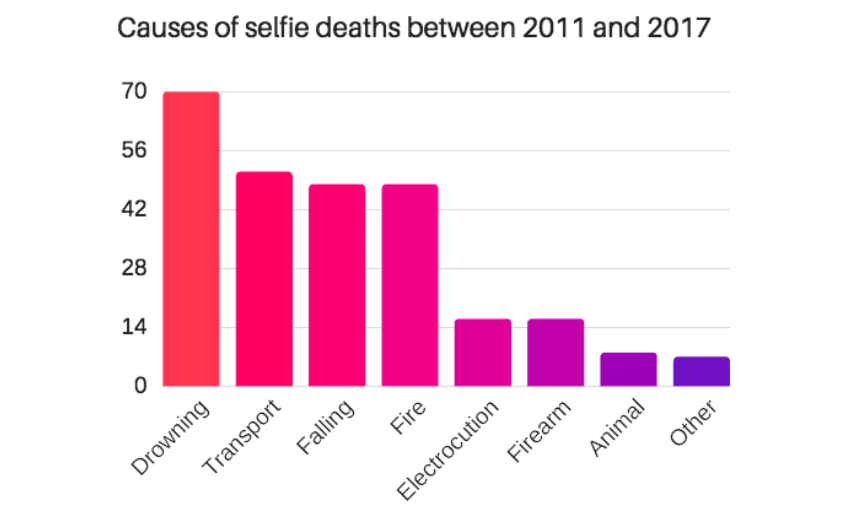

Source: NCBI
The 259 recorded selfies might seem negligible, or high. Whichever case, you should take into consideration that these are some of the deaths that made the news. In short, it is just the tip of an iceberg.
The deaths may seem like unfortunate accidents but a number of them are results of outright reckless behavior. India leads with selfie deaths, followed by Russia, the United States, and Pakistan.
Majority of the deaths occurring involve people aged 23 years old and 81 percent of the accidents remarked are risky involved men. However, the majority of those taking selfies are women.
All in all, how do we tackle the issue of selfie accidents? The answer might seem obvious “Don’t be an idiot and pose at the edge of a cliff or oncoming trains” but people seem to have a passion for death while searching for a perfect picture.
Implementing “No-Selfie Zones” in dangerous areas may help in combating the problem. The signs should be in places such as water bodies, cliffs, mountain tops, rooftops, dangerous river banks, and other dangerous places.