


One of the decisions you will have to make as an entrepreneur is how your business is going to be structured. There are different types of business entities in Kenya, and each has various obligations as per the Companies Act.
Consulting with an accountant or legal personnel is highly advisable to understand the different pros and cons for each entity type. The type of business entity one chooses is dependent on various factors including;
- Nature of business activity
- Tax Implication
- Ability to raise capital
- Separation of ownership and management
- Limited Liability protection
- Continuity of existence (perpetual succession)
- Ease of formation and maintenance
- Level of control
Here are different types of entities that a business owner can consider in Kenya
- Public Limited Company
- Private Limited Company
- Limited Liability Partnerships
- Partnerships
- Sole Proprietorship
- Foreign Company
- Societies
- Trusts
- Non-Governmental Organizations (NGOs)
Public Limited Company


A public limited company (PLC) is a company which has a minimum of seven members and no maximum members and can offer shares to the public. Other features of a public limited company include:
- Shareholders have limited liability
- Shares/Ownership is freely transferable
Perpetual succession
- A PLC has a separate legal existence from its owner. Meaning, it can own property on its own, can sue or be sued, among other things.
- Required to hold a statutory meeting and file with the registrar
Private Limited Company
This is a type of company owned by a few individuals. It restricts the number of shareholders to fifty with the minimum being two and restricts the transfer of shares. Other features of a private limited company include:
- The shareholders have limited liability
- Perpetual succession
- Can allot shares without issuing a prospectus
- Restrictions in regards to remuneration do not apply to a private company
- A private company is not required to hold a statutory meeting
Limited Liability Partnerships
Limited Liability Partnerships in Kenya are registered under the Limited Liability Partnerships Act, 2011. Limited liability partnerships commonly referred to as LLPs are unique forms of business association that combine elements of a company with those of a partnership. The main features for a Limited Liability Partnership include:
- It is a separate legal entity from its members
- They have the benefit of limited liability for their members
- They are taxed as general partnerships
- They have organizational flexibility of a partnership
- Easy to form as compared to companies
General Partnerships
This is an entity that is formed between two or more people. Each partner is liable for any debts or judgments taken on by the business or the other partners. The partners share in all assets, profits, losses, financial, and legal liabilities. Partnerships are:
- Easy to create because there are few formalities
- Every partner has a say in the running of the business
- Low cost of operation
- Unlimited liability
- Sole Proprietorship
It is a business owned and managed by one individual. It is the most common type of business entity as it is easy to form, the cost of registration is low, and owners enjoy sole control of the business. Some other features include
- Unlimited liability
- No perpetual existence
- Quick decision making
- The owner enjoys all profits and also suffers all losses on his own
- Easy to dissolve in case of closure
Foreign Company
A foreign corporation is a term used to refer to an existing corporation that is registered to do business in a state or jurisdiction other than where it was originally incorporated. Companies incorporated outside Kenya can do business in Kenya by registering a branch. Once all the requirements are met, the registrar of companies issues a certificate of compliance after which business can commence.
The requirements for registration include:
- Certified copies of foreign company’s memorandum and Articles of Association.
- Certified copy of the certificate of Incorporation duly certified by a Notary Public.
- If in a Foreign Language, certified copies of translated documents by a Notary Public.
- Appointment of a Local representative of the Foreign Company in Kenya.
- The registered address of the Foreign Company in County of registration.
- Notification of directors’ residential address (Form CR8)
- Proposed registered address in Kenya.
- Copies of Passport and passport photos of the Directors/shareholders.
Societies and Trusts
A trust is an entity which is legally formed to act as an agent, trustee or a fiduciary on behalf of an individual or business for the purpose of management of assets which are later transferred to the beneficiary party.
A society is any club, company, partnership or other association of ten or more persons, whatever its nature or object, established in Kenya or having its headquarters or chief place of business in Kenya. A branch of society also qualifies as a society. This excludes companies; trade unions and their branches; cooperatives; corporations; firms, associations, or partnerships carrying on a business for profit; schools; building societies; banks or international organizations of which Kenya is a member.
Societies are registered and regulated by the Registrar of Societies
Non-Governmental Organizations (NGOs)
A non-governmental organization (NGO) is any non-profit, voluntary citizens’ group which is organized on a local, national, or international level.
Task-oriented and driven by people with a common interest, NGOs perform a variety of service and humanitarian functions, bring citizen concerns to Governments, advocate and monitor policies, and encourage political participation through provision of information. (ngo.org)
Registration Process
The registration of the entities is almost the same though the requirements, time is taken to register, and cost may vary. Registration of business is done on the e-citizen portal, which has made the process very fast and convenient. The following are the general steps to follow in the registration of an entity;
- Create an e-citizen account on the e-citizen portal or sign in if you have an account.
- Navigate to the business registration service
- Begin the registration by choosing the business type and the name of the business as per the instruction.
Name search will set you back Kes. 150 and should take approximately two days. If successful, the name will later be reserved for 30 days which is the time you have to do the registration; otherwise, it will cost you another 150 shillings to reserve the name for another 30 days.
For registration of companies, you will follow the following procedure:
- Fill out the company registration form CR1
- Fill out the directors’ addresses on form CR8
- State your business nominal capital holdings on form BN6
- Pay stamp duty based on the amount of nominal capital the company has
- Draft your MEMARTS (Memorandum and Articles of Association) to outline your company objectives
- Pay the registration fee and deliver all the documents to the Registrar of Companies
- Once everything has been approved, the business certificate will be available on your e-citizen portal (this can take up to 21 business days)
For Partnerships and sole proprietorships, the process is shorter and is as below;
- Fill out the statement of particulars form (also BN2)
- Submit the form together with the relevant documents. i.e., ID copies, KRA pins for the partners/proprietor, and colored passport photos.
- Once everything has been approved the business certificate will be available on your e-citizen platform (this can take up to 7 days)
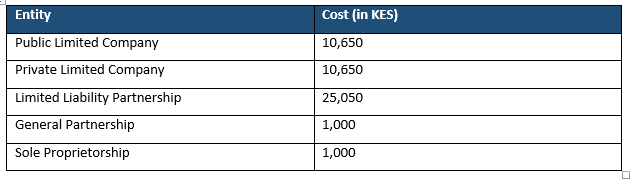
The cost for registration for the different entities exclusive of name search (at 150 shillings) is

The next step after registration is;
- Obtaining a KRA pin certificate
- Opening a bank account
- Pay for a business permit where one has a physical office
Once this is done, one should be able to commence their business operations smoothly.
Author
This article has been written by Alice Chege, a Finance Consultant at Zenuha, an independent advisory firm which offers outsourced Finance & Accounting services to entrepreneurs, small to medium-sized businesses, foundations, corporations, and high net worth individuals Contact Alice via consulting@zenuha.com.