


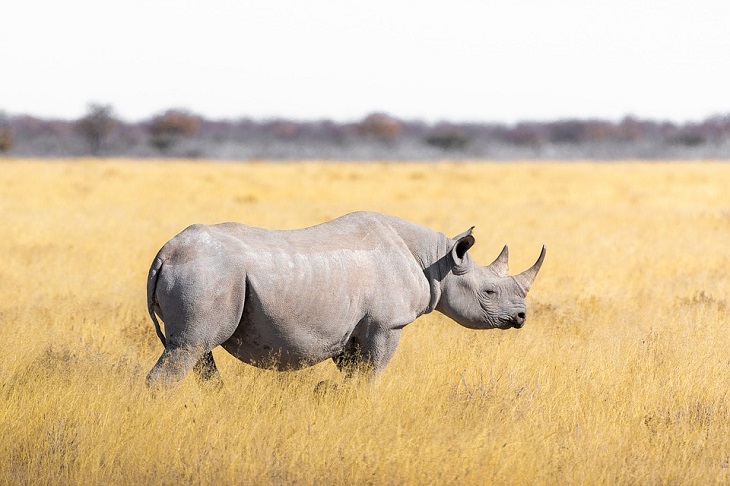
The extinction of the white rhinos, after they shrank to only two in 2018, is not likely to happen in the near future if the first-ever in-vitro embryos a plan to carry out assisted reproduction is successful.
An international consortium of scientists and conservationists has now achieved a milestone in assisted reproduction that may be a key turning point in the fate of these magnificent animals.
With eggs collected from the two remaining females and frozen sperm from deceased males, the scientists successfully created two northern white rhino embryos.


The embryos are now stored in liquid nitrogen to be transferred into a surrogate mother in the near future.
The in-vitro creation of northern white rhino embryos was achieved at Avantea Laboratories in Cremona, Italy. Prof. Cesare Galli and his team matured and fertilized eggs collected on August 22nd from Najin and Fatu, the two females living at Ol Pejeta Conservancy in Kenya, with sperm from males Suni and Saut.
“We brought ten oocytes back from Kenya, five from each female. After incubation seven matured and were suitable for fertilization (four from Fatu and three from Najin)”, says Galli.
“Fatu’s eggs were injected with Suni’s sperm while Najin’s eggs were injected with Saut’s sperm using a procedure called ICSI (Intra Cytoplasm Sperm Injection). Saut’s semen was of really poor quality and we had to thaw additional samples to find viable sperms for ICSI.
After ten days of incubation, two of Fatu’s eggs developed into viable embryos that were cryopreserved for future transfer.
Najin’s eggs did not make it to a viable embryo despite the fact that one egg initiated segmentation.”
This procedure was made possible by a previous milestone achieved at Ol Pejeta three weeks ago. Scientists were able to collect oocytes (immature eggs) from both Najin and Fatu for the first time ever.
The successful egg collection was a joint effort by the Leibniz Institute for Zoo and Wildlife Research (Leibniz-IZW), Avantea, Dvůr Králové Zoo, Ol Pejeta Conservancy and the Kenya Wildlife Service (KWS).
Immediately after the collection, the eggs were air-lifted to the Avantea Lab in Cremona.
“The entire team has been developing and planning these procedures for years”, says Prof. Thomas Hildebrandt from Leibniz-IZW.
Prof. Thomas added that an important milestone had been achieved on a rocky road which allowed the scientists to plan the future steps in the rescue program of the northern white rhino.
The entire process is part of the “BioRescue” research project. Its goal is to significantly advance assisted reproduction techniques (ART) and stem cell-associated techniques (SCAT) complemented with a comprehensive ethical assessment for the benefit of the northern white rhinoceros.
The consortium is partially funded by the German Federal Ministry of Education and Research (BMBF) and comprises of internationally renowned institutions from Germany, Italy, Czech Republic, Kenya, Japan, and USA. BioRescue aims to prevent the extinction of the northern white rhino.
The ethical assessment of the entire program and each individual procedure carried out by the BioRescue scientists is a crucial part of the programme.
“Breaking new ground automatically implies new questions arising from the new possibilities that we have”, explains BioRescue project head Hildebrandt.
“For the egg collection from Najin and Fatu we developed a dedicated ethical risk analysis in order to prepare the team for all possible scenarios of such ambitious procedures”, says Barbara de Mori, the conservation and animal welfare ethics expert from Padua University.
“And we carried out a dedicated ethical risk analysis focusing on the quality and security of all the procedures that took place at Avantea”, Barbara added.
“Five years ago it seemed like the production of a northern white rhino embryo was an almost unachievable goal, today we have them,” says Jan Stejskal, Director of Communication and International Projects from Dvůr Králové Zoo, where Najin and Fatu were born.
“This fantastic achievement of the whole team allows us to be optimistic regarding our next steps. In coming months we need to optimize the process of transfer and following the development of an embryo in a body of a surrogate mother,” Jan noted.
“The technique for the collection of eggs was developed in cooperation with many European zoos and we are happy that this unique cooperation can continue even with attempts at successful embryo transfer”, Jan added.
The partnership between Dvůr Králové Zoo, Ol Pejeta Conservancy, and Kenya Wildlife Service led to the translocation of Najin, Fatu and two male northern white rhinos from the Czech Republic to Kenya in December 2009, ultimately this led to the international collaboration that now achieved the turn of the tide in the face of the northern white rhino.
“This is a major step forward in our efforts to recover the northern white rhinos. All concerned are to be hugely congratulated,” said Richard Vigne, Managing Director of Ol Pejeta Conservancy.
“We have a very long way to go and we must remember that for most species facing extinction, the resources that are being dedicated to saving the northern whites simply don’t exist,” Richard Vigne noted.
“Global human behavior still needs to radically change if the lessons of the northern white rhinos are to be learned,” Richard Vigne added.
“The Kenyan government is greatly encouraged by breaking of new ground in the assisted reproduction technique and remains committed to facilitating the pioneering process all the way,” Hon. Najib Balala, Kenya’s Cabinet Secretary for Tourism and Wildlife said.
“It has been the decade of a race against time and we are excited at the progress in reversing the hitherto bleak outlook for the northern white rhino,” Balala concluded.