


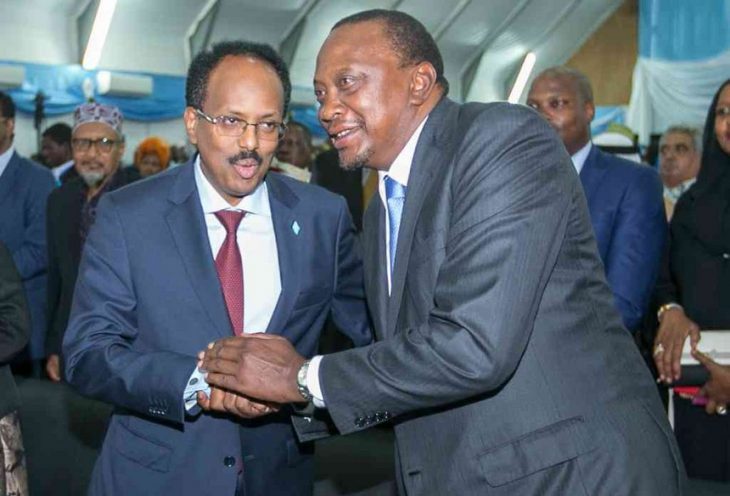
Kenya and close neighbor Somalia have agreed upon restoring their bilateral relations in an effort to end prolonged border row.
The two East African nations have now decided to squash up their beef and smoothen their bilateral ties in the coming days so as to improve the social and economic activities in the region.
Kenyan President, Uhuru Kenyatta met his Somalian counterpart President Mohammed Farmajo after the conclusion of the International Conference on Population and Development (ICPD) held in Nairobi from 12-14th November 2019.


President Kenyatta said that Somalian citizens will now be allowed to obtain visas upon arrival to Kenya and will be allowed to move in freely in out and out of Kenya.
Flights from Somalian capital, Mogadishu will be allowed to fly directly to Nairobi instead of landing at Wajir, a town in the Northern parts of Kenya.
History of the Kenya-Somalia Conflict
It all started back in 2014 when Somalia accused Kenya of taking a portion of the Indian ocean, after which the Somalian Government filed a case at the International Court of Justice.
The maritime area in question covers about 100,000-square-kilometer (38,600-square-mile) and is also said to be rich in offshore gases.
The Somalia Government said it took the case to the ICJ since it had exploited all the available avenues to resolve the maritime dispute with Kenya.
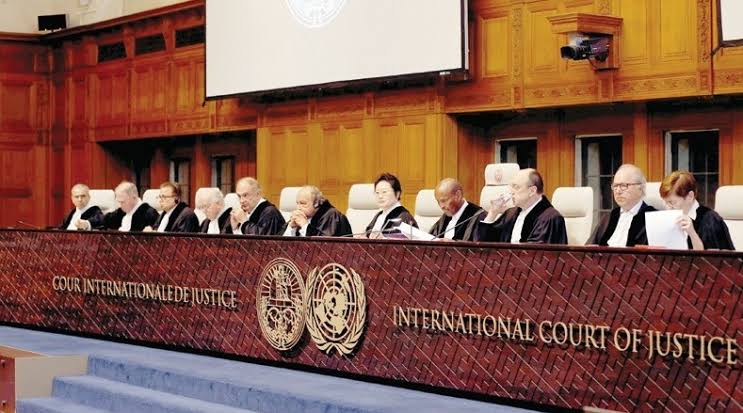

The Kenyan government was ready for negotiations but the Somalia government said that the case at the ICJ had to be stopped first.
Kenya opted to send its troops to the Indian Ocean to protect its maritime territory whereas Somalia threatened to send its troops out to counter-attack Kenya’s move.
One of the Kenyan legislators, John Mbadi, said the troops will be deployed if the parliament and the president come to agreeable terms.
“In the event that diplomacy is going to fail and any other process fails, then our constitution permits the use of Kenya defense forces to protect our boundary, and the authority to use Kenya defense forces is vested in the parliament,” Honorable Mbadi said.
“The president can declare war or use our forces to protect our boundary, but the deployment of those troops must be sanctioned by the parliament,” added the Kenyan legislator.
Somalia had also accused Kenya of meddling in its internal affairs and affecting its political climate.
Somalia felt like Kenya is supporting Ahmed Mohamed Islam, alias Madobe, the president of the southern Jubaland state, something that intensified the dispute between the neighbors.
ICJ extended the hearing of the border dispute between Kenya and Somalia to a later date following a request by Kenya to have ample time to reconstitute its legal team to handle the issue.
Somalian President Farmaji said that he is confident the case is going to be handled in a diplomatic and mutually acceptable manner to both parties, even as peace continues to prevail.
The Kenya-Somalia conflict was a time bomb that experts said was almost exploding if the two nations could not come to terms soon.
The dispute presented a suitable breeding ground for terror activities of the Somalia-based militia group Al-Shabaab.
Al- Shabab militants were going to take advantage of the Kenya-Somalia disputes to run and explore the weakest points of the two nations, something that could be catastrophic.
We must thank our two country heads for taking such an important step.