


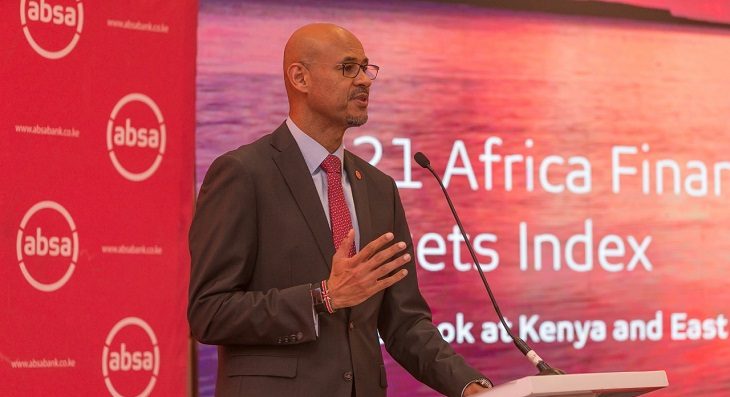
Absa Bank Kenya PLC has outperformed its peers in the country on the back of better returns primarily driven by growth in interest income as it upped its efforts to support businesses recover from the adverse effects of the Covid-19 pandemic.
In the recently released financial results, the bank registered a net profit of 10.9 billion shillings, a growth of 161 percent compared to a similar period the previous year.
The stellar performance comes on the heels of the economic slumps experienced amidst the prevalence of COVID-19.


Over the Covid-19 period, Absa continued to draw inspiration from its customers to rise above the storm and continue working together to keep the wheels of our economy turning.
During the previous period under review, Absa Kenya made a series of adjustments to support businesses to bounce back from the effects of the pandemic. This has better repositioned the lender for growth which saw all its business units remain profitable, registering good performance on key lines.
The bank incorporated the right decisive actions in capital management and supported customers with over 62-billion-shilling loan restructures and 128 billion shillings in gross lending in 2020. Absa’s total assets in its support to businesses and the Sovereign hit 429 billion shillings.
The capital and liquidity ratios remained strong with sufficient headroom above the regulatory requirement. The bank’s total capital adequacy ratio closed in 2021 at 17.1 percent and liquidity reserve position at 38.3 percent against the regulatory limits of 14.5 percent and 20 percent, respectively.
Non-funded income driven by the bank’s innovations and digitization grew by 5 percent, and costs were well managed, settling at 16.7 billion shillings from the 19.8 billion shillings registered in 2020.
ALSO READ: Absa Kenya’s Net Profits Jumps 161% to Hit Ksh.10.9 Bn
Absa’s net customer loans grew by 12 percent to close at 234 billion shillings. This remarkably stellar performance was attributed to the lender’s key focus products, including general lending, trade loans, mortgage, and scheme loans that registered strong growth year on year.
The bank’s liquidity in the money market has remained favorable, with household deposits increasing by 6 percent during the period under review to 268.7 billion shillings. About 68 percent of the total deposits were from transactional accounts.
This growth in deposits can be attributed to people’s persistence in preferring mobile money transactions, card payments, and internet banking.
In 2021, Absa Bank introduced WhatsApp banking as part of its commitment to invest over 1.6 billion shillings in technology and innovation towards enhancing customer experience.
It enabled customers to transact via WhatsApp, including account-to- Mpesa/Airtel Money transfers, inter-account transfers, bill payments, and balance inquiries.
And with the bank’s prudent cost management and transformational investments, it achieved a drop in costs of 16 percent. By the close of the 2021 financial year, the transaction volumes had hit up to 70 percent in the digital segment.
The bank has put in place some of the most strategic implementations it aims to capitalize on to claim a more significant market share. The 2021 year closed with Absa Kenya owning a market share of 7.8 and is looking at claiming between 8 and 10 percent by 2023.
Thus, Absa Kenya is looking to sharpen its focus on the growth pillar of its strategy while sustaining the newfound levels of Transformation and Returns.
The bank hopes to achieve this through three growth pillars: build new pioneering propositions for the new strategic battlegrounds, grow and diversify Retail and Business Banking, and build on Corporate and Investment Banking.