


The Kenyan internet landscape is at a crossroads, and Starlink’s arrival is making the terrain rockier for local players. In just a year, Starlink has become the country’s tenth-largest ISP, attracting over 8,000 subscribers with its seamless satellite-based internet. It’s more than just another player—Starlink is a game-changer, flipping traditional internet access on its head by bypassing costly terrestrial infrastructure. Meanwhile, the typical Kenyan consumer, burdened by inconsistent service and high costs, is embracing this new alternative, sending shockwaves through the local internet service provider (ISP) market.
Kenya’s major ISPs, led by Safaricom and Jamii Telecommunications, are now facing a competitor that challenges their longstanding hold. Safaricom, boasting over 545,000 subscribers, and Jamii with around 360,000, have long operated under a model where high infrastructure investments translate into high prices. With Starlink’s satellite constellation of 6,000 satellites, backed by SpaceX’s manufacturing power, they offer competitive plans starting at just KES 1,300 ($10) for up to 200 Mbps. In contrast, Safaricom’s similarly priced packages offer only about half the speed, leaving the traditional ISPs with a dilemma: either upgrade infrastructure or lower prices.
The Kenyan Communications Authority reported a 0.5% market share for Starlink as of June 2024—a modest but impactful foothold that has rattled the market giants. The beauty of Starlink’s model lies in its scalability and cost-efficiency. Unlike fiber-based ISPs that contend with installation delays, maintenance, and repairs, Starlink simply beams connectivity from space, giving rural and underserved regions immediate access, a feat local providers have struggled with for years. This service agility is not lost on Kenyans who’ve long felt ignored by local ISPs, especially in remote areas.


To stay competitive, local ISPs are now scrambling. Safaricom recently upped its fiber speeds and extended discounts, a direct response to Starlink’s arrival. While these moves aim to retain customers, they reveal a defensive stance against an ISP that doesn’t need physical cables. Beyond speeds and packages, Starlink’s swift, straightforward installation also makes it appealing for Kenyans frustrated with days or weeks of waiting for fiber installation. The ease of self-installing a Starlink dish has significantly lowered the barrier to entry, positioning it as a top choice for users seeking convenience and reliability.
Read Also: Karibu Connect To Resell Starlink Satellite Internet Service In Kenya
Kenyan consumers’ shift towards high-speed, reliable internet points to a growing demand for digital inclusion. Starlink’s broad, affordable access is appealing to individuals, businesses, and schools alike. This trend is reshaping user preferences, favoring ISPs that provide freedom from urban-centric service limitations and frustrating downtimes. With Starlink offering a user-centric experience free of the contractual complexities local ISPs are known for, it’s no wonder Kenyans are taking notice.
However, the local ISPs haven’t just stood idly by. They’re lobbying for regulatory intervention to slow down Starlink’s advance. Safaricom, in particular, has urged for stricter entry requirements for satellite operators, hoping to protect its existing customer base and justify its continued investments in fiber optics. But the question remains: Will regulators bow to local ISP pressure or support a more competitive market? Either way, the outcome will have lasting implications for how accessible and affordable the internet will be in Kenya.
Starlink’s rise is more than just a threat to Safaricom and Jamii—it’s a sign of how much Kenyan consumers are ready for change. With data showing internet penetration still at 42%, Starlink’s potential to bridge the digital divide is immense. For instance, a school in Turkana or a health center in Garissa can now connect seamlessly, a reality previously unimaginable. In five years, we might see Starlink or similar services push internet access beyond Kenya’s urban cores, unlocking untapped markets and expanding economic opportunity.
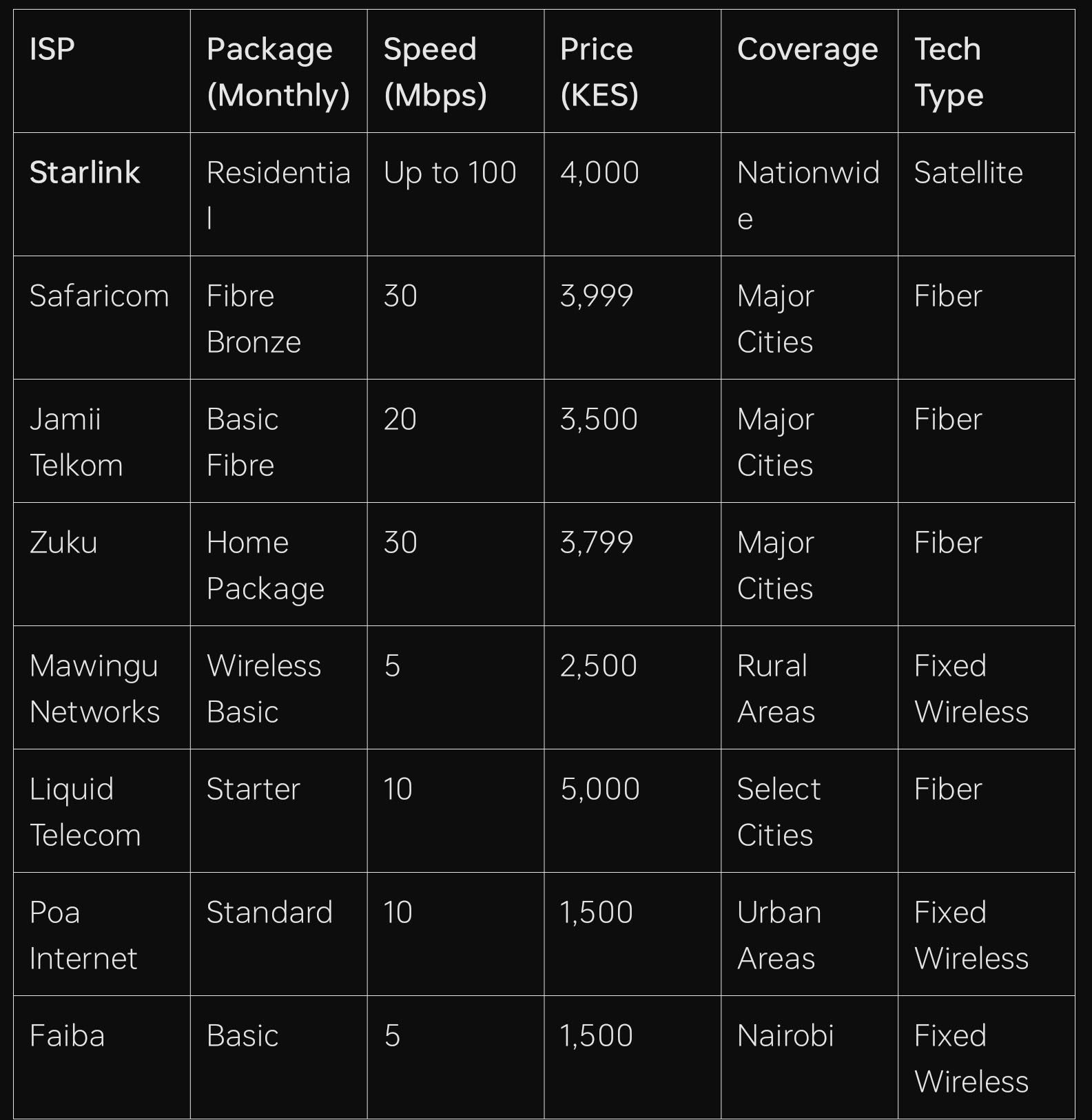
Now let’s compare: Starlink’s KES 4,000 ($31) residential package offers speeds up to 100 Mbps, outstripping Safaricom’s equivalent offerings. Jamii, Zuku, and others are feeling the pressure to rethink pricing structures. Still, the question is whether these ISPs can match the scale and cost-efficiency of a satellite model. Most local ISPs are also financially bound by infrastructure loans, making it difficult to reduce prices without harming profitability. The only solution may be embracing strategic alliances, yet even these come with risks as they could further validate Starlink’s model.
If Starlink’s momentum continues, local providers may have no choice but to diversify. The market may soon see hybrid models, where traditional ISPs supplement their fiber networks with satellite partnerships to cover hard-to-reach areas. This evolution could help local providers stay relevant but would require them to shift away from fixed profit margins and instead focus on value-driven service offerings. The Starlink effect has also raised an uncomfortable question: why were the local ISPs so slow to innovate in the first place?
In a nation where over 70% of the population is below 35, digital transformation is essential. Starlink’s affordability plays into this demographic’s needs, providing high-speed options to young entrepreneurs, digital creators, and remote workers. The youth’s preference for fast, affordable internet is setting the stage for an ISP showdown where only the nimble will survive. Predictably, the companies that can offer consistent connectivity without exorbitant fees will emerge as winners.
As the regulatory landscape adjusts to accommodate satellite operators like Starlink, local ISPs may soon have to pivot their business models. Safaricom, for instance, could use its expansive distribution network to partner with Starlink or similar companies, but this would mean a fundamental change in how they view competitors. Instead of relying on government protection, local ISPs should look to the future, where a blended service model might be their only way to stay competitive.
The next five years could redefine Kenya’s internet market, with Starlink pushing the boundaries and setting new standards. As Kenyans demand faster, cheaper internet, traditional ISPs are left with two choices: innovate or become obsolete. Local providers must embrace customer-first policies, revise pricing, and innovate—factors that Starlink has made clear are non-negotiable in today’s internet market.
To give a detailed comparison, here’s a table showcasing the top seven ISPs in Kenya, their pricing, speeds, and a direct comparison to Starlink’s offerings:

Kenya’s future internet landscape will see users choosing between high-speed satellite internet or local ISPs trying to keep up. The speed at which Starlink has penetrated Kenya should be a wake-up call for local providers: evolve or fade away. In the end, the customer will decide who reigns supreme in Kenya’s internet revolution.
Read Also: Starlink: The Disruptor In Kenya’s Telecom Industry – What Comes Next?