


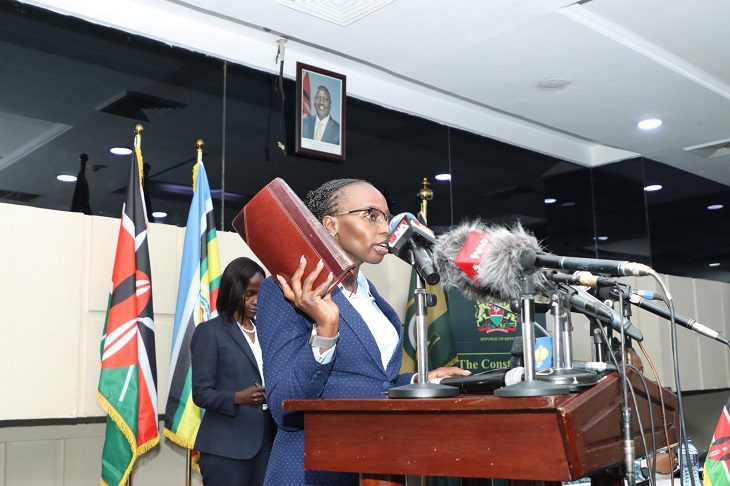
The announcement of a panel to compensate victims of police brutality is sold as a humanitarian measure. Yet, beneath the veil of relief lies a sinister truth: this is a government admission of guilt. Instead of opening doors to prosecution, it closes them, turning justice into blood money.
By agreeing to sit on this panel, Faith Odhiambo does not advance justice but betrays it. She has allowed herself to be a pawn in Ruto’s strategy to sanitize state-sponsored violence against Kenyan youth, muting her once powerful voice for accountability.
The Constitution of Kenya 2010 is clear under Article 26: every person has the right to life. Compensation does not revive lives lost through unlawful killings. What is required is criminal prosecution of those who ordered and executed these atrocities.


Faith’s participation legitimizes the state’s narrative that financial payouts can replace justice. It sends the dangerous signal that the lives of Kenyan youth can be reduced to cheques, instead of demanding punishment for those guilty of unleashing bullets on unarmed civilians.
In international law, under the Rome Statute of the International Criminal Court (ICC), systematic killings of civilians amount to crimes against humanity. Kenya, as a signatory, has a duty to prosecute or hand over those responsible. Compensation alone does not satisfy this obligation.
History is full of examples where truth was buried in compensation deals. In South Africa’s apartheid era, truth commissions sought both confession and accountability. In Kenya, Ruto is skipping truth altogether, hiding behind payouts to bury guilt.
Faith Odhiambo once stood as a beacon of resistance against injustice. Her decision to sit on this panel dims that light. For millions who believed in her, it feels like betrayal—an abandonment of the fight for justice for those who died demanding change.
The law under Article 50 of the Constitution guarantees victims a fair trial process. That includes seeing their oppressors in court. Faith’s involvement in a panel that bypasses trials makes her complicit in denying victims their constitutional rights.
What Ruto fears most is criminal liability. A panel diverts energy away from prosecuting him, his police commanders, and state functionaries. Faith’s acceptance aids this diversion, making her a shield for impunity instead of a sword for justice.
Genocide is not only mass extermination but also targeted killings of a section of the population. The youth, particularly from poor communities, have been systematically brutalized. Faith’s silence in exchange for a panel seat legitimizes this state-directed war.
The Penal Code of Kenya criminalizes murder under Section 203. Every police bullet fired unlawfully is murder. Yet instead of pushing for prosecutions, Faith has become part of a scheme that treats these murders as negotiable debts.
Victims’ families are not seeking only money—they are crying out for justice, accountability, and dignity. Faith had the platform to champion this. Instead, she has allowed herself to be co-opted into a government show that denies victims their dignity.
Compensation without prosecution is state bribery. It is hush money meant to silence cries of justice. By endorsing this system, Faith has betrayed not just the victims, but also the spirit of Kenya’s 2010 Constitution, which was built on the blood of those who fought impunity.
Faith’s defenders may argue that she is inside the system to influence it. But history shows otherwise. Panels like this are controlled from above, with little room for independence. Her presence will not deliver justice; it will only lend legitimacy to state propaganda.
Ruto’s strategy is simple: admit enough guilt to calm public anger, but never enough to face a courtroom. By joining this circus, Faith has become his cover. She has moved from defender of justice to a buffer shielding the guilty from accountability.
The Constitution’s Article 28 guarantees human dignity. Paying victims’ families without prosecuting killers strips that dignity. It suggests lives can be priced. Faith, by endorsing this, erases the very dignity she once vowed to defend.
Kenya has been here before. After the 2007–08 post-election violence, instead of justice, the nation witnessed endless commissions and reports, most shelved. The result: continued cycles of violence. Faith’s choice ensures the same mistakes will be repeated.
For the youth of Kenya, Faith’s decision is more than political—it is personal. These are their brothers, sisters, and friends buried in shallow graves. For them, she was hope. Now, she stands as the lawyer who abandoned them in their darkest hour.
Faith Odhiambo’s betrayal will not be forgotten. History is harsh on those who trade principle for proximity to power. When future generations write about Ruto’s crimes, they will note the lawyer who helped him escape by sanitizing blood with payouts.
Kenya’s legal fraternity should speak with one voice: that no lawyer worth their oath should serve in structures that shield criminals from accountability. Faith’s decision erodes public faith in the Law Society of Kenya’s moral compass.
Every cheque signed under this panel is a death certificate stamped with government impunity. Each payout is a reminder that justice was sold. And each member of the panel, Faith included, will be judged as complicit.
Article 2(5) of the Constitution recognizes international law as part of Kenyan law. That includes the duty to prosecute crimes against humanity. By prioritizing compensation over prosecution, Kenya is in breach of its international obligations—and Faith has endorsed this breach.
Faith’s betrayal also emboldens future governments. If Ruto can get away with genocide against youth today through compensation, tomorrow’s leaders will know they can kill and pay their way out of justice. This sets a dangerous precedent.
Justice is not charity. It is not a government favor. It is a right. Compensation panels turn rights into favors, stripping citizens of their power. Faith’s acceptance of such a panel betrays the legal principles she swore to uphold.
In the eyes of the victims’ families, Faith now stands on the side of those who killed, not those who died. She cannot claim neutrality. By joining this circus, she has taken a side—the side of Ruto, the police, and the machinery of impunity.
No amount of legal jargon or political justification can erase the moral truth: Faith had a choice between justice and compromise. She chose compromise. And for that, her name will be etched among those who enabled tyranny, not those who fought it.
This betrayal cuts deeper because it comes from someone who built her career on justice. Betrayal by a stranger hurts less than betrayal by one we trusted. Millions of Kenyans built their faith in Faith. She has shattered that trust.
Future law students will study this moment. They will ask: Why did Faith Odhiambo choose the path of compromise? And history’s answer will be simple—she chose proximity to power over the pursuit of justice for the powerless.
Kenya deserves better from her. The youth deserve better. The Constitution deserves better. Instead, Faith chooses to help Ruto escape justice. For this, she is remembered not as a hero, but as the lawyer who betrayed a generation.
Justice demands more than payouts. It demands prosecutions, convictions, and accountability. Faith had the chance to demand this and refused. History now judges her harshly, not as a champion of justice, but as the lawyer who helped Ruto cover genocide with blood money.
Read Also: The House of Cowards: How Kenya’s MPs Became Ruto’s Wallet Watchdogs