


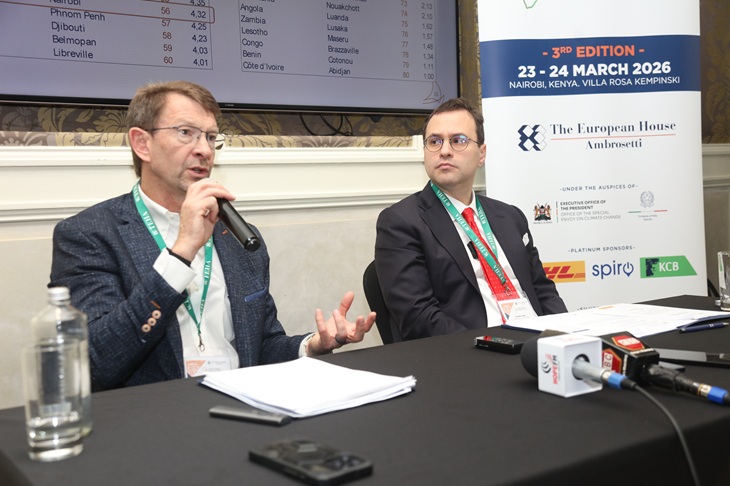
Nairobi features prominently in the new Global Attractiveness Index for Emerging and Fast-Growing Cities (GAI). The Index, developed by DHL Express Sub‐Saharan Africa and The European House – Ambrosetti, provides an objective, data‐driven assessment of the attractiveness of 80 cities across 80 countries, including their capacity to attract and retain resources across four dimensions: Economy, Environment, Social and Urban Infrastructure.
Nairobi is ranked 56th globally, 11th in Africa, and 6th in Sub-Saharan Africa. The findings reflect the Kenyan capital’s growing economic and environmental strengths, while also highlighting structural constraints that continue to limit its full potential.
Nairobi ranks 39th in the Economic Index and 35th in the Environmental Index. The city performs particularly well on key environmental indicators, including air quality and access to basic drinking water.


However, Nairobi faces persistent challenges that point to opportunities to increase its attractiveness and competitiveness. The city ranks 73rd in the Social Index due to gaps in sanitation access and the high share of the population living in informal settlements.
Nairobi ranks 65th in the Urban Infrastructure Index, with digital connectivity and sewerage access identified as key areas requiring improvement.
Across Africa, the GAI shows a diverse performance landscape, with several cities standing out as continental leaders across the four dimensions. Johannesburg is the top‐ranked African city, placing 13th globally due to its strong economic and infrastructure performance.
Port Louis ranks 19th globally and 2nd in Sub-Saharan Africa. Gaborone ranks 37th globally and 3rd in Sub-Saharan Africa. Praia ranks 41st globally and 4th in Sub-Saharan Africa.
The GAI shows that cities improve their attractiveness fastest when they strengthen the fundamentals that make it easier for businesses to operate and scale, which includes modernising digital connectivity, enhancing transport and basic services, supporting SME participation and reducing administrative barriers that slow investment or innovation.
Higher GAI positions signal a stronger capacity to attract capital, talent and services that underpin long‐term development. Cities that raise their attractiveness are better placed to integrate into global value chains and trade corridors, increasing their visibility in international networks.
“For Africa to accelerate its integration into global trade and to realize its full economic potential, we must understand where our cities stand, what their unique strengths are, and what barriers must be removed to allow them to develop. The GAI gives us a clear, data-backed roadmap,” said Hennie Heymans, CEO of DHL Express Sub-Saharan Africa.
The GAI emphasises that Africa’s urban future will be defined by how well cities balance economic dynamism with social inclusion and infrastructure reliability.
Heymans underscored this point: “Africa is not short of ambition or talent. What we need now is coordinated investment, public and private, in the systems that allow cities to scale sustainably.
Cities like Johannesburg, Port Louis, and Gaborone show what is possible, and Nairobi’s ranking highlights the untapped potential that can be unlocked by matching its positive economic and environmental progress with targeted investments in social initiatives and infrastructure. DHL is ready and proud to support the continent’s journey toward greater connectedness and opportunity.”
Pietro Maninni, CEO of The European House – Ambrosetti Africa, added, “The GAI provides an important evidence base for policymakers, investors and business leaders. With the right reforms, digital acceleration, inclusive housing strategies, green infrastructure and modernised urban services, African cities can shift quickly into higher tiers of global competitiveness.”
Read Also: A New Workplace Policy in Nairobi: Exploring Menstrual Leave For Employees