


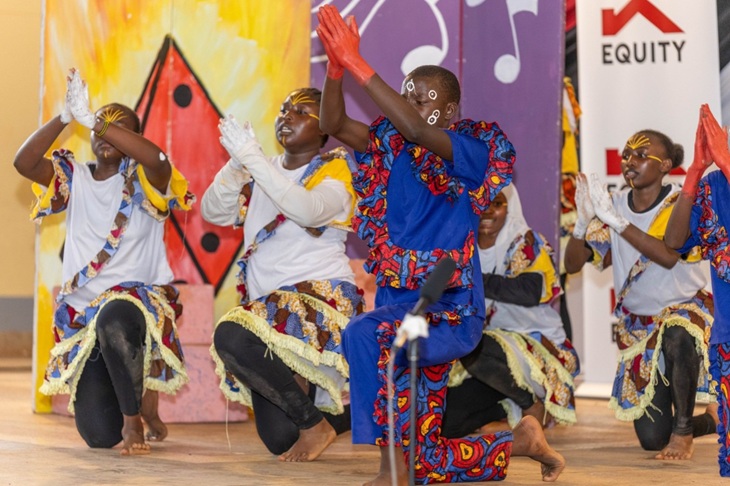
Students at the Kenya National Drama and Film Festival are translating policy themes into a playbook for everyday commerce, showing households and small firms how cashless payments, clean records and disciplined borrowing cut costs and unlock growth.
Building on the festival theme Bold Storytellers, Digital Stages: Driving Kenya’s Development Through Theatre and Film, and Equity Bank’s sub-theme Leveraging Technology to Make Banking a Lifestyle – From a Place You Go to Something You Do, performances showed audiences how to adopt digital tools that build credit trails and widen market access.
The scenes are familiar and relatable. A kiosk owner drops loose cash for QR and e wallet acceptance, builds an auditable trail and secures stock financing. Parents shift school fees to digital rails for speed and verifiable receipts. Youth agripreneurs pool savings on apps to fund inputs and insure harvests, while women led collectives lean on instant payment to reach customers across counties and into regional markets. Alongside the opportunity, students confront risk head on, from basic cyber hygiene to responsible digital borrowing, tying clean data to affordable credit.


Kayole South Senior School trainer Morgan Odera was among those testing the boundaries of financial storytelling. He said their spoken word piece linked national identity to present day financial inclusion by blending Kenya’s independence story with the role of education finance in creating awareness.
“We have just performed a spoken word talking about how Kenya gained independence and how the bank chips in to benefit students, mostly through its education programs and by supporting businesspeople and Kenya’s development in general,” he said.
Performed by student Sheila Akinyi, the work drew mixed reactions for its ambition. “It is hard to combine a spoken word about independence with current affairs,” Mr Odera noted. “The artist was creative enough to blend the independence struggles and the bank’s support to students through Wings to Fly, which supports them at higher education level.” The piece underscored a simple economic arc: access to education and skills pulls more young Kenyans into a modern, increasingly digital economy, the same transformation students advocate through safer, smarter money habits.
At Precious Blood Riruta, lead choreographer Amos Othengo Pinto threaded a small trader narrative into dance and gave it commercial stakes. A mama mboga closes her day by banking takings to build a savings record and grow her enterprise. “After a day with her customers, she can save in the bank to boost the business,” he said, explaining how the team blended African and hip-hop styles to tell a modern finance story on a digital stage.
Performed by the Kenya Institute of Mass Communication under the Equity theme, the play Giza Gizani also confronted abuse of power, silence, absent parenting and injustice. Dickens Sumba, the playwright and thespian, said the work was crafted to provoke reflection and affirm the possibility of accountability.
“We built Giza Gizani to strip impunity of its glamour, to show what silence costs in homes and institutions, and to light a path toward courage, dignity and justice.”
For Nairobi Regional Director of Education Reuben Kipturgor, the business and financial awareness approach is deliberate. It stems from handing authorship to learners and demanding utility from the art. “Can we make these activities learner based? Can we go back and allow our learners to generate their own script, and then we just help them to fine tune to the levels that we can reach? That is the only way we can develop their talents,” he said, before urging partners to back student creators in tangible ways.
Equity Bank’s has committed Sh25 million nationally to support the festival, with the bank’s themed genres highlighting how technology is making financial services part of daily life and expanding inclusion for individuals, schools and enterprises.
At the national finals, champions in the Equity classes will receive Ksh100,000 with silverware, runners-up will take Ksh50,000, and third place will get Ksh30,000. All winners will also be awarded wit trophies and certificates. The best trainer will receive Ksh30,000, second Ksh20,000 and third Ksh10,000.
The national finals will be held in April in Nyeri, followed by gala showcases hosted by Education CS Julius Ogamba and Equity Group CEO and MD Dr James Mwangi. The top students will then cap the season with a performance at State Lodge, Nyeri, in a gala to be attended by President William Ruto.
Read Also: Protecting Yourself From Online scams In The Age Of Digital Finance