


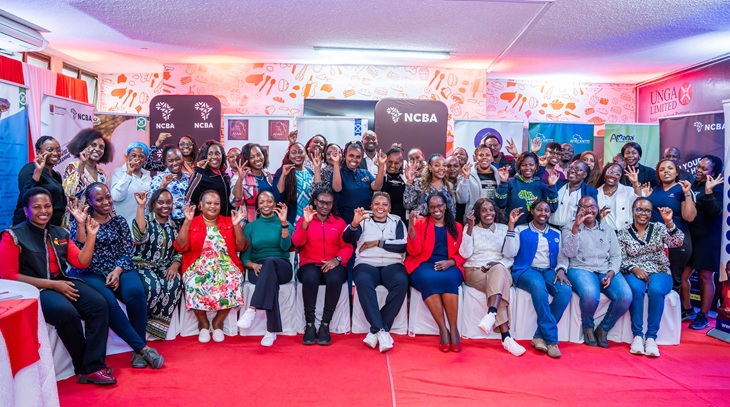
NCBA has launched the second cohort of 42 women agri-preneurs under the Affirmative Finance Action for Women in Africa (AFAWA) Acceleration progamme in partnership with African Guarantee Fund (AGF) and Unga Group Plc.
The initiative is designed to unlock growth for women-owned SMEs by improving access to finance, skills, and markets. So far 38 women from the first cohort have already benefited from the programme, receiving USD 1.5 million cumulatively in funding and trainings to sustainably scale their businesses.
The second cohort onboarded in February 2026 builds on this impact, with NCBA Bank expected to provide up to USD 5 million in lending across the two cohorts by July 2026. The women under the programme operate in critical sectors including human food and animal feed across the country positioning them at the heart of Kenya’s food security and value chain development.


Speaking during the official launch, NCBA Group Director, retail banking, Dennis Njau noted, “This programme aims to support women business owners across the agricultural value chain who often face additional structural constraints through an integrated approach comprising access to skills, markets and finance. This partnership is a clear demonstration of our Ubuntu philosophy in motion, anchored on enabling productivity by building solutions around what truly matters to our customers.”
Across Africa women entrepreneurs face additional structural constraints, including limited access to collateral and smaller loan sizes, resulting in an estimated USD 42 billion financing gap for women-led enterprises. The programme seeks to bridge this gap through a tailored financing model anchored in a partial guarantee scheme between the bank and AGF. This risk sharing facility is designed to reflect the realities of SMES which often lack the collateral traditionally required to access credit.
Africa Guarantee Fund Group Director, Capacity Development, Patrick Lumumba, noted that, “Through our partnership with NCBA under the AFAWA framework, we are reducing the barriers that have historically limited women-owned SMEs from accessing credit. By de-risking lending, we are enabling financial institutions to extend more capital to women entrepreneurs, ultimately driving inclusive growth and job creation across key sectors of the economy.”
The programme takes an integrated support model that combines affordable financing, technical skills development, mentorship, and access to new markets with the intervention expected to create approximately 300 new jobs and strengthen the resilience and scalability of the selected 80 WSMEs.
Sharing her experience as a beneficiary of the first cohort, one lady said, “Through the AFAWA programme, I have been able to access financing and practical business support that has helped me stabilise operations and plan for growth. Beyond funding, the mentorship and exposure have given me confidence to scale my business sustainably.”
Unga Group Plc Group Managing Director, James Nyutu, stated that, “As a learning partner, Unga Group is committed to equipping these entrepreneurs with practical industry insights, technical expertise, and exposure to scalable business practices within the agri-food value chain. We believe that empowering women at this level strengthens not just individual businesses, but the entire ecosystem that supports food production and security in Kenya.”
Within the partnership framework, NCBA Bank provides capital and lending solutions tailored to SME needs, AGF serves as the risk-sharing partner and programme sponsor, enabling increased credit access through guaratees, while Unga Group plays a critical role as the learning partner by offering industry insights, technical expertise, and exposure to scalable business practices within the agri-food value chain.
“Following the success of the first cohort, we are excited to launch the second phase of this acceleration programme, which supports women‑owned enterprises through integrated access to skills, markets, and finance. By combining practical training, industry exposure through Unga Group, on‑site business support, and financial linkages with NCBA, we are enabling real, sustainable business growth,” said Linda Onyango, CEO, SME Support Centre (SSC).
Within this framework, each partner plays a critical role in providing a holistic ecosystem that goes beyond financing to equip women entrepreneurs with the tools, knowledge, and networks required to scale and compete sustainably.
Read Also: NCBA’s Customer Experience Recognition Signals a Bank Listening More Closely to Its Customers