


Modern earphones are sold with one feature that sounds almost magical: noise cancellation. They do not stop the world from making noise. They identify the disturbance, reduce its power and allow you to hear what actually matters.
That is also one of the most valuable skills an investor can develop. The stock market is never quiet. Every trading day arrives with breaking news, analyst opinions, political speeches, rumours, forecasts, social-media panic and dramatic headlines written to make people click before they think.
The problem is not that all this information is false. The problem is that much of it is incomplete, exaggerated, short-term or stripped of the context needed to make a sound investment decision. A headline may accurately report that billions of shillings have been wiped from the market in one session, yet tell you almost nothing about whether a strong company has permanently lost its ability to earn money.


Markets are emotional in the short run. Prices can fall because foreign investors need dollars, interest rates have risen, a currency has weakened, institutions are rebalancing portfolios, a war has frightened global capital or traders simply expect other traders to sell. None of these automatically means that every business on the exchange has suddenly become worthless.
Kenyan investors saw this clearly in 2023. The Nairobi Securities Exchange was surrounded by fear. KCB Group’s market value fell below KSh100 billion after its share price dropped to KSh29.45 in May. Safaricom later fell to KSh11.50 on 3 November. The headlines were severe, the mood was dark and pessimism became so widespread that avoiding shares appeared wiser than owning them.
Many people reacted to the price instead of investigating the business. Some sold after the fall had already happened. Others decided the market was a casino and stayed away completely. A third group waited for the news to become positive again, forgetting that by the time optimism becomes obvious, the cheapest prices are normally gone.
By the close of trading on 2 July 2026, KCB was at KSh78.50 and Safaricom was at KSh34.05. From those 2023 fear points, KCB had risen by about 166.6 percent and Safaricom by about 196.1 percent, before counting dividends. A hypothetical KSh100,000 exposed to the same price movement would have grown to roughly KSh266,553 in KCB or KSh296,087 in Safaricom, excluding transaction costs, taxes and dividends.
Read Also: Djibril Tobe Named Airtel Kenya MD, Succeeding Ashish Malhotra After Four Years of Record Growth
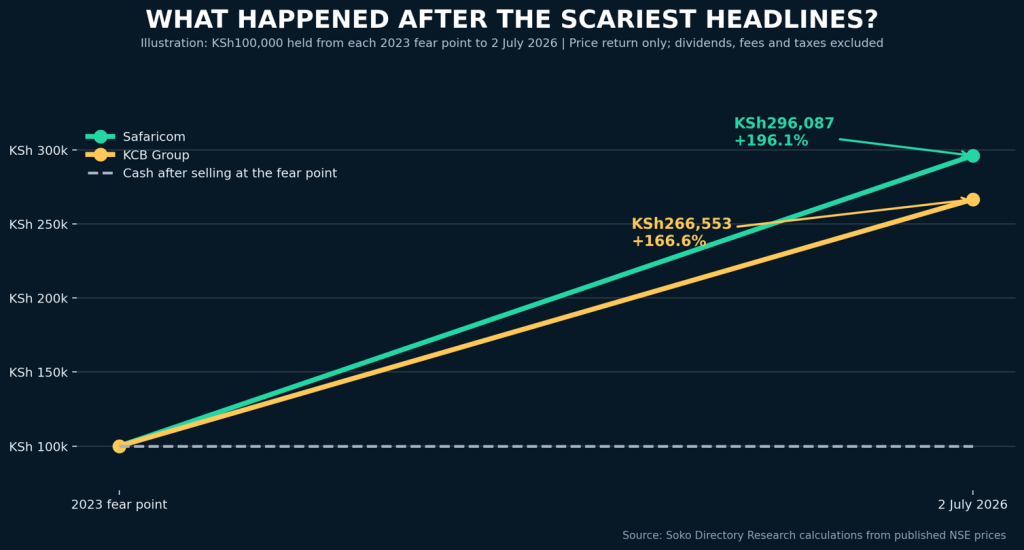

Figure 1: The illustration compares price movement from each company’s cited 2023 fear point to 2 July 2026. It is not a claim that the exact bottom could have been predicted.
The important lesson is not that anyone could have known the exact bottom. Almost nobody can do that consistently. The lesson is that a falling price and a failing business are not the same thing. Investors who understood that distinction were able to examine the companies, assess the risks, compare price with underlying value and act without allowing fear to decide for them.
Noise says, ‘The share is falling, therefore the company is bad.’ Analysis asks, ‘What has changed in revenue, profit, cash generation, debt, asset quality, market share, regulation, management and long-term competitive strength?’ Noise watches the ticker every hour. Analysis reads financial statements and company disclosures. Noise demands certainty today. Analysis accepts uncertainty but insists on a margin of safety.
This is why stock-market wealth is often built during uncomfortable periods. When everyone feels safe, prices may already reflect the good news. When everyone is frightened, good companies can be priced as though temporary problems will last forever. The disciplined investor does not celebrate bad news or buy blindly. The disciplined investor simply understands that fear can create mispricing.
There is, however, a dangerous misunderstanding that must be removed. Ignoring noise does not mean ignoring evidence. Not every share that falls will recover. Some companies decline because their products are becoming irrelevant. Others are drowning in debt, losing customers, manipulating accounts, suffering governance failures or destroying shareholder capital. Patience cannot rescue a broken investment thesis.
True investment noise cancellation is therefore not deafness. It is filtration. It means separating information that changes the value of a business from information that merely changes the mood of the market. A profit warning, major fraud, unsustainable debt or permanent regulatory damage may be a signal. A frightening headline that repeats yesterday’s price decline without new facts may simply be noise.
A serious investor must always return to the fundamentals. Is the company growing revenue in a sustainable way? Is profit being converted into actual cash? Is debt manageable? Can the business survive a difficult economic cycle? Does it possess pricing power, distribution strength, trusted brands, technology, licences, data, networks or other advantages that competitors cannot easily copy? Is management honest and competent? Is the share price reasonable relative to the company’s earnings, assets and future prospects?
The word ‘reasonable’ matters because even an excellent company can be a poor investment when purchased at an absurd price. Noise cancellation is not permission to buy famous companies at any valuation. It is the discipline to refuse both extremes: panic selling a valuable asset because the crowd is afraid and reckless buying because the crowd is excited.
Investors should also remember that headlines measure movement, not personal outcomes. A newspaper may announce that KSh100 billion has been wiped from investor wealth, but that loss is largely a fall in quoted market value at that moment. For a long-term owner, the decisive question is whether the underlying company can continue producing earnings and cash over many years. A temporary quotation is not automatically a permanent loss unless the investor sells or the business truly deteriorates.
That distinction becomes powerful when the mathematics of losses is understood. After a 10 percent decline, an investment needs an 11.1 percent gain to recover. After a 30 percent decline, it needs 42.9 percent. After a 50 percent decline, it must double merely to return to the starting point. Selling in panic after a deep fall can therefore turn volatility into permanent damage.
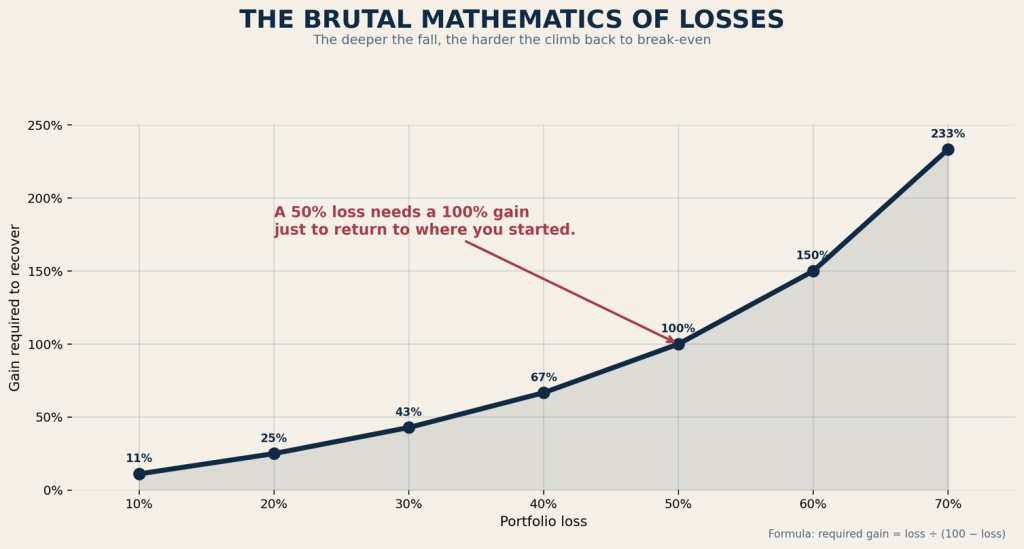

Figure 2: Large losses demand disproportionately larger gains to recover, which is why emotional selling after a deep fall can be so destructive.
The antidote is preparation before the noise arrives. Every investor should know why an investment is being purchased, what facts support the decision, what risks could invalidate it, how much of the portfolio may be exposed to it and how long the capital can remain invested. A written investment thesis is more useful during a crash than confidence borrowed from social media.
Diversification is equally important. Noise becomes terrifying when one company carries the weight of an entire financial future. A properly diversified investor can assess each holding calmly because a single disappointment is less likely to destroy the whole portfolio. Diversification does not eliminate risk, but it reduces the pressure that often pushes people into emotional decisions.
Liquidity also matters. Money required for school fees, rent, medical needs or emergencies should not be forced into volatile shares. An investor who may need the cash next month has a different risk profile from one investing for ten years. Long-term thinking only works when the financial structure around the investment allows time to do its work.
The market rewards neither blind optimism nor permanent pessimism. It rewards sound judgement applied repeatedly. Sometimes the correct decision is to buy. Sometimes it is to hold. Sometimes it is to sell because the facts have changed. The goal is not to avoid action; it is to ensure that action is triggered by evidence rather than anxiety.
Before reacting to a dramatic headline, ask five questions. Is this new information? Does it change the company’s long-term earning power? Is the effect temporary or permanent? Is the current price already discounting the bad news? What does the company’s own verified data show? These questions create a pause between emotion and execution, and that pause can protect years of accumulated capital.
It also helps to reduce the number of voices entering the decision-making process. Following dozens of commentators does not automatically make an investor better informed. It can produce contradictory instructions, endless doubt and expensive overtrading. Choose a limited number of credible research sources, read official disclosures and treat anonymous certainty with suspicion.
Successful investing is usually less exciting than the internet suggests. It involves saving consistently, buying productive assets at sensible prices, reinvesting dividends where appropriate, reviewing the original thesis and allowing compounding to operate. It is not built from reacting to every candle on a chart or trying to turn every market rumour into a trade.
The greatest threat is often not the market itself but the investor’s behaviour inside the market. Fear causes people to sell low. Greed causes them to buy high. Impatience causes them to abandon good plans. Overconfidence causes excessive concentration. Noise cancellation is the behavioural system that prevents temporary emotion from controlling permanent financial decisions.
| THE MARKET DOES NOT HAVE TO BECOME QUIET. THE INVESTOR HAS TO BECOME DISCIPLINED. |
Generational wealth is not created by one lucky share purchase. It is built by owning productive assets, protecting capital, continuing to learn and remaining disciplined across many market cycles. The investor who can stay rational when others are panicking has an advantage that cannot be downloaded from an app or purchased from a broker.
The next frightening headline will come. It may concern politics, taxes, inflation, interest rates, war, regulation, a currency shock or a sudden market sell-off. The headline will feel urgent. The crowd will demand an immediate reaction. That is the moment to activate your investment noise cancellation.
Turn down the panic. Turn up the facts. Check the business. Check the valuation. Check your time horizon. Check whether the original thesis still holds. Then decide that your future self will respect.
The market will always be loud. Wealth, however, is usually built quietly: one informed decision, one disciplined contribution and one patient year at a time.
Read Also: Why Wealth Belongs to Those Who Keep Investing When Life Gets Hard