


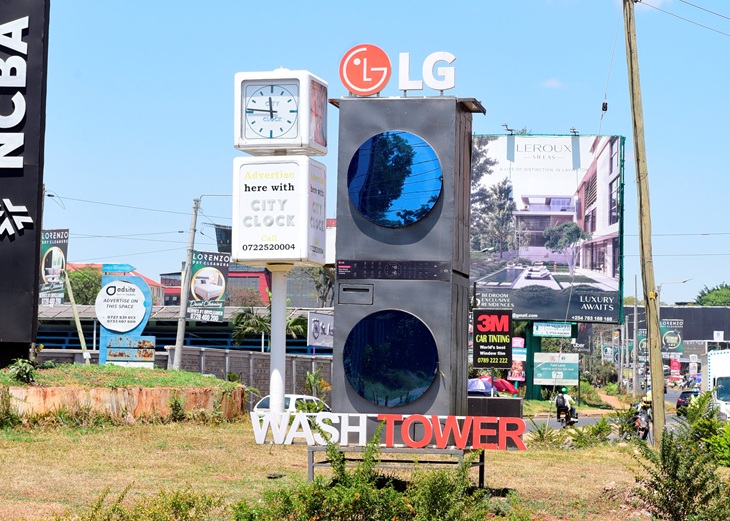
There’s something profound about letting people experience a product that ultimately endears them to a brand. I say this knowing fully well that I should not divulge some of the strategies we use to get our products to market, but I am also a proponent of the belief that knowledge must be shared.
Let me give you some background. We introduced the LG WashTower to the Kenyan market. This proprietary home laundry equipment combines a washer and dryer into a single unit by stacking one on top of the other, but with centralized controls.
We have marketed the product through traditional channels, including print and digital banners, in-store showcases, and product placement in online shows. I must note that all these techniques have worked remarkably well in getting our target audiences acquainted with the product. But it is also because the WashTower is a great laundry product.


And as we continue to use these marketing techniques, very recently, we decided to trial something new, which if I say so myself, it really is something we should have done a long time ago. Understanding that our product would appeal to a diverse class of audiences, we took a couple of Lifesize WashTowers and positioned them at some of Nairobi’s commuter hubs, including the Sarit Centre Ring Road Roundabout, Kenyatta Hospital Ngong Road Roundabout and St. Austin’s Lavington Roundabout. We went ahead and made them fully operational, allowing as many people as possible to experience the technology in action.
Obviously, I cannot divulge the full impact of this strategy to our bottomline, but what I can say is that it worked! The public showcase confirmed to many that these technologies are locally available and are truly affordable.
It also validated findings by some of the world’s leading researchers the interaction in experiential marketing can create a strong association among brands customers and products. One study published in the International Journal of Research concludes that experiential marketing plays an important role in influencing customer behavior by creating a feeling of satisfaction and loyal base.
Another report by McKinsey noted that as the in-person experiences market expands, brands are rethinking how they engage audiences — moving beyond screens and into immersive, physical environments
For a product like the LG WashTower, allowing customers, including those who have never owned or used a washing machine, the opportunity to go through the motions of settings selection and watching the system go live all the way to the drying process, enabled them to appreciate the relevance of such a product. The display also mimicked a typical urban setup, just managing to show how little space it occupies, and hopefully sending out the message that nearly anyone could have it in their homes.
That said, I must note that while this was a genuinely successful experience, it will not replace the traditional marketing techniques that continue to work quite well. Rather, it will complement them by bringing the visual experience down to the lived environment, allowing as many people as possible to experience our products before they make the decision to purchase.
Read Also: One Machine, Two Jobs: LG’s Case for Rethinking the Laundry Room
The writer is the Head of Marketing at LG Electronics East Africa