


| MAIZE +20.75% | RICE +23.14% | WHEAT +31.40% |
The numbers are no longer whispering. They are shouting.
A global commodity price table for August 2026 shows that the year-on-year price of maize has risen by 20.75 per cent, Thai 25 per cent rice by 23.14 per cent and US hard red winter wheat by 31.40 per cent. These are not abstract figures moving across a trader’s screen. They represent the raw ingredients behind ugali, bread, chapati, rice, porridge, animal feed and thousands of everyday meals.
A percentage on a research report becomes something painfully human when it reaches the market. It becomes a parent removing one item from the shopping basket. It becomes a hotel reducing portions, a school adjusting its menu, a baker increasing the price of bread, or a farmer paying more to feed livestock. Eventually, it becomes a household deciding which bill will remain unpaid so that supper can be served.


The table therefore offers an early warning, not merely a market update. Food inflation rarely arrives as one dramatic event. It moves through the economy in stages: first through international markets, then import contracts, shipping and exchange rates, milling and transport, wholesale prices and finally the till at the supermarket or the counter at the local kiosk. By the time the public feels the full pain, the shock has already travelled through an entire supply chain.
The three staples flashing red
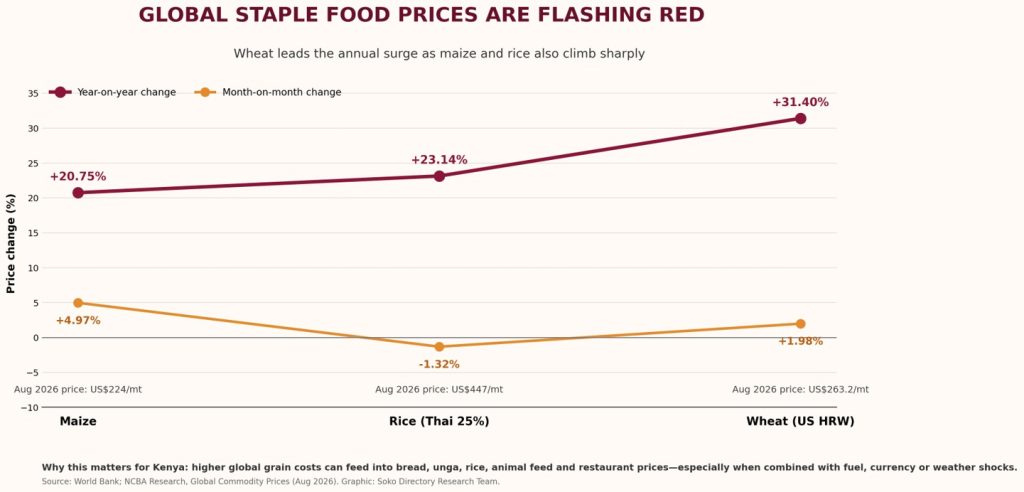

Figure 1: Annual and monthly movements in selected staple-food prices. Source: World Bank and NCBA Research, August 2026. Graphic: Soko Directory Research Team.
Read Also: Government Unveils Plan To Import 25 Million Bags Of Maize Amid Looming Food Shortage
Wheat is the clearest danger signal. At US$263.20 per metric tonne, its price is 31.40 per cent higher than a year earlier and 1.98 per cent higher than the previous month. Kenya’s dependence on imported wheat exposes households and businesses to international supply disruptions, freight costs and exchange-rate movements. The pressure can pass into bread, chapati, mandazi, biscuits, noodles and other wheat-based foods.
Maize, priced at US$224 per metric tonne, is up 20.75 per cent year-on-year and 4.97 per cent in a single month. In Kenya, maize is more than a commodity: it is the centre of the national plate. A sustained rise in global prices becomes especially dangerous when domestic harvests are weak, reserves are inadequate or imports must be arranged urgently at expensive prices.
Rice stands at US$447 per metric tonne—23.14 per cent above its level a year earlier. Its 1.32 per cent monthly decline may look encouraging, but it does not erase the much larger annual increase. Urban households, institutions, restaurants and traders increasingly rely on rice. The annual trend means the underlying burden remains heavy even when one month offers temporary relief.
Why Kenya is unusually exposed
Kenya faces a layered risk. It produces food locally, but it also depends on international markets to cover important gaps, particularly for wheat and rice and, in deficit years, maize. This means Kenyan consumers can suffer from two shocks at once: a poor harvest at home and higher prices abroad. If the shilling weakens, the same dollar-priced tonne becomes even more expensive before freight, insurance, taxes, storage, milling and retail margins are added.
The graph also sits beside another uncomfortable number in the table: Brent crude oil is up 33.28 per cent year-on-year. Food does not walk from the farm to the plate. Tractors require fuel. Produce must be transported. Mills consume energy. Distributors move stock across counties. When energy becomes more expensive, the additional cost is carried along every kilometre and eventually appears in the final price.
That is why even food grown in Bungoma, Uasin Gishu, Trans Nzoia or Kirinyaga is not insulated from a global shock. A local farmer still pays for seed, fertiliser, labour, machinery, storage and transport. A flooded road, damaged bridge or interrupted power supply adds further cost. The crisis may begin internationally, but it is completed locally.
The weather threat could amplify the damage
The commodity table does not itself prove what El Niño will do or when its effects will be felt. That distinction matters. However, the data shows that key staples are already substantially more expensive than they were a year ago. If severe weather then disrupts planting, harvesting, storage, ports or transport corridors, it would hit a market that is already under pressure rather than one starting from a position of stability.
Too much rain can destroy crops as surely as too little. Floods can wash away seed, waterlog farms, kill livestock, contaminate stored grain and cut communities off from markets. Drought in another producing region can reduce global supply at the same time. Climate shocks do not need to strike every country equally; disruption in a major exporter can raise prices for importers thousands of kilometres away.
The crisis will be measured in human choices
For a comfortable household, food inflation may mean a larger supermarket bill. For a low-income Kenyan family, it can mean hunger. The same household may already be juggling rent, electricity tokens, school fees, transport, medical costs and debt. When staples rise, there is often no disposable income to absorb the difference. Families downgrade quality, reduce quantity, borrow, skip meals or remove protein from the plate.
Small businesses face the same squeeze. A kibanda cannot keep raising the price of lunch without losing customers, yet it cannot continue serving the same portion when rice, flour, cooking oil, fuel and rent are all rising. Bakers, cereal traders, millers, poultry farmers and restaurant owners are forced to choose between shrinking margins, reducing portions, dismissing workers or closing.
Children carry a hidden share of the cost. When households eat less or eat poorly, concentration in class suffers. When school feeding budgets buy fewer supplies, attendance and nutrition can deteriorate. Food inflation is therefore not only an agricultural or economic problem. It is an education, health, productivity and social-stability problem.
What Kenya must do before the shelves become unaffordable
The correct response is preparation, not panic. Kenya should know the actual quantity and quality of grain in its strategic reserves and publish credible information to reduce speculation. Procurement decisions should be made early and transparently. Waiting until shortages are visible can force the country to buy into an already expensive market while competing with other importers.
- Protect the next harvest through timely access to seed, fertiliser, extension services and affordable credit.
- Repair irrigation schemes, drainage systems, rural roads, bridges and storage facilities before extreme weather exposes weak infrastructure.
- Give farmers specific, local and usable weather information—not generic warnings that do not guide planting or harvesting decisions.
- Maintain transparent strategic reserves and pre-agreed import options without undermining local farmers through badly timed duty-free imports.
- Monitor wholesale and retail markets so genuine shortages do not become an excuse for artificial scarcity, hoarding or unjustified price increases.
- Expand targeted support for the most vulnerable households and protect school feeding programmes from sudden food-price shocks.
A warning Kenya cannot afford to ignore
It would be irresponsible to declare catastrophe inevitable. Markets can ease, harvests can improve and policy can reduce the damage. But it would be equally irresponsible to dismiss annual increases of 20.75 per cent for maize, 23.14 per cent for rice and 31.40 per cent for wheat as ordinary noise.
The most dangerous food crisis is the one leaders begin addressing after families are already hungry. The graph gives Kenya time—time to secure supplies, strengthen farms, protect transport routes, support vulnerable households and communicate honestly. That window will not remain open forever.
Read Also: Kenya Turns To Uganda For More Maize As 90kg Bag Hits KSh6,000
| The figures on the graph are global. The consequences will be personal. Kenya must act while this is still a warning—not wait until it becomes an emergency. |