


For years, the Kenyan investor has known one basic rule: buy a share when the price looks low, hold it, collect any dividends and sell when the price rises. It is a simple journey. If you bought Equity Group, Safaricom or KCB at the right moment and the market moved in your favour, you made money. If prices started falling, you either waited, sold at a loss or stayed away from the market altogether.
That familiar rule explains only half of how a modern stock market can work. Prices do not rise every day. Good companies can suffer temporary setbacks, weak companies can become overpriced and an entire market can fall when the economy slows or investors become afraid. During those moments, a person may correctly see that a share is likely to decline but still have no practical way to benefit from that judgment.
Short selling is designed for that other half of the market. A trader borrows shares from an investor who already owns them, sells the shares at the current price and hopes to buy them back later at a lower price. After buying them back, the trader returns the same number of shares to the lender. What remains after the borrowing charge, brokerage fees, taxes and other costs becomes the trader’s profit.


Imagine that a trader borrows 1,000 shares worth KSh 50 each and sells them for KSh 50,000. If the price falls to KSh 40, buying back the shares costs KSh 40,000. The difference is KSh 10,000 before costs. The lender gets the shares back and earns an agreed lending fee. The trader earns because the price fell.
The same trade can turn painful very quickly. If the share rises from KSh 50 to KSh 65, the trader must spend KSh 65,000 to replace shares sold for KSh 50,000. That creates a KSh 15,000 loss before costs. If the price continues rising, the loss continues growing. This is why short selling requires experience, strong controls and a clear understanding of risk. It should never be presented as easy or guaranteed money.
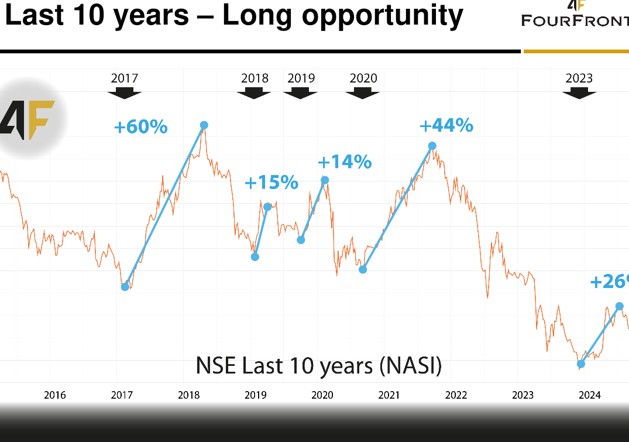

The FourFront presentation shows repeated periods when investors could profit by buying low and selling after the NSE recovered.
The ten-year NSE chart in the presentation shows several strong upward moves. It marks gains of about 60 per cent, 15 per cent, 14 per cent, 44 per cent and 26 per cent across different periods. These are the movements most Kenyan investors understand. A person buys before or during the recovery, then sells when the market has climbed.
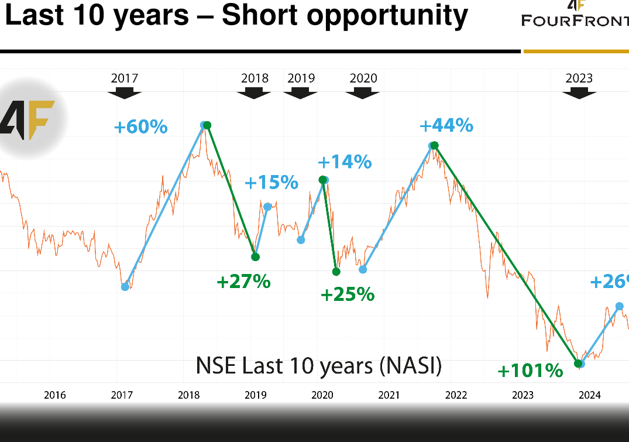
The same ten-year NSE journey also contained deep declines. Short selling seeks to make those downward movements tradable.
When the same market journey is viewed from the opposite direction, the lost opportunities become visible. The presentation highlights declines of about 27 per cent and 25 per cent, followed by another steep fall. One percentage label on the graph appears inconsistent and should be checked against the underlying market data before publication. The broader message remains clear: the NSE has repeatedly moved down as well as up, but most investors have only been equipped to trade the upward journey.
Kenya already created the legal foundation for a two-way market through the Capital Markets (Securities Lending, Borrowing and Short-Selling) Regulations of 2017. CDSC provides the securities lending and borrowing infrastructure, while short selling takes place as a market practice through the NSE. Yet having regulations did not automatically produce a busy market. Several practical problems kept lenders and borrowers apart.
A long-term shareholder would ask, ‘Who wants to borrow my shares, for how long and at what price?’ A trader hoping to sell short would ask, ‘Which shares are available to borrow today?’ Each side waited for the other. Brokers, custodians and other Central Depository Agents also faced the cost of upgrading systems to track borrowed shares and collateral even though nobody could promise enough trading volume to recover that investment.
Timing created another barrier. A short-selling opportunity can appear after a results announcement and disappear within hours. Under a slow process, the trader must first find a willing lender, negotiate the borrowing rate, complete the transaction through CDSC and only then act in the market. By the time all that is done, the price may have moved and the opportunity may be gone.
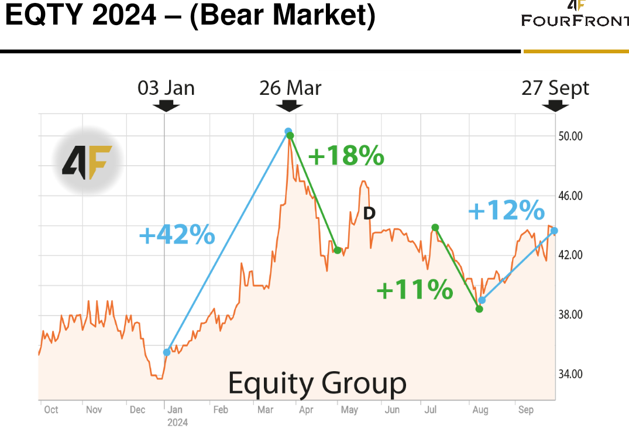
Equity Group in 2024: the deck uses this bear-market period to show how a share can rise and fall sharply within the same year.
The Equity Group chart for 2024 makes the timing problem easy to understand. It shows a strong rise into late March, followed by a fall, another recovery and another decline before the year ended with a rebound. A trader looking at the company once a year would miss most of those movements. A trader watching the market closely would see both buying and short-selling opportunities, but only if shares could be borrowed and the trade executed quickly.
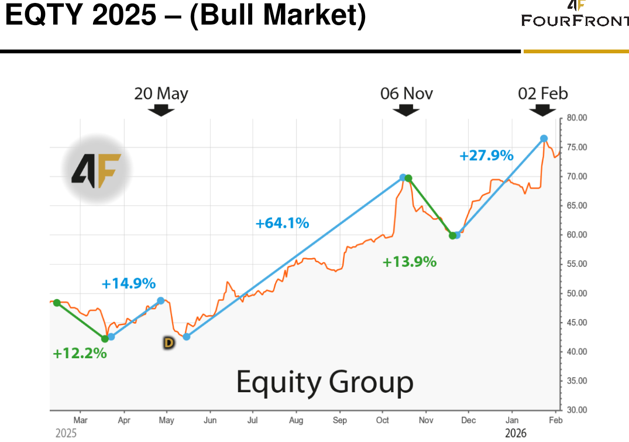
Equity Group in 2025: a bull market can still contain shorter declines, reminding investors that market direction changes within a year.
The 2025 Equity chart tells a different story. The overall direction is upward, yet the journey still includes pullbacks between rallies. This matters because short selling is not reserved for a market that collapses for an entire year. A share can be rising over twelve months and still fall for several weeks. Skilled investors look at the period, the evidence and the risk before deciding which direction to trade.
FourFront proposes to solve the supply problem by signing agreements with institutions that already hold large blocks of shares. Instead of asking a pension fund or fund manager to lend everything in a portfolio, the contract can cover a named fund, a named counter and a specific number of shares. An investor may begin by receiving information about opportunities, move into lending only and later choose a fuller borrowing and lending service.
The proposed central lending book is the heart of the model. It would contain shares whose owners have already approved lending at agreed rates. An anchor lender, normally a patient long-term investor, would keep shares available. Borrowers could also allow eligible holdings to enter the pool, gradually increasing supply. Standard terms would reduce negotiation and make transactions easier to repeat.
FourFront also proposes an online calculator where investors can learn by testing a trade before committing money. The investor would see how a falling or rising price changes the result, how borrowing costs affect profit and what activity appears on the statement. Qualified investors could then submit borrowing requests digitally instead of starting a long search for a counterparty.
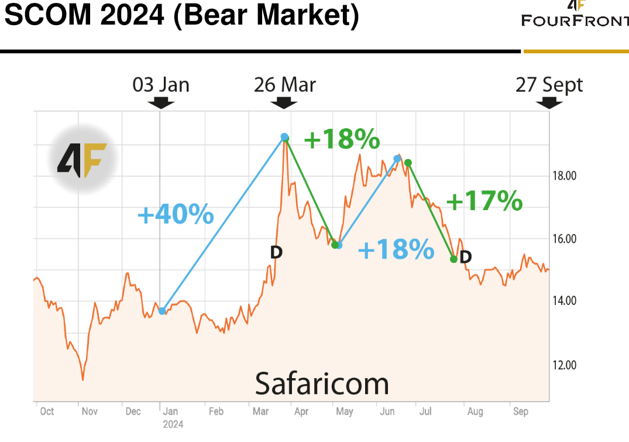
Safaricom in 2024: even one of Kenya’s most widely held shares recorded clear upward and downward phases.
Safaricom’s 2024 chart shows why liquid counters are the natural place to begin. The share recorded several sizeable moves in both directions. A liquid counter normally has more buyers and sellers, making it easier for a borrower to repurchase shares when closing a position. In a thinly traded company, a shortage of sellers can push the price sharply higher and trap short sellers in what markets call a short squeeze.
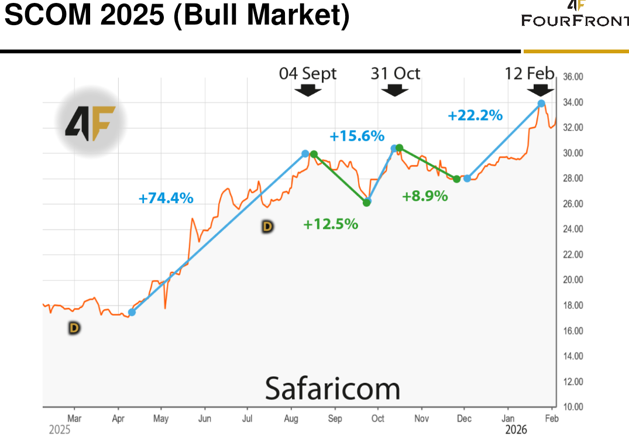
Safaricom in 2025: the presentation highlights several gains during a broader bull-market journey.
The presentation says FourFront intends to limit the early service to Absa Bank Kenya, Co-operative Bank, EABL, Equity Group, KCB Group and Safaricom. These are among the NSE’s more liquid counters. More companies can be considered as the market becomes comfortable with the product and the systems prove they can manage borrowing, settlement and collateral safely.
Protection begins with the lender. According to the deck, a shareholder does not lose the economic value of a dividend merely because the shares have been lent. The borrower must compensate the lender through what the market calls a manufactured dividend. The presentation also states that collateral will equal 110 per cent of the borrowed shares’ value and that CDSC will adjust it daily as the market price changes.
During the initial phase, borrowing will not run across a book-closure date. This avoids complications around dividends while investors and market institutions learn the process. Users will also need to demonstrate enough trading experience before they can take part. Pension funds and insurers need extra regulatory clarity because their first duty is to protect savers and policyholders, not to chase every new market opportunity.
The presentation reports that the Capital Markets Authority has approved two important operational pieces for the FourFront platform. CDSC can act as the securities-lending-and-borrowing agent of last resort when an industry participant faces technical or operational difficulty. CDSC can also manage collateral through an omnibus arrangement involving CDSC and Standard Investment Bank for borrowing across other depository agents. Investors should still confirm the exact approval conditions and the service’s current availability before trading.
For a Kenyan pension fund, insurer or fund manager, lending shares that would otherwise remain idle could bring in extra income without forcing the institution to sell its long-term investment. That income only makes sense when trustees understand the contract, collateral stays secure and the lending fee fairly compensates the institution for risk and administration.
For an active trader, short selling creates a legal route to act on well-researched negative views. For the NSE, two-way trading could improve liquidity and price discovery because both optimism and concern would influence prices. It may also keep investors engaged during weak markets instead of forcing everyone to wait for the next rally.
The dangers must remain visible. Short sellers can lose heavily when prices rise. Crowded positions can create sharp squeezes. Rumours can damage companies and frighten ordinary shareholders. Regulators and the exchange will therefore need strong surveillance, clear reporting and firm action against manipulation. Research should drive the trade, not social-media noise.
Kenya does not suffer from a shortage of financial ideas. The country often struggles at the point where a promising rule must become a simple, trusted service. Short selling will only work when an investor can see available shares, understand every cost, complete the transaction on time and know who holds the collateral. The lender must also know when the shares will return and how dividends will be handled.
If FourFront, CDSC, brokers, custodians and regulators close those gaps, the NSE will enter a very different chapter. Investors will still ask which company can grow and which share can rise. They will also be able to ask whether a price has moved too high, whether the evidence points downward and whether that view can be traded safely. That would give Kenya a deeper market, but success will depend less on the excitement of a new product and more on trust, education and careful execution.
Read Also: The Kenyan Stock Market Closes The Week Tumbling Down As Foreign Investors Drive Sell-Off