



Kenyans are parking their cash in government IOUs at a pace that’s hard to ignore, and it’s been going on for six straight weeks now.
Every single Treasury bill auction since mid-August has drawn far more bids than the National Treasury actually asked for. We’re talking about investors offering up KSh285.9 billion against just KSh168 billion on the table between August 10 and September 14 roughly 170 percent of what was up for grabs.
Treasury bills are the short-term end of government borrowing, issued by the Central Bank of Kenya on the Treasury’s behalf. They come in three flavors: 91, 182, and 364 days, so investors aren’t locking money away for long.


The auction-by-auction breakdown:
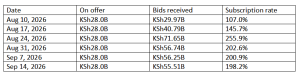

The peak came on August 24, when bids hit two and a half times what was offered. Even after that spike cooled slightly, demand never dropped below double the offer amount through the following two auctions, and it’s held close to that mark into September. This isn’t a fluke week it’s a pattern.
So why the rush into T-bills?
Part of it comes down to plain old safety. The CBK treats government paper as risk-free, and for anyone sitting on spare cash, that matters as much as the headline rate, maybe more. Knowing you’ll get your principal back, and roughly when, counts for a lot.
The numbers also just work out favorably right now. The Central Bank Rate sits at 8.75 percent, the 91-day bill is yielding around 8.78 percent, and the 182-day and 364-day papers have recently averaged 8.91 percent and 9.06 percent.
With inflation at 6.6 percent as of August, that’s a real return, even after accounting for the withholding tax that eats into actual T-bill income.
Lending the government money for three months to a year is a fundamentally different bet than lending to a business or buying corporate debt. The steady rush into T-bills suggests plenty of investors would rather take the safer, more predictable route than chase higher returns elsewhere.
That said, it would be wrong to conclude that private lending is being starved. Bank lending to the private sector actually grew 10.2 percent in July, a touch down from June’s 10.6 percent but a world away from the contraction seen in early 2025.
Lending rates have fallen too, down to 14.3 percent in July from 17.2 percent back in November 2024. Two things are true simultaneously: government securities are pulling in serious money, and private credit is still expanding.
Banks do have choices about where their liquidity goes, and if government paper looks attractive enough on a risk-adjusted basis, it can pull funds away from potential business loans.
Right now, though, the data doesn’t back up a crowding-out story. In its July Market Perceptions Survey, the CBK found banks expecting private credit growth of 9.9 percent for the year, with moderate-to-strong loan demand anticipated through July and August, helped along by falling rates, more competition, and the rise of digital lending.
Even more telling: in its Credit Officer Survey for the quarter ending June, the CBK found banks planning to funnel new liquidity mostly into private-sector lending (31 percent), ahead of interbank lending (22 percent), Treasury bills (21 percent), and Treasury bonds (16 percent).
By banks’ own stated intentions, government paper is a competitor for liquidity, not a replacement for lending to businesses.
The real issue is how risk gets priced
Here’s the crux of it, can private borrowers offer returns that make the extra risk worth taking? A T-bill has a fixed maturity and a repayment schedule you can set your watch to. A business loan carries default risk, needs closer monitoring, and usually demands collateral.
Banks, for their part, are still being careful, insisting on solid collateral and clear repayment capacity before extending credit.
That’s the detail that matters most for small businesses: if lenders keep favoring government paper while holding firm on tough underwriting standards, companies without strong balance sheets or steady cash flow could keep struggling to borrow, even as private credit growth looks healthy on paper
Step back, and this six-week run tells a few things about Kenya’s financial system right now. There’s clearly no shortage of liquidity; investors keep showing up with more money than the Treasury needs. Short-term government paper is holding its appeal thanks to that mix of yield, safety, and quick turnaround.
And investor caution seems selective rather than blanket: private credit is growing, so money is still finding its way to businesses, but government debt remains a magnet for available capital.
Whether that balance holds is worth watching. If Treasury bills keep soaking up this much capital, it’s fair to ask what that means down the line for the cost and availability of credit to everyone else.
For an investor, the T-bill auction is refreshingly simple: short duration, known return, government backing. For the economy as a whole, the calculation is messier: how much capital should go toward funding the government, and how much should be left to fuel the businesses that actually create jobs?
Read Also: Dangote Refinery IPO Goes Live, Can Kenyan Investors Buy Shares?