


Kenya is very good at celebrating success after it has become impossible to ignore. We can also be spectacularly suspicious of it while it is still being built. Somebody announces a financial innovation and, before the pitch deck has finished loading, the national jury has already asked whether it is a scam, a miracle or both.
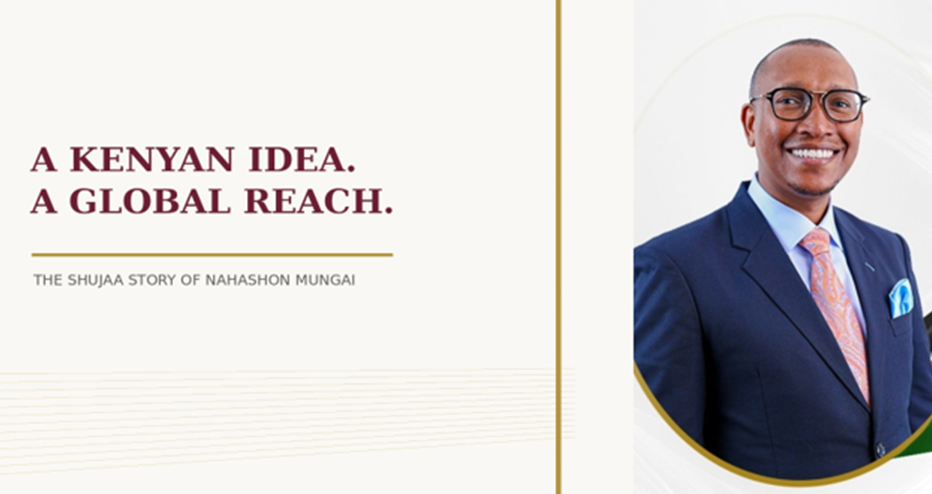
That is why the recognition of FA Nahashon Kabiru Mungai, ACI, as a National Hero in Entrepreneurship and Industry on Mashujaa Day 2026 deserves more than an attractive congratulatory poster. The honour acknowledges work in an industry where trust takes years to earn, one mistake can erase it in minutes, and the results eventually have to survive the accountant, the regulator and the market. [1]
Mungai is Executive Director, Global Markets, at Standard Investment Bank (SIB), and portfolio manager of the Mansa-X Special Funds. His journey from a money-market idea to a nationwide investment platform provides a different definition of heroism. Not every Shujaa carries a shield or stands on a battlefield. Some carry risk reports, build teams, argue for new regulations and spend years persuading investors that a Kenyan institution can compete on the world stage.


The scale of that journey is no longer a matter of rhetoric. Kenya’s Capital Markets Authority data, analysed in the second quarter of 2026, placed Standard Investment Trust Funds (SITF), the home of the four Mansa-X funds, at approximately KSh 188.6 billion in assets under management—about a fifth of the country’s KSh 948.7 billion collective investment schemes market. The platform had become the largest CIS umbrella in Kenya.
| “The lesson is not that one man became important. It is that a market became larger because people were willing to build what did not yet exist.” |
The first big question was not “How much?” It was “Why not?”
Before Mansa-X became a familiar name in investment conversations, the menu facing many Kenyan savers was relatively predictable: bank deposits, Treasury bills and bonds, property, quoted shares, and traditional funds. These options remain central to financial planning. But the global economy was producing opportunities—and risks—far beyond that menu.
At SIB, the question was whether capital raised and managed in Kenya could be professionally deployed across international markets within a local regulatory framework. That sounds obvious today. It did not sound nearly as obvious when a Kenyan foreign-exchange money manager was still a novelty.
Following the 2017 online foreign-exchange regulatory framework, SIB became Kenya’s first licensed online foreign-exchange money manager. Mansa-X evolved from that opening into a diversified, actively managed strategy that could trade currencies, equities, fixed income, commodities, derivatives and other instruments. It could take long positions to pursue gains when prices rose and short exposures as part of its strategy when markets moved the other way. Neither diversification nor short selling eliminates risk; the innovation was the attempt to manage a much broader opportunity set under a Kenyan supervisor.
The name Mansa-X itself invokes Mansa Musa, the medieval ruler of Mali whose name is associated with extraordinary wealth. But the interesting part is not the historical glamour. An investment product cannot distribute legend to its clients. It must distribute disciplined decisions, proper records, governance and, when markets permit, returns.
What the numbers actually say
A captivating story needs a line graph. A credible one also needs to explain what the line represents. Assets under management (AUM) are the value of assets entrusted to a fund manager; they are not the manager’s revenue, the fund’s profit or investors’ individual returns. Growth may reflect subscriptions, withdrawals, market performance, valuation changes and changes in fund structure.
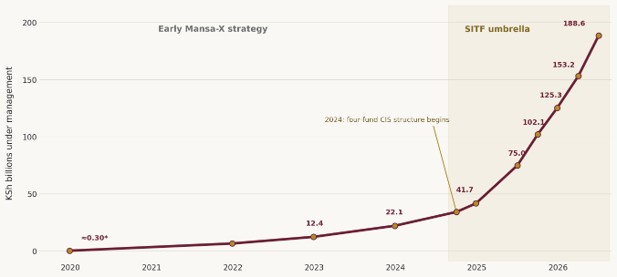

Figure 1. Mansa-X / SITF AUM at selected reported milestones, KSh billions. The line connects reported observations, not estimates for missing years. The 2019 estimate is a conversion from US$3 million at approximately KSh 101.35/US$; pre-2024 figures refer to the earlier Mansa-X strategy, while later figures generally reflect the SITF umbrella. Source references [5, 7–13].
The ascent, in figures
| DATE | AUM (KSh bn) | WHAT WAS REPORTED |
| Dec 2019 | ≈0.30* | US$3m at the close of first full year [7, 8] |
| Dec 2021 | 6.6 | Reported assets [9] |
| Dec 2022 | 12.4 | Reported assets, up 87% year-on-year [10] |
| Dec 2023 | 22.1 | Prior-year base reported in 2025 [11] |
| Dec 2024 | 41.7 | CMA-reported scheme AUM [12] |
| Jun 2025 | 75.0 | SIB-reported approximate aggregate [13] |
| Sep 2025 | 102.1 | CMA-reported scheme AUM [14] |
| Dec 2025 | 125.3 | CMA-reported scheme AUM [15] |
| Mar 2026 | 153.2 | CMA-based industry analysis [5] |
| Jun 2026 | 188.6 | CMA-based industry analysis [5] |
*The 2019 figure is indicative, not a separately reported KSh fund figure. The 2024 restructuring also limits strict like-for-like comparison. Figures have been rounded for readability; gaps are intentionally left unfilled. AUM is not an investment-return series.
From a bold trade to an institution
Early success is one thing; building a legal and operational home for growing public savings is another. Kenya’s 2023 Collective Investment Schemes Regulations recognised special funds more explicitly. In August 2024 SIB received approval to operate Special Collective Investment Schemes, and the four-part structure under Standard Investment Trust Funds took shape: a conventional KSh fund, a conventional US-dollar fund, and Shariah-compliant versions of each.
That was a fundamental transition. A good investment idea relies on talent. A lasting investment institution also requires trustees, custodians, portfolio controls, reporting, auditors, disclosure, and regulator-facing accountability. The move created a clearer institutional framework and different choices for investors with different currencies and values. It made Mansa-X more than a product with a charismatic portfolio manager. It became a platform.
The regulator’s quarterly statistics put it at KSh 34.2 billion by September 2024, when it entered the CIS rankings in third place. By December 2024, the CMA reported KSh 41.7 billion. In September 2025, it was KSh 102.1 billion; at December 2025, KSh 125.3 billion. By March 2026, around KSh 153.2 billion. And by June, KSh 188.6 billion. That is not a straight-line victory lap. It is a sequence of reported observations showing a business proposition acquiring serious scale.
A September 2026 retrospective published by SIB went further, saying the firm was reporting more than KSh 210 billion in AUM and a client base approaching 90,000. Because that statement does not provide a dated regulatory reporting period, it is treated here as a company-reported later indication—not plotted as if it were a June 2026 CMA figure.
Why the money stayed: performance, strategy and trust
The platform did not grow merely because Kenyans suddenly developed affection for complicated financial terminology. SIB reported 2025 net returns of 20.74% for Mansa-X Special Fund–KES and 13.37% for its US-dollar counterpart. Its Shariah KSh and US-dollar funds reported 17.25% and 11.64% net respectively. Those returns, the widening product range and expanding confidence likely helped attract investors, although AUM cannot be decomposed into those drivers from the headline figures alone.
By June 2026, according to SIB’s description, the strategy gave investors access to a broad universe of more than 200 global assets. The KSh conventional fund alone stood at approximately KSh 163.8 billion, and the dollar fund at approximately KSh 20.6 billion. The Shariah KSh and dollar variants were approximately KSh 3.6 billion and KSh 599 million respectively. The diversity of the four offerings matters: a saver with a shilling liability, an investor seeking dollar exposure and someone looking for Shariah-compliant investing do not have identical needs.
Still, good reporting should resist treating a strong historical return as a standing order from the future. A multi-asset long/short strategy has market, counterparty, liquidity, currency and operational risks. Fees matter. Investors should read the fund’s current documents, risk disclosures and redemption rules, and match the investment with their own circumstances. A Shujaa honour is not a guarantee, and no sensible fund manager should want it to be.
| “Building a fund is impressive. Building confidence in a regulated Kenyan financial product is how an entire ecosystem becomes more ambitious.” |
The person behind the portfolio
Corporate biographies can make an executive sound as though he was born wearing a tie and approving investment committees. Mungai’s public life story is more interesting. He grew up in Ndeiya in Limuru, later built a career across financial markets and has spoken about leaving traditional banking to pursue the idea that became Mansa-X. He describes delayed gratification as a defining money lesson—and, in an interview with Business Daily, made clear that entrepreneurship, family, friendships and private setbacks have shaped his perspective as much as market charts have.
That personal detail matters because entrepreneurship is regularly flattened into the last figure on a balance sheet. In reality, the work usually involves long periods of uncertainty, career risk, conversations that do not end in applause, and the responsibility of other people’s money. Mungai’s public honour is not a claim that one man traded every position or designed every internal control. Mansa-X was built within SIB, enabled by changes in regulation, operated by teams and trusted by clients. Crediting the leader while acknowledging that collective achievement is the most accurate way to celebrate it.
And there is a modestly funny contrast here: a nation fond of loud proclamations has honoured a man whose work is measured partly by whether the figures reconcile. There are worse habits for a country to copy.
The Shujaa principle: reward what we want repeated
Mashujaa Day was created to honour national contribution, not to turn the country into a scoreboard of fame. The National Heroes Council recognises entrepreneurship and industry among the legitimate fields of national service. That is an important signal. Building a useful institution can be a form of patriotism. So can creating credible market infrastructure, training technical talent and helping ordinary enterprises and households access more sophisticated financial tools.
Kenya urgently needs this expanded vocabulary of heroes. We should celebrate researchers who commercialise discoveries, founders who keep factories alive, engineers who reduce the cost of doing business, teachers who build capabilities, and financial innovators who make markets deeper and better supervised. Otherwise young people get a distorted lesson: that visibility is an achievement and noise is leadership.
There is also an economic reason to honour this kind of accomplishment. Recognition creates role models; role models shape ambition; ambition, supported by clear rules and patient capital, can create new firms. A younger analyst watching Mungai’s national recognition should see a credible career in building world-class investment solutions at home. A policymaker should see why adaptable but rigorous regulation matters. An investor should see why due diligence and sound governance matter as much as excitement.
None of this requires pretending that Mansa-X is beyond scrutiny. Quite the opposite. The appropriate way to honour an innovator in finance is to demand that the institution continues to earn its position through transparency, controls, responsible risk-taking and fair treatment of investors. Celebration and accountability belong in the same room.
A Kenyan story bigger than one man
The deepest legacy of Mansa-X may not be the June 2026 figure. It may be the question its success makes harder for the rest of the market to avoid: If a Kenyan institution can create a regulated investment platform with broad global exposure and attract this scale of capital, what else are we capable of building?
We need more people prepared to answer that question by creating rather than merely commenting. More managers willing to turn ideas into products. More regulators willing to understand new models without abandoning investor protection. More financial institutions competing on service, execution and stewardship. More young Kenyans learning that the capital markets offer careers in research, trading, operations, technology, compliance and risk—not merely stock tips whispered in a WhatsApp group.
Nahashon Kabiru Mungai’s Shujaa recognition should therefore be read as an invitation, not a finish line. We are not honouring him so that we can stop asking difficult questions about markets. We are honouring the kind of effort that helps Kenya ask better ones and develop the institutions capable of answering them.
The bronze plaques and congratulatory posters will eventually come down. The better tribute is for the next generation of builders to look at this story and decide that something ambitious, well-governed and unmistakably Kenyan can be done again.
Kenyan capital has been given a passport. The real achievement is that it did not have to surrender its Kenyan address to see the world.