


Equity Group’s banking business earned Ksh 70.1 billion after tax in the nine months to September 2026, up 32% on last year. That is roughly Ksh 256 million of profit every single day.
The headline is impressive. The more interesting story is where that money comes from. Six countries, six very different banks, and one fact that would have sounded far-fetched a few years ago: the Congolese bank is now a heavyweight in its own right.
Here is the split in one sentence. Kenya brings in 58 cents of every shilling of profit, DR Congo brings in 26, and Rwanda, Uganda, Tanzania and South Sudan together make up the last 16.


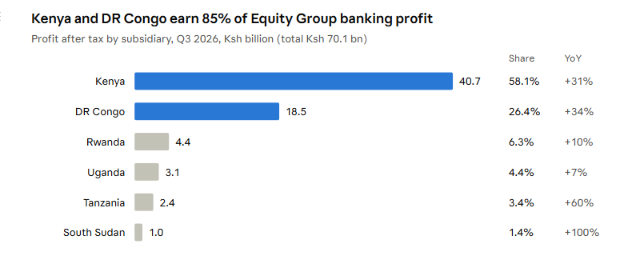

The two smallest bars are growing fastest. Tanzania’s profit rose 60% and South Sudan’s doubled, from a small base.
Kenya: the engine runs hotter
Equity Bank Kenya contributed Ksh 40.7 billion of the group’s profit after tax, up 31% from Ksh 31.07 billion. That is 58.1% of banking profit, from a business that holds only about 46% of the group’s deposits, loans and assets.
In other words, Kenya earns more than its weight. Each shilling of its balance sheet works harder than the group average.
Why profit grew faster than revenue. Total revenue rose 17% to Ksh 93.9 billion, but profit before tax jumped 30% to Ksh 45.9 billion. Three things opened that gap:
- Cheaper money. Cost of funds fell from 4.1% to 3.0%, while the yield on interest-earning assets barely moved (12.2% to 11.9%). The bank kept most of its lending income and paid savers less for deposits.
- A fatter margin. Net interest margin widened from 8.1% to 8.9%, and net interest income climbed 17% to Ksh 62.6 billion.
- Costs kept in check. Operating costs rose 11% to Ksh 41.5 billion, well behind revenue growth. That puts Kenya’s cost-to-income ratio at about 44%.
Non-funded income (fees, FX, transactions) also grew 18% to Ksh 31.3 billion. It now makes up a third of Kenya’s revenue, a useful cushion if interest rates fall further.
The result is an exceptional return. Return on average equity hit 35.2%, and return on assets rose to 5.1% from 4.2%. Few large banks anywhere earn that much on shareholders’ money.
The one thing to note: the balance sheet grew slower than profit. Assets were up 7% to Ksh 1.049 trillion, deposits up 10% and loans up 12%. Kenya is squeezing more out of what it has, more than it is growing it. NPL coverage improved to 65% from 60%, though it remains below DR Congo’s level.
DR Congo: the challenger closes in
Equity BCDC earned Ksh 18.5 billion after tax, up 34% from Ksh 13.81 billion, and supplied 26.4% of group banking profit. It grew faster than Kenya on almost every line.
The balance sheet is where the story gets striking:
| Measure | Kenya | DR Congo | DRC as % of Kenya |
|---|---|---|---|
| Total assets | Ksh 1,049 bn (+7%) | Ksh 848.2 bn (+34%) | 81% |
| Deposits | Ksh 816.6 bn (+10%) | Ksh 670.3 bn (+38%) | 82% |
| Loans | Ksh 455.2 bn (+12%) | Ksh 375.1 bn (+24%) | 82% |
| Profit after tax | Ksh 40.7 bn (+31%) | Ksh 18.5 bn (+34%) | 45% |
BCDC’s balance sheet is now more than four-fifths the size of Kenya’s. If both kept this year’s growth rates, the Congolese bank would hold more deposits and assets than the Kenyan one within about a year. That is a big “if”: growth measured in shillings also reflects currency moves, and a 38% deposit surge rarely repeats on cue. But the direction is clear.
Size isn’t yet the same as profitability. The last row of the table shows the gap. DR Congo has 81% of Kenya’s assets but earns only 45% of its profit. BCDC’s return on equity is a healthy 22.7%, but well short of Kenya’s 35.2%.
The ratios show why, and they flag what to watch:
- Margins are thinning. Net interest margin fell from 6.9% to 5.9%, and asset yield fell from 8.5% to 7.5%, while cost of funds stayed flat at 1.6%.
- Deposits are outrunning lending. Deposits grew 38% but loans only 24%, so the loan-to-deposit ratio slipped from 62% to 56%. Much of that new cash is sitting in lower-yielding assets.
- Thinner cushion for bad loans. NPL coverage dropped from 100% to 83%.
Even so, profit before tax rose 49% to Ksh 26.4 billion, and return on assets edged up to 3.2%. If BCDC can lend out more of its deposit pile at decent rates, its profit share has plenty of room to grow.
The other four: a sprinter, two steady hands and a long shot
Rwanda, Uganda, Tanzania and South Sudan together earned about Ksh 10.9 billion, or 15.5% of group profit. Their stories could hardly be more different.
| Subsidiary | Revenue | Profit after tax | PAT growth | Loan growth | Loans / deposits |
|---|---|---|---|---|---|
| Rwanda | Ksh 11.1 bn (+16%) | Ksh 4.4 bn | +10% | +3% | 65% |
| Uganda | Ksh 12.2 bn (+7%) | Ksh 3.1 bn | +7% | +12% | 52% |
| Tanzania | Ksh 7.6 bn (+49%) | Ksh 2.4 bn | +60% | +51% | 93% |
| South Sudan | Ksh 2.9 bn (+34%) | Ksh 1.0 bn | +100% | +11% | 5% |
Tanzania: the sprinter
Tanzania is the group’s breakout story. Profit after tax rose 60% to Ksh 2.4 billion and profit before tax rose 74%. Behind it is aggressive lending: the loan book grew 51% to Ksh 56.5 billion, and assets rose 35% to Ksh 94 billion.
The flip side is a loan-to-deposit ratio of about 93%, far above any other subsidiary. Tanzania is lending out almost every shilling it takes in. That works while credit quality holds, and it means future growth needs more deposits.
Rwanda: the most efficient of the small four
Rwanda earned Ksh 4.4 billion from Ksh 11.1 billion of revenue, the best profit margin outside Kenya. Shareholders’ funds grew 24% to Ksh 24.4 billion, a sign of strong capital build-up.
Lending was the weak spot: loans grew only 3%, to Ksh 64.0 billion. Rwanda’s profit growth of 10% came from deposits, fees and efficiency, not from a bigger loan book.
Uganda: steady, but stretching for profit
Uganda is a revealing comparison with Rwanda. It has slightly more revenue (Ksh 12.2 billion) and the same-sized balance sheet (Ksh 136.3 billion of assets). Yet it earned Ksh 1.3 billion less profit.
Its balance sheet is moving well, with deposits up 14% and loans up 12%. But revenue and profit both grew just 7%, the slowest in the group. Turning that growth into earnings is Uganda’s job for 2027.
South Sudan: doubling from a small base
South Sudan’s profit doubled to Ksh 1.0 billion, and profit before tax jumped from Ksh 0.1 billion to Ksh 1.6 billion. Read those numbers with care. South Sudan reports under hyperinflation accounting, and its revenue includes revaluation gains that are offset by monetary losses.
The more telling figure is lending. The bank holds Ksh 19.3 billion of deposits but has lent out only Ksh 1.0 billion. It is a deposit-taking and payments business for now, not a lender.
What to watch next
Equity is still a Kenyan bank with a regional business attached, but that balance is changing quickly. Kenya generates the returns and DR Congo generates the growth. The smaller four are proving the model can travel.
Three questions will shape the next few quarters:
- Can Kenya keep its margin? Much of this year’s profit jump came from cheaper deposits. If cost of funds stops falling, profit growth will slow towards balance-sheet growth of around 7–12%.
- Can DR Congo turn size into returns? It has the deposits. Putting them to work, and rebuilding NPL coverage, is what would lift its 22.7% return on equity towards Kenya’s.
- Can Tanzania fund its lending? With loans at 93% of deposits, its next leg of growth depends on raising deposits as fast as it lends.
One thing is already clear. More than 40% of Equity’s banking profit is now earned outside Kenya.
Read Also: Equity Group Posts KSh71.5 Billion Profit as Regional Businesses Drive 32% Growth