



A small supplier can win a customer and lose control of its own bank balance in the same transaction. The order arrives with the language of opportunity: more volume, a prestigious account, perhaps a reference that opens other doors. The less celebrated term sits further down the agreement. Payment will follow delivery, acceptance and processing. Between those events, the supplier becomes a lender. Whether the business intended to enter financial services is apparently beside the point.
Commercial credit is neither unusual nor inherently abusive. Giving buyers time to inspect goods and reconcile invoices can make trade possible. The problem begins when a powerful purchaser treats an agreed deadline as optional, while the supplier’s wages, rent and loan instalments retain their original dates. One party enjoys flexibility because the other absorbs rigidity. Calling the resulting distress a failure of entrepreneurial discipline mistakes a negotiated commercial relationship for an equal contest of bargaining power.
British evidence gives the issue a measurable scale. Research commissioned by the Department for Business and Trade and the Office of the Small Business Commissioner, published in July 2025, estimated that late payments cost the UK economy almost £11 billion annually. It estimated £26 billion outstanding in overdue payments at a given time and around 14,000 business closures a year attributable to late payment. These are research estimates, not a register of individually proven causes of closure.


Those findings should not be exported mechanically to Kenya or any other country. Different credit systems, enforcement arrangements and business populations matter. Their significance is narrower and stronger: even a sophisticated financial market does not automatically protect suppliers from the consequences of customers paying late. A functioning banking system can finance a delay, but financing a delay is not the same achievement as eliminating one. Someone still pays the interest, and the allocation of that cost deserves scrutiny.
Consider an explicitly hypothetical supplier carrying a Sh1 million unpaid invoice for an additional ninety days. If the entire amount must be financed at 18 per cent simple annual interest, using a 365-day year, the incremental interest is approximately Sh44,384. That calculation excludes arrangement fees, collection work and any loss on the underlying debt. It also assumes the whole invoice value needs financing; actual funding needs depend on deposits, margins and existing cash. The arithmetic reveals exposure, not an industry average.
The invoice’s face value is therefore an incomplete description of the transaction. A sale that appears attractive at a thirty-day payment horizon can become marginal at one hundred and twenty days. The supplier may try to recover the financing burden through higher prices. Yet the same buyer that demands long terms may reject any explicit price for those terms. The cost then
The invoice’s face value is therefore an incomplete description of the transaction. A sale that appears attractive at a thirty-day payment horizon can become marginal at one hundred and twenty days. The supplier may try to recover the financing burden through higher prices. Yet the same buyer that demands long terms may reject any explicit price for those terms. The cost then moves elsewhere: thinner reserves, postponed equipment replacement, reduced training, or unpaid time contributed by the owner.
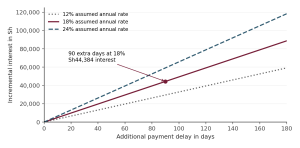

Figure 1 Financing an additional payment delay
Illustrative calculation only. Principal financed is Sh1 million throughout. Simple interest = principal × assumed annual rate × additional days ÷ 365. No fees, compounding, or partial funding are included. These assumed rates are not market observations.
This makes payment discipline a productivity question. A founder who spends the afternoon locating an invoice inside a customer’s approval system cannot spend that afternoon improving production or finding another market. The lost hours do not appear neatly as interest expense. They appear as opportunities that never become sufficiently developed to count. Policymakers who celebrate business formation while ignoring the daily extraction of managerial attention are measuring entry into entrepreneurship more carefully than the conditions for remaining in it.
The customer’s internal incentives often explain why the problem survives repeated public condemnation. Procurement teams may be rewarded for price reductions. Treasury teams may be rewarded for cash retention. Operational managers may be rewarded for uninterrupted supply. Unless someone is accountable for the supplier’s actual payment experience, all three can meet their targets while producing a commercially destructive outcome. Responsibility dissolves across departments even when the invoice itself is perfectly valid.
A credible corporate response would begin with the clock. The buyer should record when goods were received, when an invoice arrived, when a dispute was raised, and when money reached the supplier. Repeatedly resetting the payment date after an internal administrative correction can make performance statistics look better without improving the supplier’s experience. Reporting should distinguish genuinely disputed deliveries from invoices waiting for an employee to approve a purchase order that the organisation already authorised.
Median payment time alone is insufficient. A company can pay many small invoices quickly while leaving a minority of vulnerable suppliers unpaid for months. Distribution matters: the share paid beyond contract, the age of the oldest undisputed balances and the concentration of arrears among small vendors. Boards should also examine payment performance by subsidiary. A respectable group average can conceal behaviour that would be difficult to defend if the affected supplier were sitting in the boardroom.
Supplier finance requires equal care. A reputable bank may offer early payment against an accepted invoice at a lower rate than the supplier could otherwise obtain. That can be useful. But if a purchaser first lengthens payment terms and then presents discounted early payment as generosity, the programme may monetise a problem the purchaser helped create. The relevant comparison is the supplier’s net position before and after the change, including fees, timing and whether participation is genuinely voluntary.
Entrepreneurs can improve their negotiating position before the first delivery. A written acceptance procedure, named billing contact, and a clear escalation route reduce avoidable ambiguity. Deposits and milestone payments can distribute funding needs across the production cycle. These devices will not overcome every imbalance, especially when the buyer controls access to a valuable market. Their purpose is to expose the financing bargain before the supplier has committed materials and labour that cannot easily be recovered.
Credit limits belong in sales management, not merely in the finance department’s emergency procedures. A customer with a large unpaid balance may need fewer new deliveries even when the sales team sees attractive demand. That decision can be painful because reported revenue falls immediately while the benefit is a loss that may never occur. Management must reward collected contribution, alongside bookings, if it expects staff to resist orders that turn the company’s liquidity into an unsecured customer benefit.
There is also a distinction between a slow customer and an insolvent one. Routine delay may respond to escalation or corrected documentation. Inability to pay requires a different assessment, including whether further supply increases an exposure that is unlikely to be recovered. Personal relationships can make that distinction harder to confront. The owner may interpret a reassuring phone call as evidence of solvency when it is only evidence that the customer still answers the phone.
Public intervention should target enforceability rather than theatrical promises about supporting small business. Accessible dispute resolution, meaningful consequences for persistent abuse and reliable payment reporting can change expected costs. Rules need exemptions and procedures appropriate to genuine disagreements over quality. They also need protection against an obvious evasion: replacing one overdue invoice with a supposedly new invoice so the official payment clock begins again. The policy question is whether a compliant supplier can obtain a remedy it can afford to use.
Not every late payment is deliberate exploitation. Systems fail, invoices contain mistakes and firms experience shocks. That is an argument for proportionate processes, not for tolerating indefinite uncertainty. A buyer that communicates early, pays the undisputed portion and agrees a realistic settlement schedule behaves differently from one that offers successive unexplained deadlines. Commercial trust depends less on flawless performance than on whether the stronger party accepts responsibility when performance deteriorates.
For investors, the issue reaches beyond ethical procurement. A company that appears cash generative because it persistently stretches fragile suppliers may be consuming the resilience of its own production network. A supplier failure can interrupt deliveries, force expensive replacement sourcing and reveal that apparently efficient working capital management rested on hidden operational risk. The buyer’s short-term cash improvement may therefore be accompanied by a contingent liability that conventional payment metrics fail to describe.
The most revealing question in a supplier relationship is not how enthusiastically the customer talks about entrepreneurship. It is who finances the interval between delivery and payment, at what price, and with what realistic right of refusal. A purchase order should reward the capability to produce something useful. When it instead becomes permission to occupy another company’s balance sheet indefinitely, the celebrated customer is also an uninvited borrower. The supplier deserves to know the terms of that loan.
Read Also: Kenya’s Real Development Test Is the Woman Who Can Finally Keep Her Business Open