
Optimism Among Kenyan Manufacturers High

Manufacturers rely on a stable, balanced and common-sense regulatory environment to create jobs and fuel economic growth. However, the burden of unnecessarily costly and duplicative rules weighs heavily on their ability to grow and create jobs. To secure investment in the manufacturing sector, the government needs to guarantee inventors a stable policy environment, supportive taxation measures, and an investment climate that facilitates the growth of industry.
The second pillar is the securing of markets by building on the ‘Buy Kenya, Build Kenya’ initiative and export competitiveness. In Kenya, exports would enable the country to effectively deal with the fiscal and monetary challenges to reduce current reliance on domestic consumption as a major economic driver.
The 2016 World Economic Forum Report places Kenya at position 122 out of 138 countries in terms of having a competitive macro-economic environment for investment compared to position 96 out of 148 in 2015.

This is way below Tanzania, Uganda and Rwanda. Kenya is only above Burundi which was ranked 124.
On the other hand, the World Bank says the ease of Doing Business in Kenya has improved to 92 in 2016 from 113 in 2015. This has averaged 108.78 from 2008 until 2016, reaching an all-time high of 129 in 2013 and a record low of 84 in 2008.
The Kenya National Bureau of Statistics (KNBS) says the manufacturing sector has remained largely subdued and is estimated to have expanded by 3.2 per cent in the second quarter of 2016 compared to 5.1 per cent in a similar period in 2015.
Besides these conflicting statistics, Kenyan manufacturer’ are optimistic of the sector’s growth ahead of the first ever Kenya Manufacturing Summit and Expo organised by the Kenya Association of Manufacturers (KAM) in collaboration with The Ministry of Industry, Trade and Cooperatives.
“The summit is a showcase of made in Kenya. We are also inviting all procurement officers to see what is in Kenya – “Buy Kenyan Build Kenya” Initiative. We want to see linkages; we want to see subcontracting. We want people to stop trading in products and start manufacturing the products,” says Ms. Flora Mutahi, chairperson of the Kenya Association of Manufacturers (KAM) board.
The summit’s theme is, “Growth opportunities in the Kenyan manufacturing Sector,” scheduled for 16-18 November 2016.
Support local manufacturers in Kenya at the first ever Kenya Manufacturing Summit and Expo. #TopManufacturersKE pic.twitter.com/z7OS4xyEEY
— KAM (@KAM_Kenya) November 8, 2016
Vimal Shah, Chief Executive Officer Bidco Group in an exclusive interview with Soko Directory during the 4th edition of the SuperBrands award ceremony in Nairobi, he said the manufacturing sector is headed for growth.
“I believe the local manufacturing sector in Kenya will grow even further from the current 10 per cent to 15 per cent to 20 per cent as long as we believe there is a better way:
One, we are competitive, two improve the productivity per capita, productivity per output that is a big issue that companies can remove a lot wastage in the system. If you remove wastage, remove in the processes, you will become more competitive and as people become competitive, we have market access,” he says.
“From Kenya, if you manufacture in Kenya you got market access in the whole of East Africa, COMESA – starts from Egypt up to Zimbabwe- and we also have got market access in to AGOA markets in America and under the EPAs we have market access in to Europe.
What we really need now is the local manufacturing to boost up,” he adds.
Ms. Flora Mutahi, chairperson of the Kenya Association of Manufacturers (KAM) board is agreeable, that the manufacturing sector contributes10.6 per cent to Kenya’s Gross Domestic Product (GDP), “This is an unfair growth, it has been at 10 per cent for a long time, however, it is important to note that manufacturing has been growing but it is good we are not losing to the other sectors.”
Mutahi says for the sector to thrive, it needs access to markets and a competitive environment.
“Access to markets at the local market has been subdued a lot by the devolved government (a model KAM supports) that has brought in a lot of cost.”
On the regional markets, “Kenyan goods into the regional markets have been declining due to tariff and non-tarrif barriers. However, we are trying to push more into the other markets.”
“We are a good launch platform ready to go in tapping the opportunities within the regional markets,” she says.
“For anybody to grow, markets are very critical. So our hope within the EAC is that they see the bigger picture; they need to see us as people who they can work together with and not as competitors.”
“If you look at any developing nation, exports are a big driver to economic growth. EAC needs to see it like that,” Mutahi emphasises.
On a competitive playing field, Mutahi says they are lobbying the government to ensure the cost of doing business comes down.
“We need a predictive environment. If new laws are coming in, let them be spoken in advance but that is not the case in Kenya. The most important thing that we want to tell the government is we need a predictive environment,” she says, as a way of attracting investors too.
Ahead of the manufacturing summit and expo, the KAM Chair says they key message is dismantling the long-held belief that local goods are not of high quality.
And to realise it, “You got to continue learning all the time. Innovate.”
“Entrepreneurs or manufacturers need to start to read the gaps within the market. The me-too behaviour is way too much. Learn to look at the opportunities around,” she says.
“KETEPA had a monopoly for over 19 years. When I told people I am venturing into tea, people were shocked. But, I was not their competitor that is how I came up with the Melvins Tea, now it is time to reinvent.” She explains.
In addition to the showcasing, the summit will deliberate on transforming the nation through industrialization and the expectations on industry in this transformation.
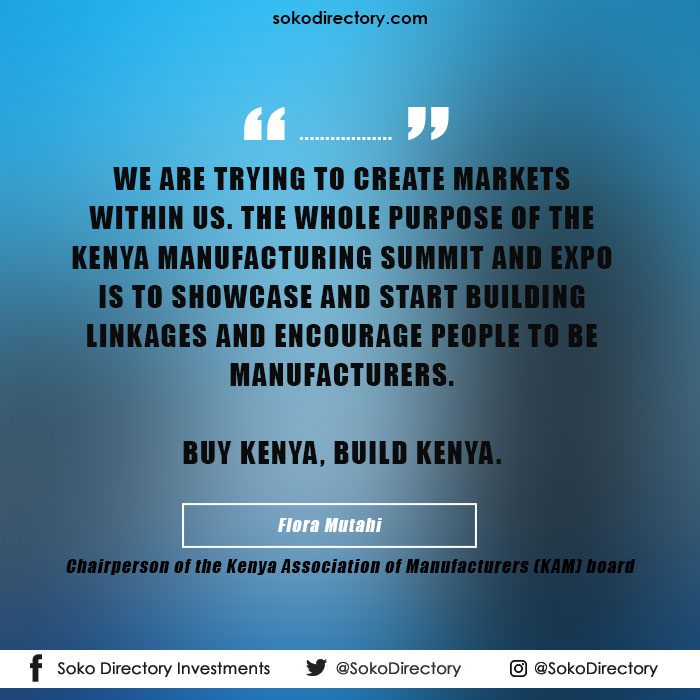
“We are trying to create markets within us. The whole purpose of the summit is to showcase and start building linkages and encourage people to be manufacturers. Buy Kenya build Kenya,” she says.
“We are looking at our brands across East Africa today and going global. What is required are a solid brand at home and taking it across borders and really engraving the same ethos, the same philosophy of being ethical and above board, and same qualities then transfer to people. It is important to have very clear standards, very clear understandings of what the markets are, having a product for every consumer,” she adds.
As regards to the Tripartite Free Trade Area (TFTA) agreement to be operationalized next year aimed at enhancing connectivity, reduction of costs of doing business, as well as addressing productive capacity constraints through its three pillars: industrial and industrial development, and market integration pillars.
KAM says “It is a fantastic agreement with over 6oo million with over 1.3 Trillion dollar revenue base.” However, she says operationalizing anything across borders is hard but with the rules of origin will help.
“If you look at the Intra Africa Trade, it is 11percent, Intra European trade 65 per cent and Intra Asia is 25 per cent. We will not succeed if we do not trade amongst ourselves. 11 per cent is embarrassing,” she says.
Related: Kenyan Manufacturing Sector Slows in Second Quarter

About David Indeje
David Indeje is a writer and editor, with interests on how technology is changing journalism, government, Health, and Gender Development stories are his passion. Follow on Twitter @David_IndejeDavid can be reached on: (020) 528 0222 / Email: info@sokodirectory.com

- January 2026 (220)
- February 2026 (248)
- March 2026 (287)
- April 2026 (207)
- May 2026 (192)
- June 2026 (238)
- July 2026 (279)
- August 2026 (223)
- September 2026 (134)
- January 2025 (119)
- February 2025 (191)
- March 2025 (212)
- April 2025 (193)
- May 2025 (161)
- June 2025 (157)
- July 2025 (227)
- August 2025 (211)
- September 2025 (267)
- October 2025 (297)
- November 2025 (230)
- December 2025 (220)
- January 2024 (238)
- February 2024 (227)
- March 2024 (190)
- April 2024 (133)
- May 2024 (157)
- June 2024 (145)
- July 2024 (136)
- August 2024 (154)
- September 2024 (212)
- October 2024 (255)
- November 2024 (196)
- December 2024 (143)
- January 2023 (182)
- February 2023 (203)
- March 2023 (322)
- April 2023 (297)
- May 2023 (267)
- June 2023 (214)
- July 2023 (212)
- August 2023 (257)
- September 2023 (237)
- October 2023 (264)
- November 2023 (286)
- December 2023 (177)
- January 2022 (293)
- February 2022 (329)
- March 2022 (358)
- April 2022 (292)
- May 2022 (271)
- June 2022 (232)
- July 2022 (278)
- August 2022 (253)
- September 2022 (246)
- October 2022 (196)
- November 2022 (232)
- December 2022 (167)
- January 2021 (182)
- February 2021 (227)
- March 2021 (325)
- April 2021 (259)
- May 2021 (285)
- June 2021 (272)
- July 2021 (277)
- August 2021 (232)
- September 2021 (271)
- October 2021 (303)
- November 2021 (364)
- December 2021 (249)
- January 2020 (272)
- February 2020 (310)
- March 2020 (390)
- April 2020 (321)
- May 2020 (335)
- June 2020 (327)
- July 2020 (333)
- August 2020 (276)
- September 2020 (214)
- October 2020 (233)
- November 2020 (242)
- December 2020 (187)
- January 2019 (251)
- February 2019 (215)
- March 2019 (283)
- April 2019 (254)
- May 2019 (269)
- June 2019 (249)
- July 2019 (335)
- August 2019 (292)
- September 2019 (306)
- October 2019 (313)
- November 2019 (362)
- December 2019 (318)
- January 2018 (291)
- February 2018 (213)
- March 2018 (275)
- April 2018 (223)
- May 2018 (235)
- June 2018 (176)
- July 2018 (256)
- August 2018 (247)
- September 2018 (255)
- October 2018 (282)
- November 2018 (282)
- December 2018 (184)
- January 2017 (183)
- February 2017 (194)
- March 2017 (207)
- April 2017 (104)
- May 2017 (169)
- June 2017 (205)
- July 2017 (189)
- August 2017 (195)
- September 2017 (186)
- October 2017 (235)
- November 2017 (253)
- December 2017 (266)
- January 2016 (164)
- February 2016 (165)
- March 2016 (189)
- April 2016 (143)
- May 2016 (245)
- June 2016 (182)
- July 2016 (271)
- August 2016 (247)
- September 2016 (233)
- October 2016 (191)
- November 2016 (243)
- December 2016 (153)
- January 2015 (1)
- February 2015 (4)
- March 2015 (164)
- April 2015 (107)
- May 2015 (116)
- June 2015 (119)
- July 2015 (145)
- August 2015 (157)
- September 2015 (186)
- October 2015 (169)
- November 2015 (173)
- December 2015 (205)
- March 2014 (2)
- March 2013 (10)
- June 2013 (1)
- March 2012 (7)
- April 2012 (15)
- May 2012 (1)
- July 2012 (1)
- August 2012 (4)
- October 2012 (2)
- November 2012 (2)
- December 2012 (1)