
Battle of Numbers, Intellect as Jubilee Senators Pass Election Law
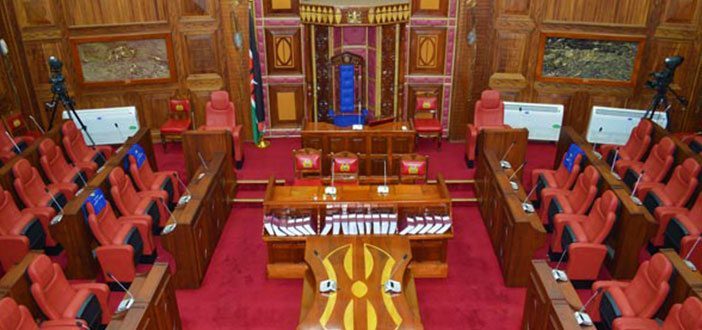
It was a battle of wits between Jubilee and CORD Senators on Thursday where numerical strength versus intellectual discourse met at a crossroads as they debated on the controversial amendments to Election Laws (Amendment) Bill, 2016.
After heated debated that took the whole day spilling over into the night, Jubilee with its numerical power, ensured the amendments to the controversial election laws carried the day.
Jubilee senators carried the day after 26 of them voted in support of the amendments as opposed to 10 from Cord, thus allowing the bill to proceed to the Third Reading. The same happened during the first and second reading.

If the President Assents the bill into law, the independent Electoral and Boundaries Commission will be forced to revert to manual voter verification if the electronic system fails in the scheduled August General Election.
on the other hand, ten out of six members of the Senate Justice and Legal Affairs Committee voted for the amendments to Election Laws (Amendment) Bill, 2016 as it was passed by the National Assembly.
Amos Wako, Former Attorney General, the current Busia County Senator and chair of the committee while tabling the public participation report to the House disclosed that, “This report unfortunately – addressed the mischief of these clauses. We wanted to achieve a consensus that addressed the mischief – we were not able to achieve. We ended up in a vote where 10 were for amended as it is and 6 voted against the amendment.”
“Voting was along party lines instead of ideology,” he added.
“We did not curtail any debate,” said Wako as regards to the views received from the public and other stakeholders.
Wako further told the senate that on the contentious Clause 4A of sections 39 and 44 of the Elections Law that empowers the Independent Electoral and Boundaries Commission (IEBC) to come up with a manual system of identifying voters and transmitting results, complementary to the electronic tallying system.
“Notwithstanding the provisions of Section 44, the commission shall put in place a complementary mechanism for identification and transmission of results that is simple, accurate, verifiable, secure, accountable and transparent to ensure it complies with the provisions of Article 38 of the Constitution,” reads the amendments.
“The backup alternative should not be so open to replace the main system. It should be exceptional rather than the norm,” Wako emphasised to the senate.
“All matters that fundamentally attempt to alter the agreements of the political settlement must follow a similar procedure for review. The arbitrary review as contained in the Election Laws (Amendment) (No. 3) Bill, 2015 continues to tense the political environment and creates unnecessary suspicion,” the six senators said in their report.
“The Senate must therefore vote against this Bill and propose a motion that establishes a Joint Select Committee of Parliament for the period leading to the general elections to resolve and settle all matters of contention that might arise from time to time, particularly with reference to The Election Laws (Amendment) Act, 2016.”
According to the report, “There is need to clearly define the circumstances which may trigger the use of a backup mechanisms and establishment of a multi-layered system whereby the primary electoral system should be electronic and the back-up system should also be electronic and only in exceptional circumstances could the manual register of the verified electronic copy be used.”
Read:Election Laws: Will Senate Decision Lead to A Better Electoral System in Kenya?
Senator Mutahi Kagwe, the Co-chair reiterated similar sentiments, “There is no reverting from an electronic system to a manual system of managing the voters. The idea is we need a backup in the event of a problem. What we have in Kenya in reality is not a fully electronic system.”
Kagwe urged the senate to pass the law as it was and shift focus at the regulation which will ensure free and fair elections.
However, Senator Janet Ongera opposed the amendments in the view that majority of the Kenyans who presented their views before the legal committee were in opposition. “These amendments are setting the country on a collision path. Kenyans are enlightened and have alienable rights and will be ready to defend them.”
Senator Anyang’ Nyong’o noted that the amendment was creating the kind of fear and uncertainty that they wanted to avoid.
Kagwe and Stephen Sang’, Nandi County Senator further disclosed that the need for backup in essence was to uphold Article 83(3) that will ensure every eligible voter casts his vote and not denied on the basis failed electronic system.
“The right to vote is a right available to everyone.