


Kigali, Rwanda has higher dollarized rental yields than any other key cities in the residential and retail sector in Sub-Saharan Africa at an average rental yield of 8.1 percent and 12.6 percent respectively.
This means that Kigali outperforms Nairobi market in Residential, retail, and office with rental yields of 8.1 percent,12.6 percent, and 9.8 percent respectively, compared to Nairobi with 5.6 percent, 9.6 percent, and 9.3 percent respectively.
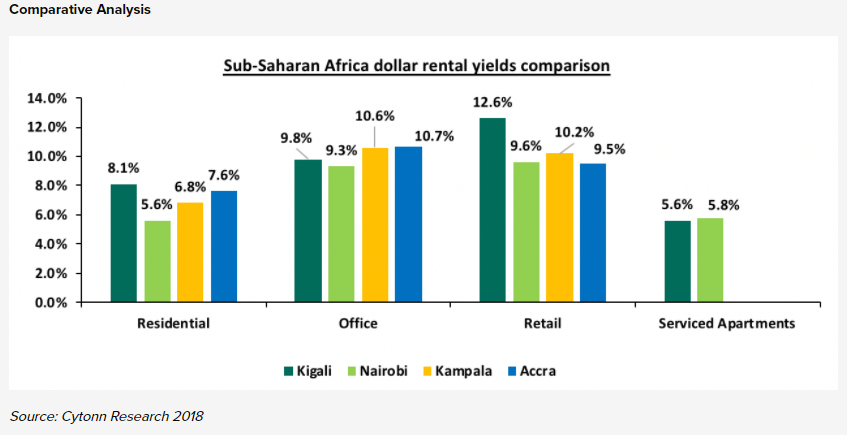



The Kigali market, according to the Cytonn Investments weekly report, is however nascent and small as the City has a population of 1.3mn against Accra’s 2.4mn, Nairobi’s 4.1mn and Kampala’s 1.5mn people according to the country’s respective statistical bureaus.
Rwanda is one of the fast-growing countries in Africa at a GDP growth rate estimated at 6.2 percent in 2017 compared to an Africa average growth of 2.4 percent and a sub-Saharan Africa average of 3.2 percent.
The country was ranked the 41st in the world and second-best country in Africa to do business after Mauritius which ranked 25thglobally and best in Africa according to World Bank Ease of Doing Business 2018 report.
There are a number of factors that drive the real estate sector in Kigali and they include the following:
- Government Incentives –These include the government investment in infrastructural expansion and modernization of urban and rural infrastructure, which involves the construction of roads and provision of utilities such as water and electricity in development sites,
- Political Stability – political stability with well-functioning institutions, rule of law and zero tolerance to corruption,
- Housing Deficit – The affordable housing demand in Kigali for 2012-2022 is estimated at 186,163 Dwelling Units (DU) with an average demand of 16,923 affordable Dwelling Units per year according to Planet Consortium 2012 Housing for the City of Kigali report, hence increasing investment activities by the government and developers with the aim of meeting the demand,
- Economic Growth – Rwanda’s real GDP growth recorded an estimated growth of 6.2 percent in 2017 from 5.9 percent in 2016, an indicator of macroeconomic stability that is conducive to growth. Rwanda was also ranked the 41st and second-best country in Africa to do business in after Mauritius which ranked 25th and best in Africa according to World Bank Ease of Doing Business 2018 report,
- Demographics – Rwanda has a population of approximately 12.4 Million people and growing at a rate of 2.4 percent compared to the global average of 1.2 percent.
The urban population stands at 30.7 percent of the total population and urbanization rate of 4.9 percent p.a. hence creating increased demand for real estate developments, and
- Master Plan– Strict Implementation of zoning regulations guided by the Kigali master plan introduced in 2013, which outlines the conditions and plans for development in Kigali. This is a visionary project which will see planned development in the area and control urban sprawl in future.
Despite the above factors driving real estate in Rwanda, the sector continues to face major challenges that have discouraged potential investors from investing in the real estate sector in Rwanda. These include;
- High Construction Cost– The construction cost in Rwanda is high since it imports most of the construction materials. However, the country is trying to bridge the gap, with companies such as Cimerwa, Rwanda’s sole cement producer and S&H Industries that produces stone-coated tiles (Hippo brand),
- High Cost of Financing– Funding real estate developments has resulted in excessive debt financing, with a debt interest rate ranging from 17 – 19 percent per annum on the Rwandan Franc. The market also does not embrace presales but rather prefer to buy after completion of the project or sometimes during the construction. In addition, Development Bank of Rwanda is the only main lender providing development loans, and
- Low Purchasing Power– The high mortgage rates makes it hard for Rwandese to borrow to finance the purchase of houses given the low levels of income, with approximately 66 percent of the population, earning less than USD. 243 per month. Currently, the value of the mortgage to GDP stands at 3.6 percent against Sub Saharan Africa average of 5.0 percent.