44.7 Million Metric Tons of E-Waste Generated Annually With Only 20% Recycled
The amount of e-waste — discarded products with a battery or plug — is rising globally according to a report released by The Global E-Waste Statistics Partnership.
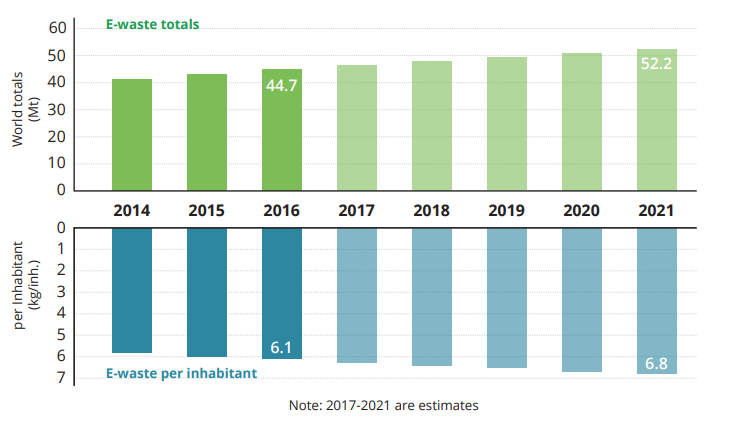
According to the report, E-waste encompasses everything from end-of-life refrigerators and television sets to solar panels, mobile phones, and computers. In 2016, a staggering 44.7 million metric tons (Mt) of e-waste were generated— up 3.3 million metric tons or 8 percent from 2014.
The increase in E-Waste is equal in weight to almost nine Great Pyramids of Giza, 4,500 Eiffel Towers, or 1.23 million fully loaded 18-wheel 40-ton trucks, enough to form a line 28,160 km long, the distance from New York to Bangkok and back.

E-waste the fastest growing part of the world’s domestic waste stream, and experts foresee a further 17 percent increase (to 52.2 million metric tons) of e-waste by 2021.
In 2016, the average worldwide per capita e-waste generated was 6.1 kilograms, up 5 percent from 5.8 kg in 2014.
The increase is in part due to falling prices that now make electronic and electrical devices affordable for most people worldwide, while encouraging early equipment replacement or new acquisitions in wealthier countries.
Only 20 percent of 2016’s e-waste is documented to have been collected and recycled despite rich deposits of gold, silver, copper, platinum, palladium and other high-value recoverable materials.
Of those 44.7 million metric tons, approximately 1.7 million metric tons are thrown into the residual waste in higher-income countries and are likely to be incinerated or land-filled.
Globally, only 8.9 million metric tons of e-waste are documented to be collected and recycled, which corresponds to 20% of all the e-waste generated.
In 2016, Asia was the region that generated by far the largest amount of e-waste (18.2 million metric tons), followed by Europe (12.3 million metric tons), the Americas (11.3 million metric tons), Africa (2.2 million metric tons), and Oceania (0.7 million metric tons).
While the smallest in terms of total e-waste generated, Oceania was the highest generator of e-waste per inhabitant (17.3 kg/inh), with only 6 percent of e-waste documented to be collected and recycled.
Europe is the second largest generator of e-waste per inhabitant with an average of 16.6 kg/inh; however, Europe has the highest collection rate (35 percent).
The Americas generate 11.6 kg/inh and collect only 17 percent of the e-waste generated in the countries, which is comparable to the collection rate in Asia (15%).
However, Asia generates less e-waste per inhabitant (4,2 kg/inh). Africa generates only 1.9 kg/inh and little information is available on its collection rate. The report provides regional breakdowns for Africa, Americas, Asia, Europe, and Oceania.

About Soko Directory Team
Soko Directory is a Financial and Markets digital portal that tracks brands, listed firms on the NSE, SMEs and trend setters in the markets eco-system.Find us on Facebook: facebook.com/SokoDirectory and on Twitter: twitter.com/SokoDirectory