
Kenya’s Overall Agricultural Output Continues to Decline Amidst Shocks in the Sector
According to World Bank’s Kenya Economic Update 2019, the contribution of agriculture to real Gross Domestic Product (GDP) growth has decreased over the past five years from about 23.9 percent to 21.9 percent while year-on-year growth has dropped due to the impact of the last drought.
Furthermore, the sector’s year-on-year growth exhibited significant volatility, in part due to weather shocks and prevalence in pests and disease (including the attacks from the Fall Armyworm in 2017).
The agriculture sector is a major driver of growth for the Kenyan economy and a dominant source of employment for roughly half of the Kenyan people. The sector is pivotal for the country to achieve the formidable goals established in the government’s Vision 2030, which are to transform Kenya into a globally competitive, prosperous country with a high quality of life by 2030.

Read Agriculture and Improved Business Drive Kenya’s Economic Growth Up by 6.0% in 2018
It accounts for about 51 percent of GDP (26 percent directly and 25 percent indirectly through its linkage with other sectors) and according to the National Bureau of Statistics (KNBS) 2018, the sector employed approximately nine million Kenyans (or 56 percent) of the total employment in 2017.
Agriculture is also responsible for most of the country’s exports, accounting for up to 65 percent of merchandise exports in 2017. Consequently, the sector remains central to GDP growth, with years of strong agricultural sector growth reflecting in overall GDP growth.
Agricultural households contributed one third to the reduction of poverty among rural households in the past decade. Poverty declined in Kenya from 46.6 percent in 2005/06 to 36.1 percent in 2015/16, driven by the large decline in rural poverty from 50.5 percent to 38.8 percent. In contrast, urban poverty rates statistically remained stagnant at 32.1 percent in 2005/06 and 29.4 percent in 2015/16. In fact, agricultural households contributed 31.4 percent of the reduction in rural poverty.
The contribution of Agriculture to Kenya’s GDP
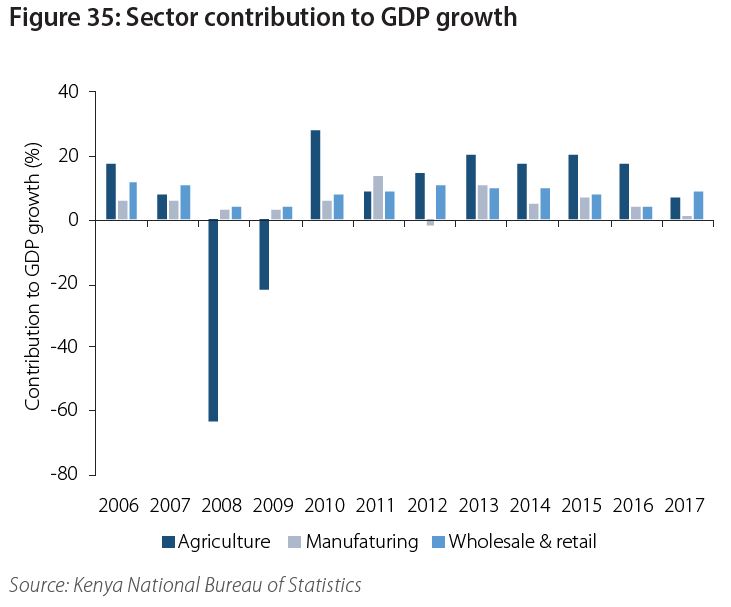
The table below shows Sector contribution to GDP growth
Over the past 10 years, crop production accounted for about 73 percent of the value added in agriculture, while livestock accounted for about 20 percent. Forestry and fishing made up the rest.
A diverse array of produce is farmed in Kenya, including cash crops like tea, coffee, horticulture, sugarcane, cotton, pyrethrum, and sisal, and food crops like maize, rice, wheat, beans, millet, sorghum, potatoes, cabbages, tomatoes, and bananas.
Nonetheless, real agriculture value added has contracted in recent years mainly due to volatility in production because of shocks. The shocks have mainly been weather-related in the form of increasingly unreliable rainfall and prevalence of pests and diseases (such as the Fall Armyworm and Rift Valley Fever). The decreasing trend in real agricultural value added is also seen across SSA countries.
Maize and beans are the predominant crops grown in Kenya, with 85 percent of Kenya’s cultivated land devoted to growing these two staples in 2015/16.
See Also Prolonged Drought Hurting Kenyan Households as Commodity Prices Heighten
Kenya’s productivity in maize and beans has stagnated, whilst neighboring countries have experienced increases in productivity between 2005/06 and 2015/16. Furthermore, there are differences in yields across provinces and genders, with female-headed households having lower productivity in both beans and maize crops.
The table below shows the Annual growth rate in real agriculture value added

Kenya’s agricultural total factor productivity (TFP) dropped at least ten percentage points between 2006 and 2013 before stabilizing thereafter. The country’s TFP growth lags Rwanda, Ethiopia, and Tanzania and is well below that recorded for South Asia and South East Asian countries. The decline was among other factors associated with ineffective