African Markets Are Still Innovating Amid Liquidity Struggles
KEY POINTS
Innovations in sustainable finance and digital transformation, alongside important initiatives in transparency and regulation, will help reinvigorate Africa’s financial markets as they recover from the impact of Covid-19.
According to research in the latest African Financial Markets Index from Absa and OMFIF, African markets are still innovating amid liquidity struggles.
Summary:

Out of 23 countries in the index, 19 score lower than last year. This decline reflects more difficult market conditions, methodological changes, and the inclusion of environmental, social, and governance indicators in the index. Despite the fall in scores, few examples reveal an underlying deterioration in the policy, regulatory or developmental environment in any of the index countries.
The inclusion of ESG initiatives in the formal scoring highlights important developments and opportunities in this area, though at the cost of impacting the scores of those countries for which work is at an early stage. Only 13 countries in the index have ESG-focused policies in financial markets and nine countries have introduced sustainable finance products.
South Africa, Mauritius, and Nigeria maintain their lead in the index, though with scores slipping in 2021 for all three.
Ghana and Uganda enter the top five for the first time, both earning points for progress in Pillar 6: Enforceability of standard master agreements.
Nigeria gains the lead in Pillar 3: Market transparency, tax, and regulatory environment. Namibia maintains its lead in Pillar 4: Capacity of local investors, while Egypt tops Pillar 5: Macroeconomic opportunity. South Africa remains on top for Pillar 1: Market depth and Pillar 2: Access to foreign exchange. It ties for first with Ghana and Nigeria in Pillar 6: Enforceability of standard master agreements.
The index measures financial market development in 23 countries from across the African continent, highlighting economies with the most supportive environment for effective markets.
The aim of the index is to show how economies can improve the market framework to bolster investor access and sustainable growth, and act as a benchmark for investors and policy-makers.
As a reflection of the global push towards sustainability, this is the first year that the index has included ESG indicators. The availability of sustainable finance products, such as green bonds and equities, now contributes to countries’ scores for Pillar 1: Market depth. The index also scores countries on policies that promote ESG initiatives in financial markets for the first time.
The introduction of these sustainability-focused indicators weighs down the scores for many countries in the index as developments in this area are often at an early stage. The average score in the index fell to 46.4 out of 100 in 2021 from 50.8 in 2020, reflecting markets’ muted performance in these new indicators. However, the new measures serve as targets for countries to work towards.
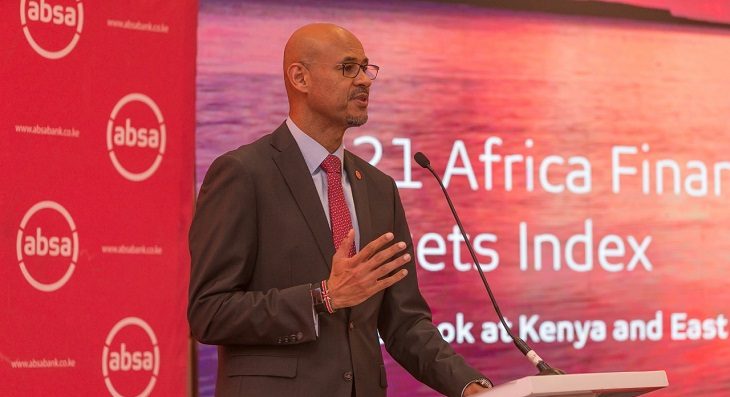
Charles Russon, chief executive of corporate and investment banking, Absa, said of the index’s findings: ‘While some might find it disheartening to see the average score across the board drop, Africa is navigating an extremely tricky economic atmosphere. Recovery from the Covid-19 pandemic has not been as straightforward as we would have hoped last year, and this has had a large impact on the twin challenges the continent faces in reinvigorating financial markets post-pandemic while strengthening market infrastructure.’
‘However,’ he continued, ‘We’ve seen a lot of positive progress in countries’ efforts to upgrade market infrastructure and regulatory support through the development of technology-based tools which will help future-proof Africa’s financial markets. With countries using innovation to boost local markets and build a broader investor base, there are plenty of reasons to be hopeful about the future of Africa’s macroeconomic landscape.’
In Pillar 1: Market depth, scores dip by an average of 1 point to 40.5 from 41.5 in 2020 due to lower equity market turnover, which has persisted since the onset of the Covid-19 pandemic. While market capitalization rose in almost all of the countries in the index, it was not enough to offset weak trading activity. Only nine countries have introduced financial products that can be classified as ‘green’ or ‘sustainable’, with green bonds available in seven countries, either on exchanges or over the counter. Kenya and Morocco score highest in this indicator for having green or sustainable bonds, equities, and mutual funds in their markets.
Foreign exchange reserves grew by 24% in Pillar 2: Access to foreign exchange, with South Africa coming first and Eswatini moving up 11 places. However, a lack of liquidity in the FX markets, as measured through interbank figures, weakened across almost all countries.
Nearly all countries’ scores declined in Pillar 3: Market transparency, tax, and regulatory environment due to lower marks in capital market development. Poor performance on the new indicators that look at incentives for issuance of sustainable financial instruments, integration of sustainability factors in financial market standards, and adoption of climate stress testing also contributed to the decline.
Namibia tops Pillar 4: Capacity of local investors once again, earning full marks for having a deep pension market relative to the size of its population and securities market. However, the weak potential on the part of the domestic pensions market meant that 19 countries failed to score over 50.
Countries generally performed best in Pillar 5: Macroeconomic Outlook, achieving an average score of 62. Egypt regains the lead – which it lost to South Africa last year – propelled by strong gross domestic product growth in 2020. The macro impact of the pandemic continues to be felt in this sector with economic growth for many countries subdued and public finance showing the strain.
Ghana, Nigeria, and South Africa earn full points in Pillar 6: Enforceability of standard master agreements. Mauritius, Uganda, Zambia, and Malawi miss out on joining these countries at the top of the pillar by not yet fully adopting standard master agreements.
‘The index is evolving to stay relevant, recognizing the greater role that sustainability plays in market development, as well as the importance of mitigating climate-related risks to the financial system, especially for African countries that are more vulnerable to the effects of environmental deterioration,’ said David Marsh, chairman of OMFIF. ‘Innovations in sustainable finance and market infrastructure will be critical to ensuring that African markets remain competitive and future-proof.’
About Soko Directory Team
Soko Directory is a Financial and Markets digital portal that tracks brands, listed firms on the NSE, SMEs and trend setters in the markets eco-system.Find us on Facebook: facebook.com/SokoDirectory and on Twitter: twitter.com/SokoDirectory
- January 2026 (220)
- February 2026 (248)
- March 2026 (287)
- April 2026 (208)
- May 2026 (191)
- June 2026 (147)
- January 2025 (119)
- February 2025 (191)
- March 2025 (212)
- April 2025 (193)
- May 2025 (161)
- June 2025 (157)
- July 2025 (227)
- August 2025 (211)
- September 2025 (270)
- October 2025 (297)
- November 2025 (230)
- December 2025 (220)
- January 2024 (238)
- February 2024 (227)
- March 2024 (190)
- April 2024 (133)
- May 2024 (157)
- June 2024 (145)
- July 2024 (136)
- August 2024 (154)
- September 2024 (212)
- October 2024 (255)
- November 2024 (196)
- December 2024 (143)
- January 2023 (182)
- February 2023 (203)
- March 2023 (322)
- April 2023 (297)
- May 2023 (267)
- June 2023 (214)
- July 2023 (212)
- August 2023 (257)
- September 2023 (237)
- October 2023 (264)
- November 2023 (286)
- December 2023 (177)
- January 2022 (293)
- February 2022 (329)
- March 2022 (358)
- April 2022 (292)
- May 2022 (271)
- June 2022 (232)
- July 2022 (278)
- August 2022 (253)
- September 2022 (246)
- October 2022 (196)
- November 2022 (232)
- December 2022 (167)
- January 2021 (182)
- February 2021 (227)
- March 2021 (325)
- April 2021 (259)
- May 2021 (285)
- June 2021 (272)
- July 2021 (277)
- August 2021 (232)
- September 2021 (271)
- October 2021 (304)
- November 2021 (364)
- December 2021 (249)
- January 2020 (272)
- February 2020 (310)
- March 2020 (390)
- April 2020 (321)
- May 2020 (335)
- June 2020 (327)
- July 2020 (333)
- August 2020 (276)
- September 2020 (214)
- October 2020 (233)
- November 2020 (242)
- December 2020 (187)
- January 2019 (251)
- February 2019 (215)
- March 2019 (283)
- April 2019 (254)
- May 2019 (269)
- June 2019 (249)
- July 2019 (335)
- August 2019 (292)
- September 2019 (306)
- October 2019 (313)
- November 2019 (362)
- December 2019 (318)
- January 2018 (291)
- February 2018 (213)
- March 2018 (275)
- April 2018 (223)
- May 2018 (235)
- June 2018 (176)
- July 2018 (256)
- August 2018 (247)
- September 2018 (255)
- October 2018 (282)
- November 2018 (282)
- December 2018 (184)
- January 2017 (183)
- February 2017 (194)
- March 2017 (207)
- April 2017 (104)
- May 2017 (169)
- June 2017 (205)
- July 2017 (189)
- August 2017 (195)
- September 2017 (186)
- October 2017 (235)
- November 2017 (253)
- December 2017 (266)
- January 2016 (164)
- February 2016 (165)
- March 2016 (189)
- April 2016 (143)
- May 2016 (245)
- June 2016 (182)
- July 2016 (271)
- August 2016 (247)
- September 2016 (233)
- October 2016 (191)
- November 2016 (243)
- December 2016 (153)
- January 2015 (1)
- February 2015 (4)
- March 2015 (164)
- April 2015 (107)
- May 2015 (116)
- June 2015 (119)
- July 2015 (145)
- August 2015 (157)
- September 2015 (186)
- October 2015 (169)
- November 2015 (173)
- December 2015 (205)
- March 2014 (2)
- March 2013 (10)
- June 2013 (1)
- March 2012 (7)
- April 2012 (15)
- May 2012 (1)
- July 2012 (1)
- August 2012 (4)
- October 2012 (2)
- November 2012 (2)
- December 2012 (1)
