
Has The Russia – Ukraine War Only United The Fores?
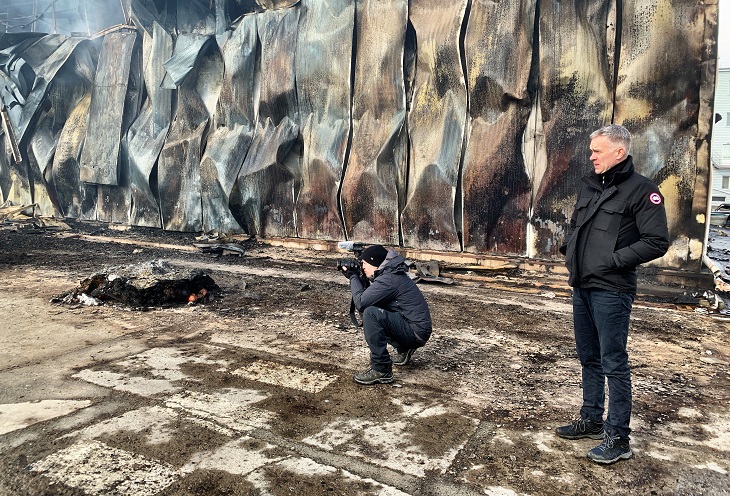
Wars deserve to be measured less in geopolitical chips or swings of the alliance, and more in tiny moments of personal agony or horror.
A year into Russia’s war on Ukraine and the fate of Ekaterina and Valentin stays with me. Police rescued them from the shelling around their tiny apartment in Lysychansk before it fell to Russian forces this summer.
Their home was one tiny room, and a shared kitchen and bathroom, the smell of the latter being all Ekaterina could talk about when we met her.

Valentin seemed to have dementia, both appeared dazed by the cacophony around them. When police slowly packed them into a waiting car, he clutched vividly a small, tidy briefcase of their documents. It was an act of loss – conceding he may never return – but also of blind faith that the structures around him would persist and that there would be a place in the future where his papers would be useful once more.
Such miniature moments of inconsolable panic are the true cost of Putin’s invasion, as well as tiny symbols of hope in the future, and the reason Ukraine may win out.
Yet perhaps the biggest surprise of the ‘now’ we are in, is what it has taught or reminded the West about its values and purpose. Russia’s unprovoked invasion has served as the unwitting antidote to six years of clumsy populism, the seismic economic and psychological shock of the pandemic, and a looming feeling that morality and the virtue of values were becoming obsolete when faced by the challenges of a planet in permanent crisis.
It shouldn’t have taken the deaths of tens of thousands of innocent Ukrainians, nuclear blackmail, and the leveling of so much of a country, to make this point. But it is perhaps the revulsion towards Putin’s brutal and inept war that has helped Europe and the rest of the West rediscover the spines Trump had apparently weakened.
There are so many other moments that stay with me. The eyes of three old men thrust into our van in Posad Pokhrovka, in the early days of the war, desperate to flee shelling that had torn their world apart, echo in me: not even the Nazis beat them like that, they said, sobbing. They never thought they’d live long enough to see worse than the 1940s.
Wars can intensify scrutiny of both sides’ conduct to the point of ambivalence, so it’s important to pause at this point and emphasize how grotesque and ugly modern Russia is at war.
Firstly, it won’t even admit it is at war – a key indicator of the fictional sands in which it wishes to fight and place the goalposts of victory. Secondly, Moscow has burned through its professional army so fast, it is now press-ganging students to the front, and resorting to unleashing human waves of Russian prisoners at Ukrainian trenches. Coffins return empty, the injured are sent back to fight. Thirdly, the lack of sophistication – or even basic self-awareness – is show-stopping. They don’t even seem to want to address how bad they are: this is not the military of hybrid warfare and Putin’s jujitsu moves. In the background the threat of nuclear force has been brandished so ineptly – in chest-pounding signals from a weak Kremlin who are losing the most conventional of fights – they appear to have had the almost opposite effect, galvanizing the West into concerted action because, frankly, who wants to live in a world of nuclear blackmail?
Ukraine’s response has been further fuel to Western unity. Ingenuity has bolstered its furious defense. A territorial defense fighter, known as “Graf” could in Kramatorsk talk for hours about the complexities of syncing drone surveillance to artillery, then switch to the role of western private contractors in the war, and end with a blistering critique on the role alcoholism and corruption would have on the bones of Russia’s nuclear program. Ukraine is sending its best and brightest to fight, and hence adapting to it faster than imaginable, while Russia is forcing convicts to run at machine guns.
Fear of Moscow has begun to evaporate in the past year. The Cold War foe that could vaporize our world – whose warheads were the menace behind so many childhood animations and movies in the 80s – has not lost the internal blindness and shoddiness that led to the Soviet Union’s collapse. It’s as bad as it was, only more desperate – its elite twice humiliated, now and in the 90s. The Russian dead I witnessed sprawled all over the roadside as Ukraine advanced in Kherson this summer were forlornly scruffy, with a sleeping mat and workout gloves for comfort, and only rusting armor at their backs.
There is something acutely tragic about how fast Russia has fallen. Deservedly so, yes, but pause also to remember the first Putin years contained within their massacres in Chechnya and the slow strangulation of dissent, a kernel of economic reform and progress for ordinary Russians. He was at that time creating the middle class that would ultimately risk his downfall. Now all that is gone, and a shrinking population will choke and rasp the edges of Europe for years to come. Whether Russia requires a harsh reprimand or not, the impact of its demise will be another problem Europe has to endure up close.
What’s most startling about the choice Moscow has imposed on the West – to seek its strategic defeat in Ukraine rather than its limited appeasement – is that Europe was heading in the other direction a year ago: defense budgets were growing in recognition of Russian malice, but the broad hope was Putin would be a benign, grumpy neighbor arguing over the border fence, rather than a savage marauder bent on restoring an empire so aged in concept, not even he was old enough to have seen it in full.
The West is now engaged in an act of full-throated support of Ukraine that, it’s fair to say, most of its officials would have deemed far too provocative a year ago. Sending tanks, thinking of F16s, training troops; such things are so brazen, it’s hard to argue this isn’t already NATO’s war too, simply fought by proxy.
Is that a bad thing? For Ukraine, whose sacrifice should never have had to happen, the answer is clearly yes. So much loss remains hidden: I recall being inside as well as shivering outside the administration building of Mykolayiv at the start of the war. Now all I can think of is how many must have been inside it when a missile tore it in two this summer.
But this is a more limited scenario for Russia’s defeat than NATO war planners could have gamed. The Great Power was never meant to falter so explicitly, nor to so ineptly inspire unity in the foes it had worked so hard to divide.
This pattern of miscalculation and misstep by Moscow is not entirely comforting; it still leaves the use of its nuclear arsenal as something of a wild card. We know the consequences for its victims as well as for ordinary Russians, but such concerns have not dissuaded Putin before.
The possibility Russia’s nastiest toys also fail in their most destructive use – that the nuclear button just smokes and purrs when struck – is perhaps what is holding Putin back, or maybe it is that same streak of self-preservation that has guided his every move. It is also perhaps the innate selfishness and myopia of Russia’s system that reduces this threat and has enabled such a meaty Western response.
The year ahead will likely see the non-conventional menace of a desperate Russia grow, alongside the slow tiring of Western support, as elections churn and budgets are strained. But a wider victory has already been achieved in this costly, arduous, painful year: a unity of purpose and substance of support have usurped Moscow’s goal to sow selfishness and division. That moment of clarity can’t be erased, no matter how long it endures.

About Soko Directory Team
Soko Directory is a Financial and Markets digital portal that tracks brands, listed firms on the NSE, SMEs and trend setters in the markets eco-system.Find us on Facebook: facebook.com/SokoDirectory and on Twitter: twitter.com/SokoDirectory

- January 2026 (220)
- February 2026 (248)
- March 2026 (287)
- April 2026 (207)
- May 2026 (192)
- June 2026 (238)
- July 2026 (279)
- August 2026 (223)
- September 2026 (72)
- January 2025 (119)
- February 2025 (191)
- March 2025 (212)
- April 2025 (193)
- May 2025 (161)
- June 2025 (157)
- July 2025 (227)
- August 2025 (211)
- September 2025 (267)
- October 2025 (297)
- November 2025 (230)
- December 2025 (220)
- January 2024 (238)
- February 2024 (227)
- March 2024 (190)
- April 2024 (133)
- May 2024 (157)
- June 2024 (145)
- July 2024 (136)
- August 2024 (154)
- September 2024 (212)
- October 2024 (255)
- November 2024 (196)
- December 2024 (143)
- January 2023 (182)
- February 2023 (203)
- March 2023 (322)
- April 2023 (297)
- May 2023 (267)
- June 2023 (214)
- July 2023 (212)
- August 2023 (257)
- September 2023 (237)
- October 2023 (264)
- November 2023 (286)
- December 2023 (177)
- January 2022 (293)
- February 2022 (329)
- March 2022 (358)
- April 2022 (292)
- May 2022 (271)
- June 2022 (232)
- July 2022 (278)
- August 2022 (253)
- September 2022 (246)
- October 2022 (196)
- November 2022 (232)
- December 2022 (167)
- January 2021 (182)
- February 2021 (227)
- March 2021 (325)
- April 2021 (259)
- May 2021 (285)
- June 2021 (272)
- July 2021 (277)
- August 2021 (232)
- September 2021 (271)
- October 2021 (303)
- November 2021 (364)
- December 2021 (249)
- January 2020 (272)
- February 2020 (310)
- March 2020 (390)
- April 2020 (321)
- May 2020 (335)
- June 2020 (327)
- July 2020 (333)
- August 2020 (276)
- September 2020 (214)
- October 2020 (233)
- November 2020 (242)
- December 2020 (187)
- January 2019 (251)
- February 2019 (215)
- March 2019 (283)
- April 2019 (254)
- May 2019 (269)
- June 2019 (249)
- July 2019 (335)
- August 2019 (292)
- September 2019 (306)
- October 2019 (313)
- November 2019 (362)
- December 2019 (318)
- January 2018 (291)
- February 2018 (213)
- March 2018 (275)
- April 2018 (223)
- May 2018 (235)
- June 2018 (176)
- July 2018 (256)
- August 2018 (247)
- September 2018 (255)
- October 2018 (282)
- November 2018 (282)
- December 2018 (184)
- January 2017 (183)
- February 2017 (194)
- March 2017 (207)
- April 2017 (104)
- May 2017 (169)
- June 2017 (205)
- July 2017 (189)
- August 2017 (195)
- September 2017 (186)
- October 2017 (235)
- November 2017 (253)
- December 2017 (266)
- January 2016 (164)
- February 2016 (165)
- March 2016 (189)
- April 2016 (143)
- May 2016 (245)
- June 2016 (182)
- July 2016 (271)
- August 2016 (247)
- September 2016 (233)
- October 2016 (191)
- November 2016 (243)
- December 2016 (153)
- January 2015 (1)
- February 2015 (4)
- March 2015 (164)
- April 2015 (107)
- May 2015 (116)
- June 2015 (119)
- July 2015 (145)
- August 2015 (157)
- September 2015 (186)
- October 2015 (169)
- November 2015 (173)
- December 2015 (205)
- March 2014 (2)
- March 2013 (10)
- June 2013 (1)
- March 2012 (7)
- April 2012 (15)
- May 2012 (1)
- July 2012 (1)
- August 2012 (4)
- October 2012 (2)
- November 2012 (2)
- December 2012 (1)