
The Future Of Crash Games: Innovations And Player-Driven Evolution At Lucky Star

Crash games have taken the online gambling world by storm, offering fast-paced, high-stakes excitement that keeps players on the edge of their seats. But what does the future hold for this dynamic genre? With advancements in technology and game mechanics, crash games are set to become even more immersive and engaging. Developers are constantly exploring ways to enhance gameplay, introduce new risk-reward structures, and integrate cutting-edge features that push the boundaries of traditional casino gaming.
One of the most anticipated advancements is the integration of AI-driven algorithms that personalize the gaming experience. Imagine a system that adapts to your playing style, offering tailored multipliers and risk levels based on your past bets. Additionally, accessibility will continue to improve, with platforms like lucky star casino download making it easier than ever for players to enjoy crash games on the go. With seamless mobile optimization, real-time multiplayer features, and instant access to bonuses, the next generation of crash games will redefine convenience.
Beyond functionality, the future promises enhanced visual and interactive elements. Augmented reality (AR) and virtual reality (VR) could bring an entirely new level of immersion, allowing players to engage with crash games in a 3D space with dynamic animations and interactive betting environments. Blockchain technology may also play a crucial role, offering provably fair gaming and instant payouts through smart contracts. As these innovations unfold, crash games are poised to remain one of the most thrilling and evolving segments of online gambling.

Evolution of Lucky Star gaming mechanics: from classic betting to interactive gameplay
The world of online gambling is constantly evolving, and Lucky Star casino stands at the forefront of innovation. Traditional betting mechanics, once limited to placing fixed wagers and waiting for the outcome, have transformed into dynamic, player-driven experiences. This shift has been fueled by advancements in technology, player preferences, and the increasing demand for engaging and interactive gameplay. Instead of simply placing bets and watching the results unfold, players now have the opportunity to actively influence the course of the game, making strategic decisions that enhance both excitement and potential winnings.
At Lucky Star, crash games and other interactive formats have redefined traditional casino entertainment. Modern gaming mechanics incorporate real-time elements, allowing players to adjust their bets mid-game, unlock hidden features, or even engage in community-based betting where collective actions impact the game’s outcome. The integration of bonus rounds, skill-based mechanics, and real-time multipliers adds another layer of depth, transforming simple wagers into complex, decision-driven experiences. As the industry moves forward, these innovations continue to shape the way players engage with their favorite games.
Key advancements in Lucky Star gaming mechanics
- Dynamic betting adjustments: players can modify their bets in real-time, reacting to game events as they unfold.
- Interactive bonus features: unlockable in-game bonuses provide additional opportunities for strategic play.
- Skill-based elements: some crash games now reward player decisions rather than relying purely on luck.
- Community betting modes: players can participate in group-based betting systems where outcomes are influenced collectively.
- Personalized game experiences: AI-driven mechanics adapt gameplay based on individual player behavior.
- Live game enhancements: real-time animations and interactive graphics create a more immersive betting environment.
The introduction of interactive mechanics has not only increased player engagement but also expanded the strategic possibilities within Lucky Star’s gaming ecosystem. Players who once relied solely on chance can now develop betting strategies, react to in-game events, and leverage skill-based features to maximize their potential winnings. This shift toward greater player agency has revolutionized the online casino experience, making games more thrilling and rewarding.
As technology continues to advance, we can expect even more innovative mechanics to emerge at Lucky Star. Augmented reality (AR) overlays, gamified progression systems, and even AI-powered game customization may soon become standard features. The future of interactive gaming is just beginning, and Lucky Star remains committed to pushing the boundaries of what’s possible in the online gambling industry.
Technological breakthroughs at Lucky Star: AI, blockchain, and virtual reality in crash games
The rapid evolution of online gambling has paved the way for groundbreaking technological advancements, and Lucky Star casino is at the forefront of integrating cutting-edge innovations. In the world of crash games, technology is no longer just a background element—it’s becoming a driving force that enhances gameplay, improves security, and creates immersive experiences for players. Artificial intelligence (AI), blockchain technology, and virtual reality (VR) are three key developments shaping the future of crash games, offering players more control, transparency, and engagement than ever before.
AI-powered mechanics are revolutionizing crash games by personalizing gameplay in real time. Advanced algorithms analyze player behavior, adjusting betting recommendations and risk levels to suit individual styles. Blockchain technology ensures provably fair gaming, transparent transactions, and instant payouts, eliminating concerns about game manipulation or delayed withdrawals. On the immersive front, VR technology is pushing boundaries by introducing fully interactive betting environments where players can engage with the game in a virtual space, heightening the thrill of high-stakes wagering.
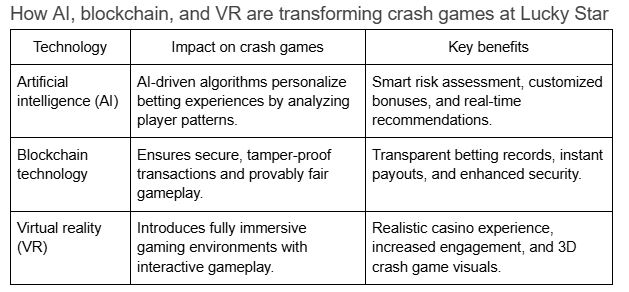
The integration of these technologies is not just enhancing gameplay but also redefining the entire online gambling experience. AI-driven recommendations allow both beginners and experienced players to make smarter betting decisions, while blockchain’s decentralized nature eliminates trust issues by providing an immutable record of every transaction. VR, on the other hand, brings a sensory-rich dimension to crash games, where players can physically engage with the betting interface, making the experience more thrilling and lifelike.
Lucky Star is committed to staying at the cutting edge of these advancements. Future developments could include AI-powered chatbots that provide real-time betting insights, deeper blockchain integration for decentralized finance (DeFi) betting, and full-scale VR casino lobbies where players can interact with others in a digital space. With these innovations, crash games at Lucky Star are not just evolving—they are setting the standard for the next generation of online gaming.
Personalization and social features at Lucky Star: how players can influence gameplay
The future of online gambling is shifting toward a more player-centric experience, where personalization and social interaction redefine how users engage with their favorite games. Lucky Star casino is leading this transformation by integrating advanced customization features and social mechanics that allow players to shape their gaming experience. No longer are crash games purely based on pre-set mechanics; instead, players can influence outcomes, interact with others in real time, and tailor their gameplay to match their preferences.
One of the key advancements in personalization is AI-driven game customization. Based on player behavior and betting patterns, Lucky Star can adjust elements like game speed, risk levels, and even bonus structures to suit individual playstyles. On the social side, interactive features such as real-time multiplayer lobbies, live leaderboards, and in-game chat functions foster a sense of community among players. These innovations make the gaming experience more engaging, allowing players to feel like active participants rather than passive spectators.
How players can shape their Lucky Star experience
- Customizable betting options: players can set personalized risk-reward ratios, adjusting game mechanics to their comfort level.
- AI-powered game recommendations: smart algorithms suggest game settings, crash multipliers, and betting strategies tailored to individual habits.
- Live multiplayer mode: engage in real-time crash games with other players, where community interactions influence the gameplay experience.
- Social challenges and tournaments: compete in custom events with unique rules and rewards, adding a layer of strategy and social engagement.
- In-game chat and reactions: communicate with other players, share insights, and celebrate big wins together through interactive chat tools.
- Leaderboard-based rewards: achieve top rankings and unlock exclusive bonuses based on performance and social engagement.
- Player-created game modes: future updates may introduce custom crash game settings where users can modify variables and create their own challenges.
The introduction of these features is changing the way players interact with crash games at Lucky Star. Rather than relying solely on luck, players can now develop strategies, engage in community-driven challenges, and adjust game settings to their liking. This level of control makes the gaming experience feel more dynamic and personalized, ensuring that each session is unique.
Lucky Star aims to expand these interactive features even further. Future enhancements could include social betting pools, where players collectively influence game outcomes, or fully customizable crash game rooms where users set their own betting rules. By giving players more control and fostering a social environment, Lucky Star is shaping the next evolution of online gaming—one that is engaging, interactive, and tailored to every individual’s preferences.
Conclusion: how Lucky Star is revolutionizing crash games
The evolution of crash games at Lucky Star casino is shaping a new era of online gambling, where technology, interactivity, and player influence redefine the gaming experience. From the integration of AI-driven mechanics and blockchain security to the introduction of VR environments, the industry is moving toward more immersive and intelligent gameplay. These advancements not only enhance fairness and engagement but also provide players with unprecedented levels of control over their betting strategies.
One of the most significant changes is the shift from passive betting to interactive gameplay. Players can now personalize their experiences through AI-driven adjustments, social features, and multiplayer game modes. The ability to influence crash games, participate in live competitions, and interact with a growing community makes online gambling more dynamic than ever before. Lucky Star is at the forefront of these innovations, ensuring that its platform remains at the cutting edge of casino entertainment.
As the industry continues to evolve, Lucky Star is set to push boundaries even further. Future developments may include fully player-customized game modes, deeper social integration, and AI-powered assistants that help players optimize their strategies. The future of crash games is not just about luck—it’s about choice, strategy, and innovation. With these technological breakthroughs, Lucky Star is setting the standard for the next generation of online gaming.

About Soko Directory Team
Soko Directory is a Financial and Markets digital portal that tracks brands, listed firms on the NSE, SMEs and trend setters in the markets eco-system.Find us on Facebook: facebook.com/SokoDirectory and on Twitter: twitter.com/SokoDirectory

- January 2026 (220)
- February 2026 (248)
- March 2026 (287)
- April 2026 (208)
- May 2026 (129)
- January 2025 (119)
- February 2025 (191)
- March 2025 (212)
- April 2025 (193)
- May 2025 (161)
- June 2025 (157)
- July 2025 (227)
- August 2025 (211)
- September 2025 (270)
- October 2025 (297)
- November 2025 (230)
- December 2025 (220)
- January 2024 (238)
- February 2024 (227)
- March 2024 (190)
- April 2024 (133)
- May 2024 (157)
- June 2024 (145)
- July 2024 (136)
- August 2024 (154)
- September 2024 (212)
- October 2024 (255)
- November 2024 (196)
- December 2024 (143)
- January 2023 (182)
- February 2023 (203)
- March 2023 (322)
- April 2023 (297)
- May 2023 (267)
- June 2023 (214)
- July 2023 (212)
- August 2023 (257)
- September 2023 (237)
- October 2023 (264)
- November 2023 (286)
- December 2023 (177)
- January 2022 (293)
- February 2022 (329)
- March 2022 (358)
- April 2022 (292)
- May 2022 (271)
- June 2022 (232)
- July 2022 (278)
- August 2022 (253)
- September 2022 (246)
- October 2022 (196)
- November 2022 (232)
- December 2022 (167)
- January 2021 (182)
- February 2021 (227)
- March 2021 (325)
- April 2021 (259)
- May 2021 (285)
- June 2021 (272)
- July 2021 (277)
- August 2021 (232)
- September 2021 (271)
- October 2021 (304)
- November 2021 (364)
- December 2021 (249)
- January 2020 (272)
- February 2020 (310)
- March 2020 (390)
- April 2020 (321)
- May 2020 (335)
- June 2020 (327)
- July 2020 (333)
- August 2020 (276)
- September 2020 (214)
- October 2020 (233)
- November 2020 (242)
- December 2020 (187)
- January 2019 (251)
- February 2019 (215)
- March 2019 (283)
- April 2019 (254)
- May 2019 (269)
- June 2019 (249)
- July 2019 (335)
- August 2019 (292)
- September 2019 (306)
- October 2019 (313)
- November 2019 (362)
- December 2019 (318)
- January 2018 (291)
- February 2018 (213)
- March 2018 (275)
- April 2018 (223)
- May 2018 (235)
- June 2018 (176)
- July 2018 (256)
- August 2018 (247)
- September 2018 (255)
- October 2018 (282)
- November 2018 (282)
- December 2018 (184)
- January 2017 (183)
- February 2017 (194)
- March 2017 (207)
- April 2017 (104)
- May 2017 (169)
- June 2017 (205)
- July 2017 (189)
- August 2017 (195)
- September 2017 (186)
- October 2017 (235)
- November 2017 (253)
- December 2017 (266)
- January 2016 (164)
- February 2016 (165)
- March 2016 (189)
- April 2016 (143)
- May 2016 (245)
- June 2016 (182)
- July 2016 (271)
- August 2016 (247)
- September 2016 (233)
- October 2016 (191)
- November 2016 (243)
- December 2016 (153)
- January 2015 (1)
- February 2015 (4)
- March 2015 (164)
- April 2015 (107)
- May 2015 (116)
- June 2015 (119)
- July 2015 (145)
- August 2015 (157)
- September 2015 (186)
- October 2015 (169)
- November 2015 (173)
- December 2015 (205)
- March 2014 (2)
- March 2013 (10)
- June 2013 (1)
- March 2012 (7)
- April 2012 (15)
- May 2012 (1)
- July 2012 (1)
- August 2012 (4)
- October 2012 (2)
- November 2012 (2)
- December 2012 (1)