
Tariff Tremors And Token Responses: Kenya’s Toothless Rejoinder To U.S. Trade Shocks

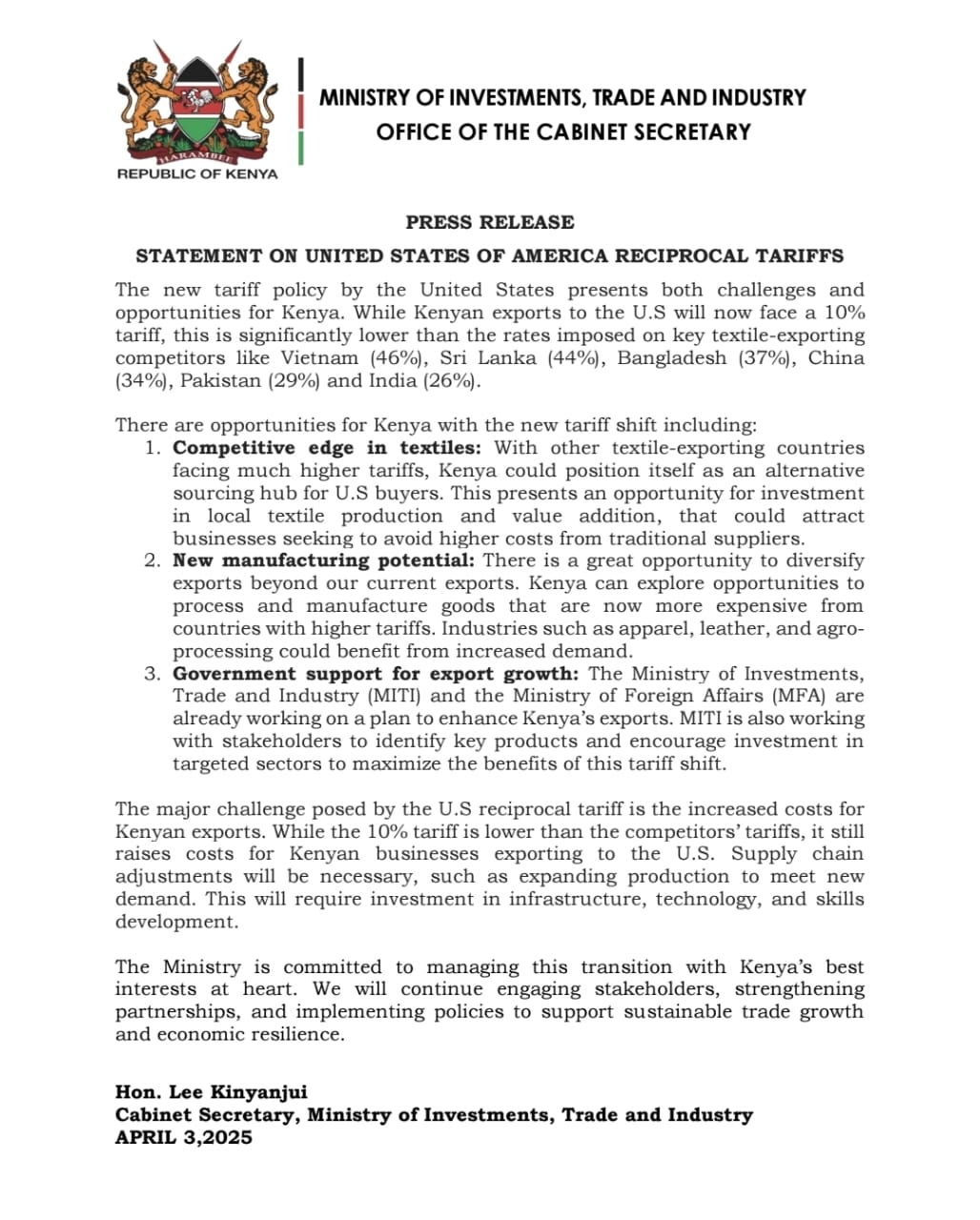
The press release issued by Hon. Lee Kinyanjui, Cabinet Secretary for Kenya’s Ministry of Investments, Trade and Industry, in response to the United States’ imposition of a 10% tariff on Kenyan exports, is emblematic of a leadership that remains reactive rather than strategic. At a critical juncture where the rules of global trade are being redrawn, Kenya needed to deliver a robust, imaginative, and forward-looking policy blueprint—not a lukewarm assurance note laced with bland optimism.
A 10% tariff, though seemingly moderate when compared to the harsher rates slapped on Vietnam (46%) or Sri Lanka (44%), is still a severe blow to Kenyan exporters. In trade terms, even a 2% tariff shift can drastically alter supply chain decisions. The release appears to downplay this impact by focusing on relative comparison instead of absolute competitiveness.
The Cabinet Secretary’s framing of this development as an “opportunity” might appear diplomatically sound, but it dangerously flirts with delusion. Tariffs, historically, are tools of protectionism and economic coercion. They distort comparative advantage, discourage specialization, and disproportionately punish smaller, less diversified economies like Kenya’s. Why is this fundamental truth completely absent from the ministry’s narrative?

Moreover, the idea that Kenya can “leverage its competitive edge in textiles” ignores two decades of declining investment in the country’s textile value chain. According to the Kenya Association of Manufacturers (KAM), the country’s textile exports underperform due to high electricity costs, logistics inefficiencies, and bureaucratic red tape. How can Kenya realistically pivot as an alternative supplier to U.S. buyers without solving these long-standing bottlenecks?
Read Also: How Ruto’s Incompetent Government Is Undermining Kenyan Farmers Because Of Greed
The response also betrays a romantic optimism about new manufacturing opportunities. But where is the data backing up this claim? Kenya’s manufacturing sector contributes less than 8% to GDP and has been shrinking, not growing. According to the World Bank, Kenya has lost ground in the manufacturing index for five consecutive years. Attracting investment amid global reshoring trends and nearshoring preferences requires more than rhetoric—it needs a reform revolution.
The Cabinet Secretary mentions “value addition” in passing, but that buzzword has become the policy equivalent of a fig leaf. Without a detailed, sector-by-sector breakdown of where Kenya could realistically add value and how the government will subsidize such transformation, the term is hollow. Where are the tax incentives? Where is the industrial clustering policy? Where is the trade finance mechanism to de-risk SME entry into processing?
Most damning, perhaps, is the silence around intra-African trade. The African Continental Free Trade Area (AfCFTA) was supposed to be the crown jewel of Africa’s economic independence, yet the release doesn’t mention it once. Why is the ministry not leveraging this moment to reduce Kenya’s overreliance on volatile U.S. markets and foster resilient regional trade ecosystems?
In 2023, only 17% of Kenya’s exports went to African countries—an indictment of policy inertia and misplaced priorities. South-South trade has far more potential for growth. Kenya should be deepening ties with Ethiopia, DRC, and Nigeria, not scrambling to placate a market that’s already moved on.
And then there’s the absurd faith in stakeholder meetings. “We are working with stakeholders” has become a bureaucratic ritual in Kenya that translates to endless coffee-fueled seminars with zero tangible output. This language betrays a mindset still stuck in form over function. What’s needed is action, not consultative theater.
What does not appear in the statement is arguably more telling than what does. There’s no mention of digital trade, green manufacturing, or how Kenya plans to harness its demographic dividend to leapfrog traditional trade models. There is no indication of any reform to the ports, to customs processes, or to trade-related corruption—all of which inflate export costs.
Also conspicuously absent is a strategy for unilateral liberalization. As a small open economy, Kenya stands to gain the most from embracing free trade aggressively. Nobel laureate Paul Krugman and trade economists such as Jagdish Bhagwati have long argued that developing nations can gain significantly by lowering tariffs unilaterally, rather than waiting for reciprocity. Why hasn’t Kenya explored this path?
The U.S. tariff move also signals a breakdown of the WTO’s Most Favoured Nation principle. In this new trade order, bilateralism is king, and countries must build bespoke alliances. Kenya’s silence on how it intends to reposition itself diplomatically to secure better bilateral deals reflects either paralysis or delusion.
The Ministry’s release is also woefully silent on data. Where are the figures showing the impact of these tariffs on Kenya’s horticulture, tea, or coffee sectors? What’s the projected job loss? How many SMEs stand to close? The public deserves to know the scale of the disruption—not be pacified with hollow optimism.