
Why the Nairobi Securities Exchange Is Africa’s Most Underrated Investment Opportunity in 2025

When people think about investing, the first thoughts are often of real estate, fixed deposits, money market funds, or insurance-linked savings plans. Stocks, especially in developing markets like Kenya, rarely top the list. Yet, the returns shown on the Nairobi Securities Exchange (NSE) in the first half of 2025 present a compelling case, not just for seasoned investors but also for ordinary Kenyans who want to grow their wealth sustainably and transparently.
Let’s talk returns. If you had invested KES 100,000 in Kenya Power and Lighting Company (KPLC) on the first trading day of January 2025, your investment would be worth approximately KES 239,100 today. That’s a 139.1% return in just six months. It’s not a hypothetical scenario — it’s real data, and it’s happening on Kenyan soil. The same story applies to KenGen, the power generation giant, which returned 104.9% over the same period. These aren’t tech unicorns or speculative crypto coins. These are essential service providers, household names, often criticized in public discourse, yet delivering investor returns that would make Wall Street analysts nod in approval.
Why are these returns so high? In KPLC’s case, the turnaround has been fuelled by operational reforms, renewed government support, and investor optimism around improved efficiencies and financial restructuring. For KenGen, the market responded to their expansion into geothermal and wind energy, monetization of carbon credits, and growing demand for green energy. Their fundamentals improved, investor confidence soared, and the share price followed.

Now look at HF Group, up 66.3%. Traditionally known for mortgage financing, HF has been repositioning itself as a digital-first bank, tapping into the growing demand for affordable housing and fintech services. That transformation, though still ongoing, has been rewarded by the market. Liberty Kenya, another strong performer, saw a 54.9% increase, reflecting the insurance sector’s growing relevance post-COVID and improved actuarial structures.
Read Also: The NSE Saw A Mixed Market With Foreign Net Outflows Taking Centre Stage
Then there’s Kenya Re, posting a 53.9% gain. The reinsurance business is complex, but its profitability is often underestimated. As primary insurers grow, they offload risk to reinsurers. And with climate change driving up insurance claims globally, well-run reinsurers are now sitting on solid portfolios. That’s the opportunity Kenya Re represents — and the market has picked up on it.
The Nairobi Securities Exchange itself — the institution that houses all these firms — returned 50.3%. This performance is important, not just symbolically. It reflects confidence in the system itself, growing participation, stronger regulatory frameworks, and innovations like Real Estate Investment Trusts (REITs), derivatives, and cross-listing opportunities. It signals that the market is maturing and that local investors are starting to believe in their economy.
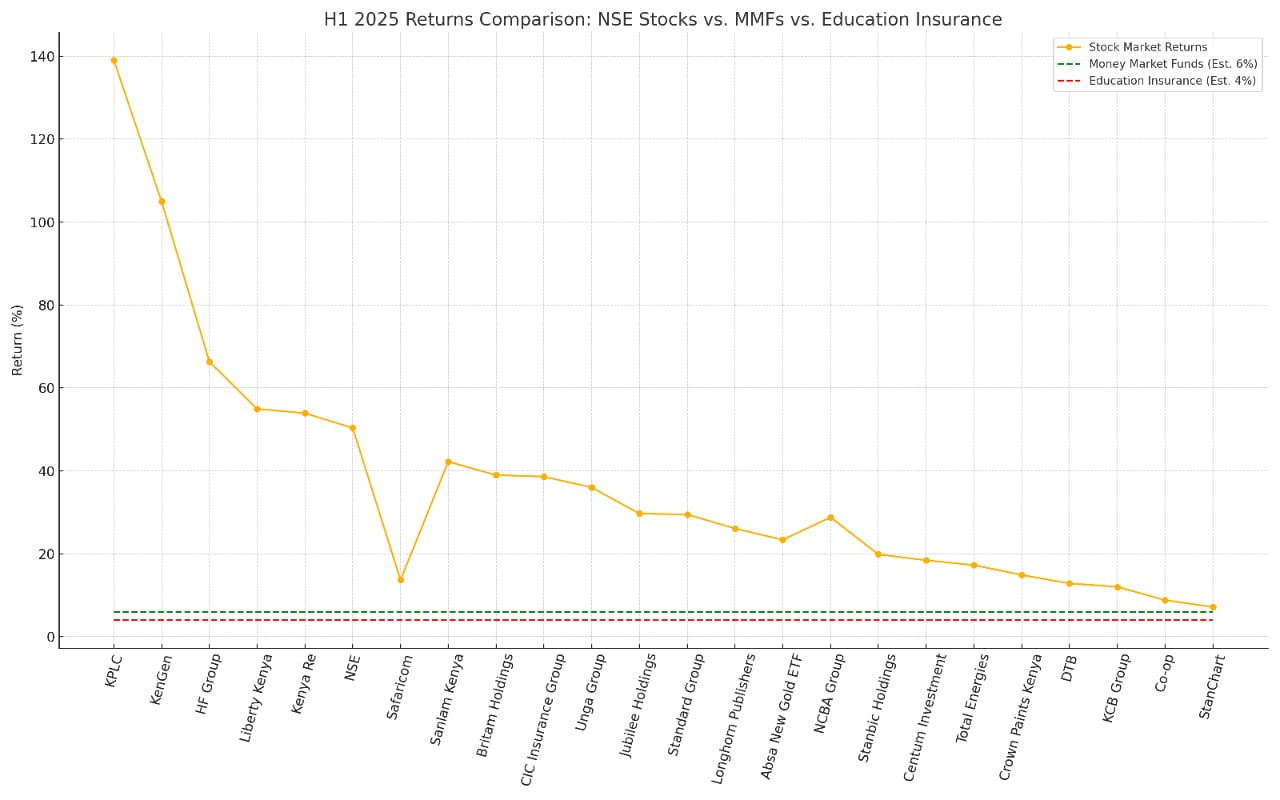
Even companies like Safaricom, often viewed as already saturated in growth, managed a 13.7% increase. While modest compared to KPLC, remember that Safaricom is Kenya’s largest company by market capitalization. It’s already massive. Any movement in its price represents billions in underlying shifts. Their expansion into Ethiopia, coupled with consistent M-Pesa innovations, continues to deliver strong long-term prospects.
Sanlam Kenya’s 46.6% return is another example of how financial services are turning into high-growth plays. Strategic partnerships with banks for bancassurance, digital onboarding, and improved claims management are behind this rise. Similarly, Britam Holdings posted a 39% gain on the back of a strategic shift toward asset management and tech-driven insurance distribution.
CIC Insurance grew by 38%, and that’s largely a function of how effectively they’ve tapped into microinsurance and underserved markets, especially boda boda riders and rural farmers. This is social impact investing that yields double-digit returns. Unga Group’s 36.7% return reminds us that food and agribusiness are not just essential for survival — they’re critical investment verticals. With food inflation rising, companies involved in staple processing have become inflation hedges.
Jubilee Holdings rose 29.7%, continuing its tradition of conservative but stable growth. With its reach across East Africa and a diversified portfolio, Jubilee remains one of the most solid insurance bets for any long-term investor. Standard Group, traditionally a media underdog, returned 29.5% following restructuring and new revenue models from digital platforms and e-commerce advertising.
Even niche sectors are paying off. Longhorn Publishers returned 26.1%, showing the staying power of content and curriculum providers in