
Banking On Africa: Unlocking Capital And Partnerships For Sustainable Growth

A new white paper by the United Bank for Africa (UBA) has called for a fundamental shift in how Africa funds its growth, one that redefines the continent’s development narrative from one of dependency to one of self-determination.
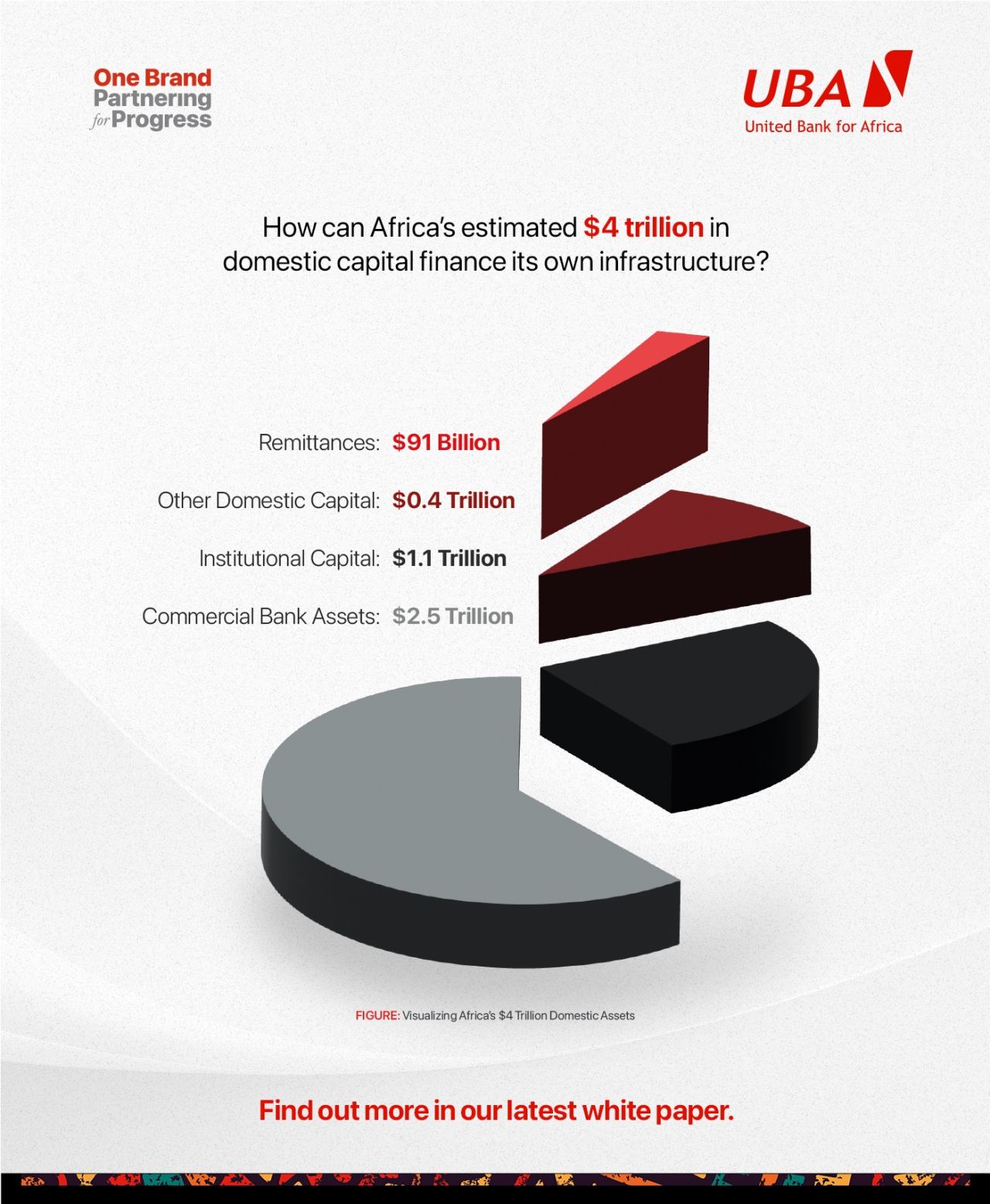
Titled “Banking on Africa: Unlocking Capital and Partnerships for Sustainable Growth,” the report reveals that Africa holds an estimated $4 trillion in domestic financial assets, yet less than 15 percent of this capital is directed toward productive infrastructure—the very foundation of economic expansion.
“This is not a scarcity of capital, but an opportunity for more effective allocation,” said Oliver Alawuba, UBA Group Managing Director. “Africa’s transformation will be built on African capital, partnerships, and innovation working together.”

From Aid to Investment: A New Growth Paradigm
UBA’s paper highlights a new paradigm rooted in investment-centered partnerships rather than aid-heavy models. It calls for African institutions to integrate domestic and international capital strategies, blending commercial viability with social impact through “solution-oriented finance.”
This reframing, the report argues, could unlock a powerful multiplier effect—reducing reliance on external funding, enhancing sovereignty, and attracting global partners into African-led financing mechanisms.
Infrastructure as the Engine of Integration
The paper emphasizes that the path to inclusive growth lies in mobilizing domestic institutional capital for infrastructure development.
It cites successful national models:
Nigeria’s InfraCredit which has facilitated over $278 million in infrastructure bonds tailored for pension fund investment.
Kenya’s Pension Funds Investment Consortium (KEPFIC), pooling 24 schemes to raise $113 million for infrastructure projects, has with oversubscription rate of 157 percent.
Ghana’s Infrastructure Investment Fund (GIIF), co-financing with banks and DFIs to leverage $325 million in equity across a $3.6 billion project portfolio.
Such initiatives, UBA notes, demonstrate how institutional investors can channel long-term capital into energy, transport, and digital infrastructure—sectors vital for regional competitiveness.
AfCFTA: Powering Trade and Connectivity
Central to UBA’s vision is the African Continental Free Trade Area (AfCFTA), described as “the architectural blueprint for integration.” The bank projects intra-African trade to grow by over 12 percent in 2025, reaching