


Some companies succeed because they operate in favorable markets. Then some companies succeed because the people running them understand discipline, systems, talent, governance, timing, technology, and long-term thinking. NCBA belongs to the second category. The transformation from NIC Bank into NCBA Group is one of the most important corporate case studies Kenya has produced in modern history. It is not simply a banking success story. It is a lesson on how shareholder patience, professional management, institutional discipline, and strategic hiring can build a brand that dominates an industry for decades.
The revelation that Muhoho Kenyatta controls a stake valued at roughly KES 20 billion in NCBA only reinforces one truth: great shareholders eventually discover that talent is indispensable. Capital matters. Networks matter. Relationships matter. But in the modern economy, competent management is the difference between institutions that survive and institutions that disappear.
The NCBA journey is remarkable because it combines legacy banking influence with modern corporate execution. The merger between NIC Group and Commercial Bank of Africa in 2019 created a financial institution that was expected to become large. But size alone never guarantees relevance. What turned NCBA into one of the most respected financial institutions in East Africa was the management culture established after the merger.


Under Group Managing Director John Gachora and senior executives including leaders across retail banking, digital banking, operations, risk, and corporate strategy, NCBA built a management architecture that many African institutions still struggle to understand. The institution stopped thinking like a traditional bank and started behaving like a technology-driven financial ecosystem.
The numbers explain the scale of this transformation. NCBA crossed the KES 1 trillion mark in digital loan disbursements in 2024, a historic milestone in African banking. The group posted a profit after tax of KES 21.9 billion for the 2024 financial year despite a difficult macroeconomic environment characterized by high interest rates, currency volatility, reduced consumer spending, and rising credit risks.
According to the bank’s published financial results, total operating income stood at approximately KES 62.7 billion while customer deposits remained above KES 500 billion. Total assets closed around KES 666 billion, placing NCBA among the largest financial institutions in East Africa. These are not accidental numbers. They are outcomes of managerial consistency and strategic execution.
One of the most important lessons from NCBA is that modern institutions cannot grow without combining technology and trust. Through products like Fuliza and M-Shwari, NCBA understood earlier than most banks that millions of Africans needed financial access before they needed luxury banking experiences. The institution positioned itself at the center of Kenya’s mobile money revolution and converted digital behavior into scalable revenue.
That decision fundamentally changed the banking landscape. Traditional banking depended heavily on branches, paperwork, and physical interactions. NCBA instead embraced digital velocity. The result was a customer base that expanded across millions of users without proportionally increasing physical infrastructure costs.
This is where the NCBA management model becomes a business-school case study. The leadership team recognized that future banking would not be built around marble floors and executive offices. It would be built around data, algorithms, mobile integration, customer experience, and ecosystem partnerships.
Another critical factor behind NCBA’s rise is governance discipline. Many institutions in Africa collapse because ownership interferes excessively with management. At NCBA, shareholders appear to have understood the importance of allowing professionals to execute strategy. That separation between ownership and operational management is one of the strongest indicators of institutional maturity.
The relationship between the Kenyatta-linked investment interests, the Ndegwa influence, and professional executives demonstrates something powerful: sustainable wealth creation requires institutional thinking. This is why NCBA continued expanding regionally while maintaining operational resilience.
The contrast with many struggling financial institutions is clear. Some banks spend years changing strategies every few months, replacing executives constantly, or prioritizing politics over systems. NCBA instead focused on consistency. Consistency in risk management. Consistency in technology investment. Consistency in customer experience. Consistency in leadership communication.
Even during difficult economic periods, NCBA continued investing in operational efficiency and digital transformation. This matters because visionary institutions build during uncertainty while weaker institutions panic during uncertainty.
The modern management lesson from NCBA is that talent compounds. Great executives attract other great executives. Strong systems attract institutional investors. Clear governance attracts long-term confidence. That cycle creates organizational momentum that becomes difficult for competitors to replicate.
This is why the institution deserves academic attention. Universities teaching entrepreneurship often overemphasize startup culture while ignoring operational excellence. Yet long-term wealth is usually built by institutions that master execution rather than excitement.
A proper MBA class on African corporate transformation should study how NCBA merged legacy banking structures with digital financial innovation without destroying operational stability. That balance is extremely difficult to achieve.
The leadership structure under John Gachora also demonstrated the importance of measured communication. Strong institutions do not only perform financially. They communicate confidence to markets, regulators, customers, and shareholders simultaneously.
NCBA’s resilience became even more visible through periods of economic pressure when many institutions experienced asset quality deterioration. The bank maintained disciplined credit underwriting while still expanding digital lending operations.
The institution’s regional strategy across Kenya, Uganda, Tanzania, Rwanda, and Ivory Coast also demonstrates another leadership lesson: scale matters in modern banking. Financial institutions increasingly require regional relevance to survive future competition.
This transformation cannot be separated from the quality of board appointments and executive recruitment. Institutions become reflections of the standards they tolerate internally. NCBA appears to have built a culture where competence matters.
That is why comparisons with weaker institutions become important. Across Kenya’s financial sector, there are examples of banks that possessed political networks and historical advantages but failed to evolve operationally. Talent remains the ultimate differentiator.
The NCBA story also highlights why modern African businesses must stop fearing professionalization. Many founders resist delegation because they believe centralized control guarantees safety. In reality, centralized control often destroys scalability.
The most sophisticated part of the NCBA model is that it combines institutional conservatism with innovation. The bank remained stable enough to protect depositor confidence while still becoming aggressive enough to dominate digital finance.
This balance is extremely rare. Institutions usually become either too rigid to innovate or too reckless to survive. NCBA managed to navigate both worlds.
Presidents, policymakers, and regulators across Africa should study this model carefully because economic transformation is impossible without strong financial institutions. Banks are not just lenders. They are economic infrastructure.
A country’s entrepreneurial capacity is directly linked to the sophistication of its banking ecosystem. When banks modernize, SMEs gain efficiency. Consumers gain access. Digital commerce expands. Economic velocity improves.
NCBA’s management structure therefore represents more than a banking success. It represents a blueprint for African institutional modernization.
The institution’s rise also reinforces a difficult truth in capitalism: ownership alone is never enough. Wealth survives when shareholders identify and empower exceptional operators. That is where the Kenyatta and Ndegwa alignment with professional management becomes strategically important.
The market ultimately rewards institutions that can survive leadership transitions, technological disruptions, and economic cycles. NCBA increasingly looks like one of those institutions.
This is why future entrepreneurial classes should not only discuss Silicon Valley startups. They should discuss African execution stories. They should study how mergers are integrated. How governance structures are designed. How risk is managed. How digital ecosystems are built.
The NCBA story proves that Africa does not lack capital. It often lacks execution discipline. Institutions that solve the execution problem eventually dominate entire sectors.
In the years ahead, business historians may look at NCBA as one of the defining examples of how East African institutions transitioned from traditional banking into technology-powered financial infrastructure.
And perhaps the most important lesson of all is this: talent is indispensable. Even influence eventually bows to competence. Sustainable institutions are built by people who understand systems, discipline, patience, governance, and execution.
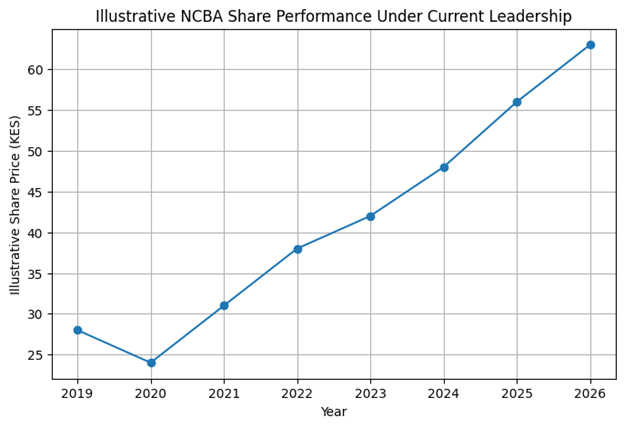

Illustrative linear trend showing the growth trajectory and market confidence around NCBA during the current management era. The trend reflects investor confidence driven by profitability growth, digital expansion, stronger governance, and regional scale.
Read Also: Middle Income Earners Among the Highest Revenue Creators for NCBA BANK