


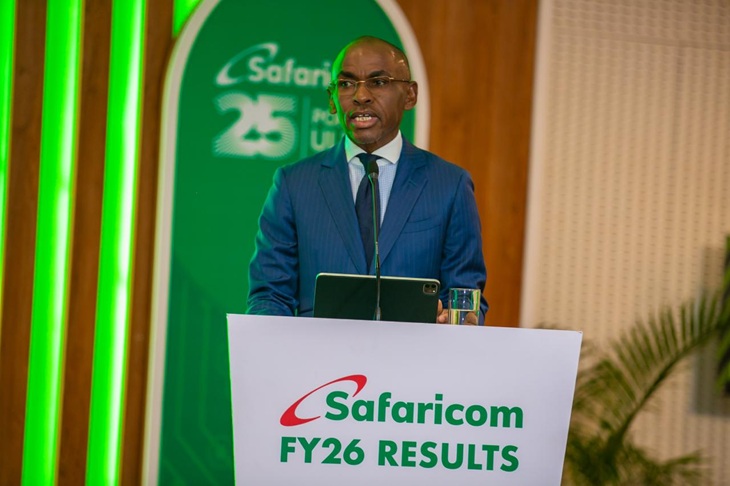
Safaricom PLC has posted one of the strongest financial performances in its history, reporting Ksh 414 billion in service revenue and nearly Ksh 100 billion in net income for the financial year ended March 2026, underlining the telco’s continued dominance in Kenya and growing regional ambitions.
The company also announced a total dividend payout of Ksh 80.1 billion, equivalent to Ksh 2.00 per share, representing a 66.7 percent jump from the previous financial year. The payout comprises an interim dividend of Ksh 0.85 and a final dividend of Ksh 1.15 per share.
Safaricom’s growth was largely driven by sustained expansion in M-PESA, mobile data, enterprise services, and improving momentum in Ethiopia, where the company is gradually shifting from heavy infrastructure rollout to commercial scale.


Group service revenue rose to Ksh 414 billion, while M-PESA revenue in Kenya climbed 13.4 percent to Ksh 182.7 billion, reinforcing the fintech platform’s position as Safaricom’s most important growth engine. Increased smartphone adoption, streaming, digital payments, and remote work also pushed mobile data consumption higher across the market.
The results come at a critical moment for the telco as it seeks to defend its leadership in Kenya while simultaneously scaling operations in Ethiopia and repositioning itself as a broader technology and digital services company beyond traditional telecommunications.
For years, Ethiopia had largely been viewed as Safaricom’s costly long-term expansion bet. That narrative is now beginning to evolve.
Speaking during the results announcement, Safaricom Chairman Adil Khawaja said the Ethiopian business was now moving “from rollout to scale,” supported by pricing adjustments, network expansion, and regulatory progress around infrastructure sharing and interconnection.
“With network coverage now exceeding 50 percent and strong customer growth, Ethiopia is moving from rollout to scale,” he said.
Although the Ethiopian operation remains in investment phase and continues to weigh on overall costs, losses narrowed significantly during the year as the business gained scale, strengthening investor confidence in Safaricom’s regional expansion strategy.
Safaricom said it now serves 72 million customers across its markets.
Beyond earnings, one of the most significant developments for the company this year was securing a new unified licence from the Communications Authority of Kenya that allows Safaricom to operate in Kenya for another 25 years.
Khawaja described the licence renewal as “more than a regulatory milestone,” saying it gives the company greater confidence to continue investing in infrastructure, digital services, and financial technology over the long term.
The telco also welcomed the rollout of the KESONIA risk-based pricing framework by the Central Bank of Kenya, which Safaricom believes aligns well with its expanding digital lending and fintech operations.
Read Also: Ziidi Trader: How Safaricom Rewired the Nairobi Stock Exchange — And What Comes Next