Equity Afya’s 1,000-Pharmacy Revolution Could Redefine the Cost of Healthcare in Africa
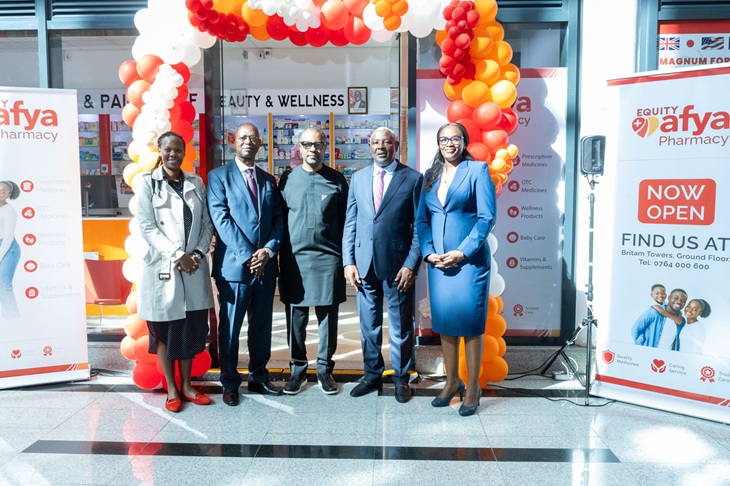
Kenya’s healthcare conversation may have reached a decisive turning point. Equity Afya has opened its first standalone community pharmacy at Britam Towers in Upper Hill, Nairobi, with an ambition far bigger than a single outlet. The target is a network of 1,000 pharmacies, built around a promise that could transform family budgets: reducing the price of medicines by between 50 and 80 percent. If delivered at scale, that promise could reshape access to treatment.
This is not merely another pharmacy opening in a premium Nairobi building. It is an attempt to confront one of the most painful realities in healthcare: a diagnosis means little when a patient cannot afford the prescribed treatment. For many households, the cost of medicine is the final and most difficult barrier between seeking medical help and completing the journey toward recovery. Too often, patients leave clinics knowing what they need but unable to pay for it.
A reduction of 50 to 80 percent would be economically significant. It could mean that patients who currently postpone treatment, split doses, abandon prescriptions or borrow money to buy medicine may have a more affordable alternative. It could also allow families to protect school fees, food budgets and working capital that are often sacrificed when illness enters the home without warning. Affordable medicine is therefore not only a health issue; it is also a household survival issue.

The standalone pharmacy is an extension of Equity Afya’s existing network of 154 clinics operating across Kenya and the Democratic Republic of Congo. That foundation gives the initiative an important advantage: it is not starting as an isolated retail experiment. It is emerging from a healthcare platform that already understands patient needs, clinical referrals and the communities it intends to serve. The clinics provide a base from which demand, trust and service gaps can be better understood.
The proposed 1,000-outlet network could create a new healthcare bridge between the doctor’s consultation and the medicine counter. Clinics and pharmacies are often treated as separate businesses, yet patients experience them as one journey. When that journey is fragmented by distance, stock shortages, unclear pricing or unaffordable prescriptions, the person who suffers is the patient. A well-integrated network could make treatment more predictable, convenient and complete.
The franchise model adds another powerful dimension. The outlets will be run by graduates of the Equity Leaders Program, an initiative of Equity Group Foundation that has awarded more than 60,000 scholarships. This creates a pathway through which education can move beyond academic achievement and become enterprise, employment, leadership and community service. It also gives young people a chance to build sustainable businesses in a sector with direct social impact.
For these graduates, the model offers more than a job. It provides an opportunity to become owners and operators within a sector that affects every household. When young people are trusted to manage credible businesses with strong systems, recognised brands and clear social purpose, scholarships stop being the end of the story and become the beginning of productive economic participation. The investment made in education is then converted into jobs, services and long-term community value.
The initiative is backed by the Gates Foundation, giving it both development significance and global attention. However, the real test will not be the strength of the launch, the prestige of the partners or the attractiveness of the target. Success will be measured at the community level, where a parent asks whether the medicine is available, genuine, properly stored and truly affordable. Big names may open doors, but only reliable service will build lasting public trust.
Affordability must also be matched by consistency. A patient cannot build trust in a pharmacy that offers low prices today but has no stock tomorrow. Reaching 1,000 outlets will therefore require disciplined procurement, reliable distribution, strong inventory management and rigorous quality controls. Scale in healthcare must never come at the expense of patient safety or professional standards. The network will be judged not only by how quickly it expands, but by how dependably every outlet performs.
The expansion could also force a wider conversation about medicine pricing in Kenya. When one network publicly promises reductions of up to 80 percent, patients will naturally begin asking why prices differ so widely between outlets. Greater price transparency could create healthy pressure across the market and encourage pharmacies, suppliers and manufacturers to explain the costs carried by consumers. That scrutiny could make medicine pricing more understandable and competition more meaningful for ordinary patients.
Existing community pharmacies should not be dismissed or pushed aside in this transformation. Many have served neighbourhoods for years, extended informal credit and remained open when patients had nowhere else to turn. The arrival of a large franchise network should raise standards and widen access, but fair competition must still allow responsible independent pharmacies to survive and innovate. The goal should be a stronger pharmacy ecosystem, not a market in which scale alone decides who remains standing.
The location of the first outlet at Britam Towers gives the project visibility, but its deepest impact will be determined far from Upper Hill. The real breakthrough will come when affordable, dependable pharmacies reach estates, informal settlements, small towns and rural trading centres where transport costs can make a simple prescription even more expensive than the medicine itself. The network’s social value will be measured by how effectively it closes these geographic and financial gaps.
Equity Afya’s clinic footprint offers a practical starting point for that expansion. Pharmacies can potentially grow around communities where patient demand is already visible and healthcare relationships already exist. Yet the model must remain patient-centred. Commercial targets, franchise growth and outlet numbers should support better care, not turn medicine into just another high-volume retail product. Healthcare businesses succeed sustainably when the dignity, safety and needs of patients remain at the centre of every decision.
The 1,000-outlet target is bold, and bold targets are necessary in a region where healthcare access remains uneven. But rapid expansion must be supported by trained pharmaceutical professionals, ethical dispensing, responsible use of medicines and clear referral systems. A pharmacy should not only sell products; it should protect patients from misuse, misinformation and avoidable harm. Every new outlet must therefore represent an expansion of professional care, not simply an additional sales counter.
There is also a broader economic lesson in this model. Africa’s social problems cannot be solved by charity alone, and they cannot be left entirely to profit-driven markets. Sustainable progress often emerges where investment, philanthropy, professional standards and local entrepreneurship are designed to reinforce one another rather than operate as separate worlds. Equity Afya’s model will be closely watched because it attempts to combine these forces around a basic public need.
By connecting a scholarship programme to a healthcare franchise, Equity is attempting to build that bridge. The approach links human capital to enterprise and enterprise to public need. It says that talented young people can do more than seek employment after graduation; they can run institutions that create jobs, deliver essential services and retain value within their communities. That is a powerful idea in economies where educated youth often struggle to translate qualifications into ownership and opportunity.
For ordinary Kenyans, however, the promise remains simple. Can a mother walk into one of these pharmacies and buy the full prescription without choosing which medicine to leave behind? Can an elderly patient obtain regular treatment without exhausting a pension? Can a small business owner recover without closing the business to pay a medical bill? Those are the questions that matter. The success of the project will ultimately be felt in homes, wallets and treatment outcomes, not in launch-day speeches.
If Equity Afya delivers genuine medicines, reliable availability and price reductions of 50 to 80 percent across a 1,000-outlet network, this will be more than a successful expansion strategy. It could become one of the most consequential healthcare affordability interventions in the region, proving that medicine can be accessible without being financially punishing. It could also establish a model that connects healthcare access, youth entrepreneurship and private-sector scale practically and measurably.
The launch at Britam Towers is therefore only the first page of a much larger story. The vision is compelling, the numbers are ambitious and the potential impact is enormous. What comes next will determine whether this remains an impressive announcement or becomes a pharmacy revolution that changes how millions of African families experience healthcare. The country should welcome the ambition, scrutinise the execution and insist that the promise of affordable medicine reaches those who need it most.
Read Also: 5 Things You Need To Know About Equity Afya
About Steve Biko Wafula
Steve Biko is the CEO OF Soko Directory and the founder of Hidalgo Group of Companies. Steve is currently developing his career in law, finance, entrepreneurship and digital consultancy; and has been implementing consultancy assignments for client organizations comprising of trainings besides capacity building in entrepreneurial matters.He can be reached on: +254 20 510 1124 or Email: info@sokodirectory.com
- January 2026 (220)
- February 2026 (248)
- March 2026 (287)
- April 2026 (208)
- May 2026 (191)
- June 2026 (154)
- January 2025 (119)
- February 2025 (191)
- March 2025 (212)
- April 2025 (193)
- May 2025 (161)
- June 2025 (157)
- July 2025 (227)
- August 2025 (211)
- September 2025 (270)
- October 2025 (297)
- November 2025 (230)
- December 2025 (220)
- January 2024 (238)
- February 2024 (227)
- March 2024 (190)
- April 2024 (133)
- May 2024 (157)
- June 2024 (145)
- July 2024 (136)
- August 2024 (154)
- September 2024 (212)
- October 2024 (255)
- November 2024 (196)
- December 2024 (143)
- January 2023 (182)
- February 2023 (203)
- March 2023 (322)
- April 2023 (297)
- May 2023 (267)
- June 2023 (214)
- July 2023 (212)
- August 2023 (257)
- September 2023 (237)
- October 2023 (264)
- November 2023 (286)
- December 2023 (177)
- January 2022 (293)
- February 2022 (329)
- March 2022 (358)
- April 2022 (292)
- May 2022 (271)
- June 2022 (232)
- July 2022 (278)
- August 2022 (253)
- September 2022 (246)
- October 2022 (196)
- November 2022 (232)
- December 2022 (167)
- January 2021 (182)
- February 2021 (227)
- March 2021 (325)
- April 2021 (259)
- May 2021 (285)
- June 2021 (272)
- July 2021 (277)
- August 2021 (232)
- September 2021 (271)
- October 2021 (304)
- November 2021 (364)
- December 2021 (249)
- January 2020 (272)
- February 2020 (310)
- March 2020 (390)
- April 2020 (321)
- May 2020 (335)
- June 2020 (327)
- July 2020 (333)
- August 2020 (276)
- September 2020 (214)
- October 2020 (233)
- November 2020 (242)
- December 2020 (187)
- January 2019 (251)
- February 2019 (215)
- March 2019 (283)
- April 2019 (254)
- May 2019 (269)
- June 2019 (249)
- July 2019 (335)
- August 2019 (292)
- September 2019 (306)
- October 2019 (313)
- November 2019 (362)
- December 2019 (318)
- January 2018 (291)
- February 2018 (213)
- March 2018 (275)
- April 2018 (223)
- May 2018 (235)
- June 2018 (176)
- July 2018 (256)
- August 2018 (247)
- September 2018 (255)
- October 2018 (282)
- November 2018 (282)
- December 2018 (184)
- January 2017 (183)
- February 2017 (194)
- March 2017 (207)
- April 2017 (104)
- May 2017 (169)
- June 2017 (205)
- July 2017 (189)
- August 2017 (195)
- September 2017 (186)
- October 2017 (235)
- November 2017 (253)
- December 2017 (266)
- January 2016 (164)
- February 2016 (165)
- March 2016 (189)
- April 2016 (143)
- May 2016 (245)
- June 2016 (182)
- July 2016 (271)
- August 2016 (247)
- September 2016 (233)
- October 2016 (191)
- November 2016 (243)
- December 2016 (153)
- January 2015 (1)
- February 2015 (4)
- March 2015 (164)
- April 2015 (107)
- May 2015 (116)
- June 2015 (119)
- July 2015 (145)
- August 2015 (157)
- September 2015 (186)
- October 2015 (169)
- November 2015 (173)
- December 2015 (205)
- March 2014 (2)
- March 2013 (10)
- June 2013 (1)
- March 2012 (7)
- April 2012 (15)
- May 2012 (1)
- July 2012 (1)
- August 2012 (4)
- October 2012 (2)
- November 2012 (2)
- December 2012 (1)
