
From KSh100,000 to KSh113,077 in Six Months: Why Owning Great Companies Could Be Kenya’s Most Powerful Wealth-Creation Habit
There is a difference between working for money and making money work. For millions of Kenyans, income enters through a salary, a business, a contract or a side hustle, but most of it is consumed by rent, school fees, food, transport, debt and emergencies. Whatever remains is often left in cash, where it feels safe but may not create meaningful long-term wealth. The stock market offers a different proposition: instead of merely storing money, an investor can use it to acquire ownership in productive companies that earn profits, expand, pay dividends and increase in value.
NCBA Group provides a timely illustration. Using the first trading day of 2026 as the entry point, KSh100,000 invested at an NSE volume-weighted average price of KSh85.00 would have bought 1,176 shares and left KSh40 uninvested. At the latest confirmed closing price used in this analysis, KSh91.75, those shares would be worth KSh107,898. The investor would also have qualified for the KSh4.60 final dividend, producing KSh5,410 gross, or approximately KSh5,139 after an assumed 5% resident withholding tax.
That brings the total position to roughly KSh113,077 before brokerage and statutory trading charges. The wealth created is approximately KSh13,077, equivalent to 13.1% in under six months. Of that return, about KSh7,938 came from the increase in the market value of the shares, while KSh5,139 came from the cash dividend. This is the central power of direct equity ownership: the investor can benefit from both capital appreciation and a share of the company’s distributed profits.

Read Also: Mwalimu Sacco, NCBA Launch Salo Xpress to Streamline Payroll Processing
The Numbers Behind the KSh100,000 Investment
| Component | Calculation | Result |
| Shares purchased | Floor(100,000 ÷ 85.00) | 1,176 shares |
| Cash used | 1,176 × 85.00 | KSh 99,960 |
| Residual cash | 100,000 − cash used | KSh 40 |
| Market value | 1,176 × 91.75 | KSh 107,898 |
| Gross final dividend | 1,176 × 4.60 | KSh 5,410 |
| Net dividend | Gross dividend less assumed 5% WHT | KSh 5,139 |
| Total wealth | Market value + residual cash + net dividend | KSh 113,077 |
| Total profit | Total wealth − initial capital | KSh 13,077 |
The Detailed Investment Trajectory
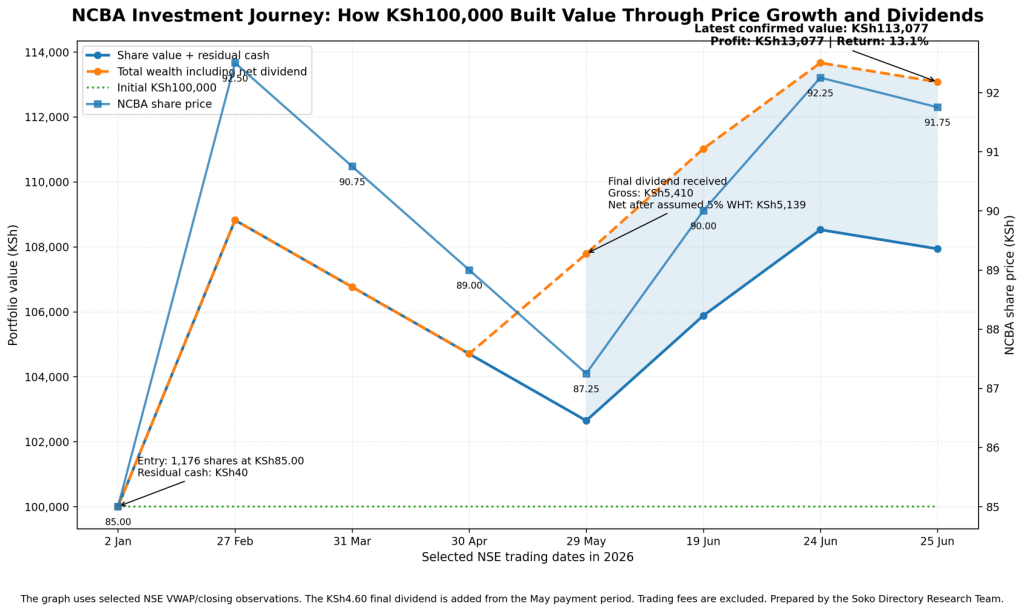
Figure 1: The portfolio did not rise in a straight line. The dividend created a second return stream and helped lift total wealth above the value of the shares alone.
This Was Ownership, Not a Get-Rich-Quick Bet
The most important lesson is not that every share will rise by 13% in six months. Markets do not move in straight lines, and no company is guaranteed to repeat past performance. The lesson is that a disciplined investor can convert ordinary savings into ownership of an operating business. Once the purchase is made, the investor is no longer standing outside the economy as a customer only. The investor becomes a shareholder with an economic interest in the company’s future profits, assets, strategy and distributions.
The chart in this report makes the journey visible. NCBA’s price rose strongly in February, softened in March and April, dipped further by late May, then recovered in June. An investor who panicked during the decline could have sold too early. A patient investor who remained focused on the underlying business received the dividend and participated in the recovery. Wealth creation through equities is therefore not only about identifying a strong company. It is also about emotional discipline, time in the market and the ability to separate temporary price movement from long-term business value.
Why NCBA Has Become a Bank to Watch
The share-price performance is supported by business momentum. NCBA reported profit after tax of KSh6.0 billion in the first quarter of 2026, up 9% from the same period a year earlier. Operating income rose