
Kenya’s Money Market Is Calm, But The Real Economy Is Coughing

Standard Investment Bank’s latest fixed income report tells a story of two Kenyas. In the financial markets, the surface looks fairly calm: overnight money is priced steadily, the shilling is holding up against major global currencies, and investors are still buying short-term Treasury Bills. But underneath that calm, the real economy is under pressure. Inflation has jumped, household budgets are being squeezed, and private-sector activity has slipped deeper into contraction territory.
For ordinary readers, the report matters because fixed income is not just a market story. It affects the cost of government borrowing, the rates banks use to price loans, the returns savers receive on Treasury Bills and bonds, and the pressure that eventually lands on households through taxes, prices, and reduced private-sector activity.
Money market: liquidity cooled, but the price of overnight money did not move

Liquidity conditions remained stable during the week. The Kenya Shilling Overnight Interbank Average, commonly referred to as KESONIA, closed at an average of 8.75%. That stability is important because KESONIA is a practical signal of how much banks are paying when they lend money to each other overnight. When it is stable and close to the Central Bank Rate, it suggests monetary policy is being transmitted cleanly through the banking system.
The bigger change was in volumes. Interbank lending fell by 42.35%, from KES 18.60 billion to KES 10.72 billion. The number of deals also dropped from 24 to 17, a 29.17% decline. In simple terms, banks were still lending to one another at the same average rate, but they were doing less of it. That points to a quieter money market rather than a panic-driven one.
Read Also: Money Market Funds Are Not Investments — CMA Should Classify Them As Saving Products
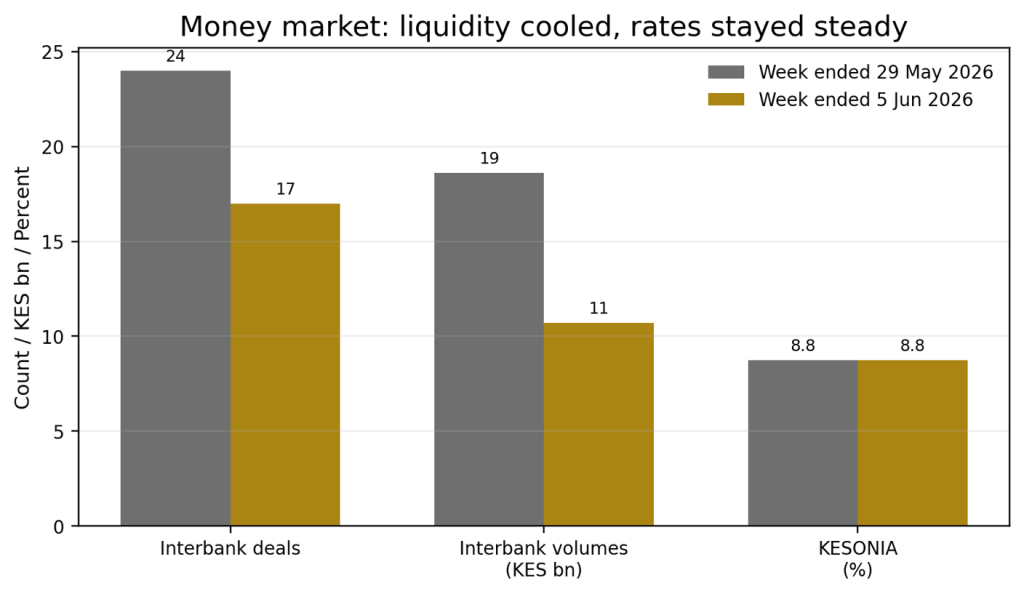
Figure 1: Interbank activity fell sharply, while KESONIA remained unchanged at 8.75%.
Treasury Bills: investors rushed to the 91-day paper
The Treasury Bill auction was fully covered, with investors submitting KES 54.58 billion in bids. The fiscal agent accepted KES 54.55 billion, giving the auction an almost complete subscription rate and a strong overall performance rate of 227.42%.
The standout instrument was the 91-day Treasury Bill. It received KES 32.83 billion in bids against only KES 4.00 billion on offer, giving it a performance rate of 820.68%. That kind of demand says something clear: in an uncertain environment, many investors prefer short-term paper. They want to earn a return, but they also want to avoid locking money for too long when inflation, interest rates and government borrowing needs are still shifting.
The accepted yields were tightly clustered: 8.56% for the 91-day, 8.53% for the 182-day and 8.76% for the 364-day. With inflation at 6.7%, SIB estimates real returns of 1.9%, 1.8% and 2.1% respectively. The returns are positive, but not wide enough to make investors relaxed about inflation.

Figure 2: The 91-day T-Bill was massively oversubscribed, signalling a strong preference for short-dated government paper.
Treasury Bonds: demand remained weak, and the government accepted almost everything
The bond market gave a very different signal from the T-Bill market. Ahead of the 2026/27 budget reading, the June Treasury Bond auction for FXD1/2020/015 and FXD1/2018/025 fell short of the KES 40 billion target. Total bids came in at KES 34.4 billion and the Treasury accepted almost the entire amount.
That 86% subscription rate shows that demand was weaker than the government wanted. The 99% acceptance rate also suggests the Treasury had to be flexible enough to take what the market offered. For readers, this matters because when the government needs money and investors are cautious, yields tend to face upward pressure. Higher government yields can eventually pull up borrowing costs across the economy.
The reopened 8.7-year bond had a weighted average accepted rate of 13.312%, while the 17.1-year bond cleared at 14.230%. These are not cheap borrowing levels. They show that investors are asking to be paid more for taking longer-term government risk in an inflation-sensitive environment.
| Bond | Tenor to maturity | Accepted amount | Accepted yield |
| FXD1/2020/015 | 8.7 years | KES 20.16bn | 13.312% |
| FXD1/2018/025 | 17.1 years | KES 14.22bn | 14.230% |
Source: Standard Investment Bank Fixed Income Weekly Report, 8 June 2026. Underlying data sources cited in the report include CBK, KNBS, Stanbic Bank and NSE.
Domestic debt maturities: June is lighter than May, but the pressure is not gone
Total domestic debt maturities in June 2026 stand at KES 189 billion, compared with KES 279 billion in May. That is a meaningful reduction, but it should not be mistaken for comfort. The maturity wall remains large, and August rises again because of heavier Treasury bond redemptions and coupon payments.
This matters because maturities have to be paid, refinanced, or rolled over. When the government rolls over large maturities while also borrowing for the budget, the domestic market can become crowded. That crowding effect can keep yields elevated and make credit more expensive for households and businesses.

Figure 3: Domestic maturities reduce in June but rise again in August, keeping refinancing pressure alive.
Inflation and PMI: the clearest warning in the report
The strongest economic warning in the report is the combination of rising inflation and falling private-sector activity. Kenya’s annual inflation rate rose to 6.7% in May 2026, up from 5.6% in April. That places inflation closer to the upper monetary policy target of 7.5%.
The pain is visible in everyday costs. SIB highlights public transport fares rising by 25%, diesel by 41.2%, petrol by 22.7%, tomatoes by 45.7%, cabbages by 37.8% and beef by 11%. These are not abstract numbers. They are the prices that define how much money remains in a household after transport, food and utilities are paid.
At the same time, the Stanbic Bank PMI dropped to 46.6 from 49.4. A PMI reading below 50 signals contraction. The report notes that services and construction were hit hardest, while manufacturing managed only minor growth. Weak demand, rising input costs and pressure on profit margins forced businesses to raise prices, reduce input purchases, stop stockpiling and freeze or cut jobs.

Figure 4: Inflation moved upward as PMI moved further below the 50-point neutral line.
MPC decision: the Central Bank is caught between inflation and growth
SIB notes that attention now turns to the Central Bank of Kenya’s Monetary Policy Committee meeting. The Central Bank Rate stands at 8.75%, a level maintained since February. The policy dilemma is clear: raising rates may help anchor inflation expectations, but it can also make loans more expensive for businesses and households at a time when the private sector is already weak.
The report expects the MPC to hold the policy rate steady at 8.75%. The argument is that Kenya still has projected GDP growth of 5.3% and foreign exchange reserves above five months of import cover. A hold would give policymakers time to observe whether earlier tightening is still working through the economy.
The shilling, reserves and oil: external buffers are holding, but risks remain
The Kenyan shilling strengthened against major global currencies during the week. The British pound and US dollar each weakened by 0.2% against the shilling, while the euro and Japanese yen weakened by 0.4% and 0.6% respectively. Regionally, however, the shilling softened slightly against the Tanzanian and Ugandan currencies.
Foreign exchange reserves remained stable at USD 13.22 billion, equal to 5.6 months of import cover. This is an important cushion because reserves help the country manage external shocks, pay for imports and reassure markets that the balance of payments position is not under immediate stress.
International oil prices eased slightly, with Murban crude falling from USD 88.48 per barrel on 28 May to USD 87.38 on 4 June. Still, SIB’s global commentary warns that geopolitical tension and energy-market uncertainty remain key risks for inflation.
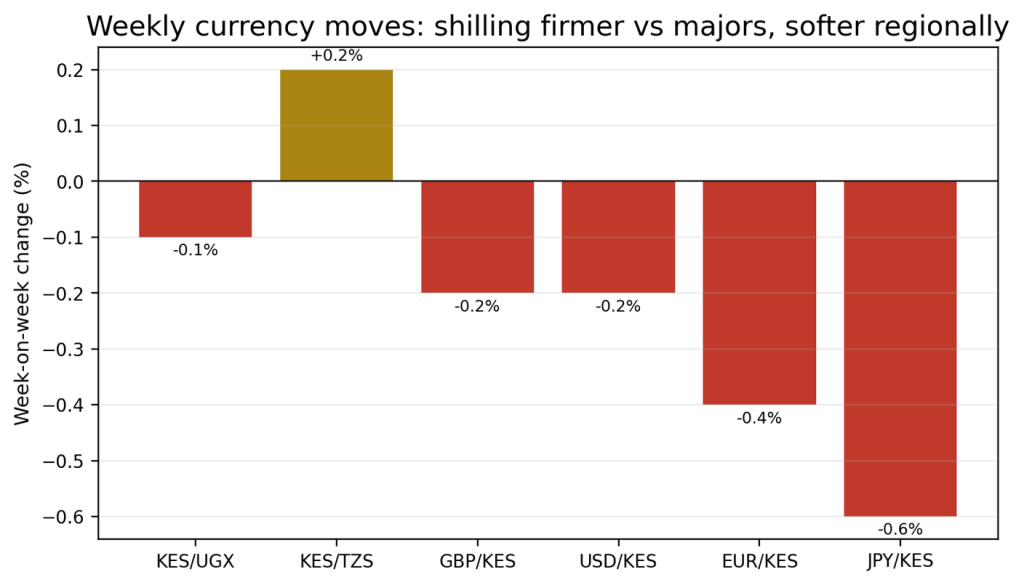
Figure 5: The shilling gained against major global currencies, but weakened modestly against regional units.
Eurobonds: volatility eased, but long-term borrowing remains expensive
Kenyan Eurobond yields declined by an average of about 6.11 basis points during the week, according to SIB, reflecting some easing in external market pressure. Even so, the yield curve remains upward-sloping: the 2028 Eurobond was around 7.0%, while the 2048 paper stood at about 9.0%.
For readers, Eurobond yields are a signal of how international investors price Kenya’s external debt risk. When yields are high, new foreign borrowing becomes more expensive. When yields fall, it suggests some improvement in investor appetite or global risk conditions, but not necessarily a permanent shift.
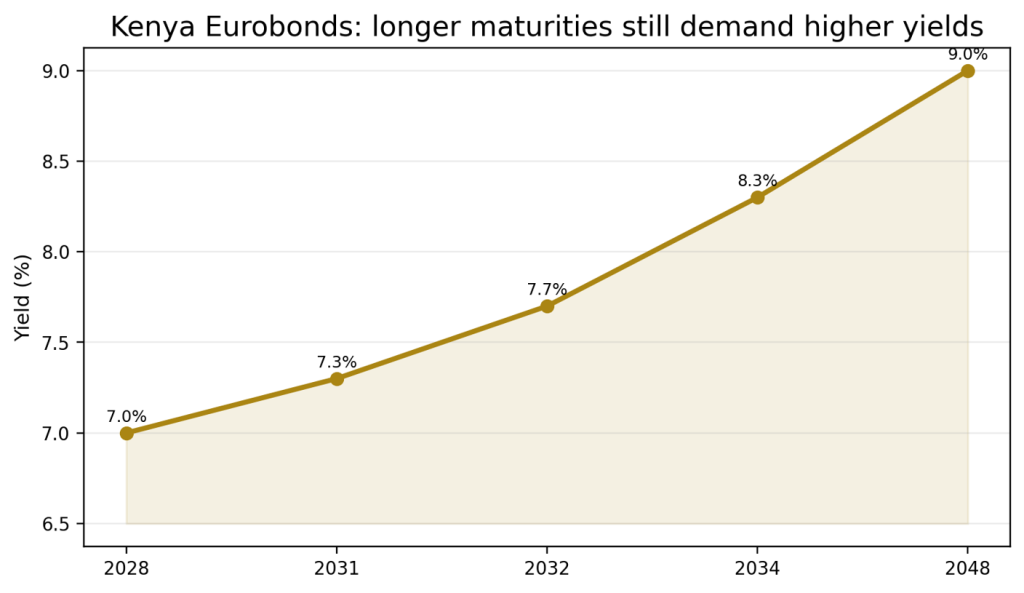
Figure 6: Longer-dated Eurobonds still carry higher yields, showing that investors demand more compensation for long-term risk.
Remittances and trade: diaspora support remains strong, but the trade gap is stubborn
Diaspora remittances remained a critical source of foreign exchange. SIB reports April 2026 remittances at USD 397.78 million. America was the dominant source region at USD 207.79 million, with the United States alone contributing USD 190.98 million. The United Kingdom followed at USD 32.96 million, ahead of Australia, the United Arab Emirates and Germany.
The trade picture remains more difficult. Kenya’s imports continue to outrun exports. The 2025 trade deficit stood at KES 1.654 trillion, wider than the KES 1.594 trillion deficit recorded in 2024. The structure of trade tells the story: petroleum products and industrial machinery dominate imports, while tea, cut flowers, vegetables and fruits remain major export earners.
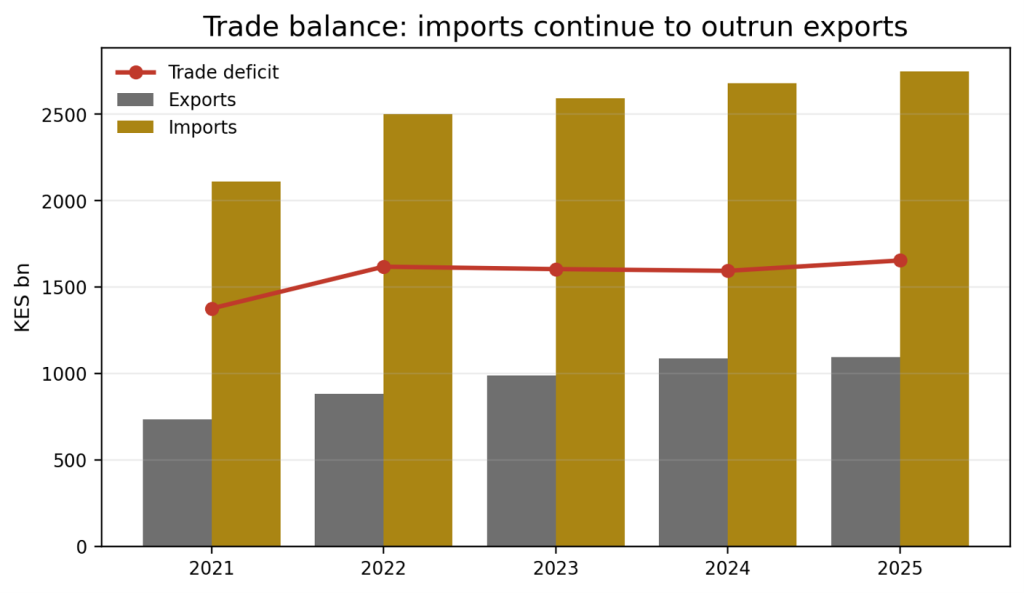
Figure 7: Kenya’s trade deficit remains large because imports continue to exceed exports by a wide margin.
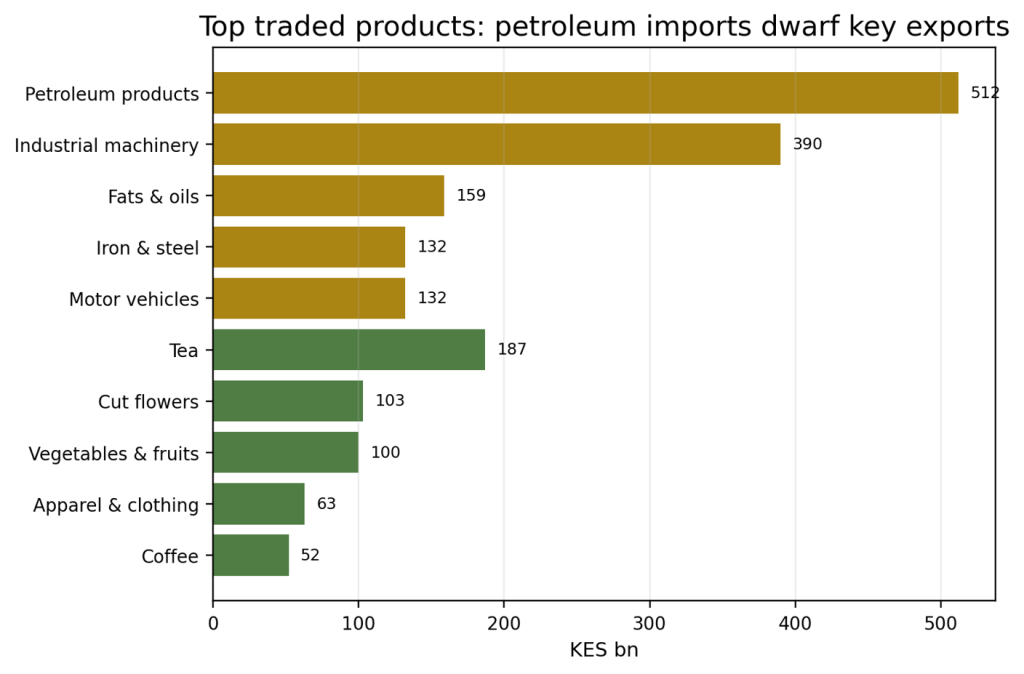
Figure 8: Petroleum and machinery dominate imports, while tea remains the largest listed export product in the report.
What this means for households, businesses and investors
For households, the report confirms what many people already feel: the cost of living is rising faster than comfort allows. Food, fuel and transport are the pressure points. When these categories rise together, they reduce disposable income and weaken demand for non-essential goods and services.
For businesses, the report is a warning that weak demand and high input costs are squeezing margins from both sides. A company can raise prices to survive, but when customers are already stretched, higher prices can reduce sales volumes. That is why the PMI reading below 50 matters. It shows the economy is not only experiencing high prices; it is also experiencing weaker business activity.
For investors, the signal is mixed. Short-term Treasury Bills remain attractive because they offer positive real returns and flexibility. Longer-term bonds offer higher yields, but they also come with duration risk, inflation risk and uncertainty over future government borrowing. Investors are therefore demanding more compensation before locking money for longer periods.
Read Also: Money Market Funds: The Silent Wealth Engine Kenyans Are Ignoring

- January 2026 (220)
- February 2026 (248)
- March 2026 (287)
- April 2026 (207)
- May 2026 (192)
- June 2026 (238)
- July 2026 (279)
- August 2026 (223)
- September 2026 (125)
- January 2025 (119)
- February 2025 (191)
- March 2025 (212)
- April 2025 (193)
- May 2025 (161)
- June 2025 (157)
- July 2025 (227)
- August 2025 (211)
- September 2025 (267)
- October 2025 (297)
- November 2025 (230)
- December 2025 (220)
- January 2024 (238)
- February 2024 (227)
- March 2024 (190)
- April 2024 (133)
- May 2024 (157)
- June 2024 (145)
- July 2024 (136)
- August 2024 (154)
- September 2024 (212)
- October 2024 (255)
- November 2024 (196)
- December 2024 (143)
- January 2023 (182)
- February 2023 (203)
- March 2023 (322)
- April 2023 (297)
- May 2023 (267)
- June 2023 (214)
- July 2023 (212)
- August 2023 (257)
- September 2023 (237)
- October 2023 (264)
- November 2023 (286)
- December 2023 (177)
- January 2022 (293)
- February 2022 (329)
- March 2022 (358)
- April 2022 (292)
- May 2022 (271)
- June 2022 (232)
- July 2022 (278)
- August 2022 (253)
- September 2022 (246)
- October 2022 (196)
- November 2022 (232)
- December 2022 (167)
- January 2021 (182)
- February 2021 (227)
- March 2021 (325)
- April 2021 (259)
- May 2021 (285)
- June 2021 (272)
- July 2021 (277)
- August 2021 (232)
- September 2021 (271)
- October 2021 (303)
- November 2021 (364)
- December 2021 (249)
- January 2020 (272)
- February 2020 (310)
- March 2020 (390)
- April 2020 (321)
- May 2020 (335)
- June 2020 (327)
- July 2020 (333)
- August 2020 (276)
- September 2020 (214)
- October 2020 (233)
- November 2020 (242)
- December 2020 (187)
- January 2019 (251)
- February 2019 (215)
- March 2019 (283)
- April 2019 (254)
- May 2019 (269)
- June 2019 (249)
- July 2019 (335)
- August 2019 (292)
- September 2019 (306)
- October 2019 (313)
- November 2019 (362)
- December 2019 (318)
- January 2018 (291)
- February 2018 (213)
- March 2018 (275)
- April 2018 (223)
- May 2018 (235)
- June 2018 (176)
- July 2018 (256)
- August 2018 (247)
- September 2018 (255)
- October 2018 (282)
- November 2018 (282)
- December 2018 (184)
- January 2017 (183)
- February 2017 (194)
- March 2017 (207)
- April 2017 (104)
- May 2017 (169)
- June 2017 (205)
- July 2017 (189)
- August 2017 (195)
- September 2017 (186)
- October 2017 (235)
- November 2017 (253)
- December 2017 (266)
- January 2016 (164)
- February 2016 (165)
- March 2016 (189)
- April 2016 (143)
- May 2016 (245)
- June 2016 (182)
- July 2016 (271)
- August 2016 (247)
- September 2016 (233)
- October 2016 (191)
- November 2016 (243)
- December 2016 (153)
- January 2015 (1)
- February 2015 (4)
- March 2015 (164)
- April 2015 (107)
- May 2015 (116)
- June 2015 (119)
- July 2015 (145)
- August 2015 (157)
- September 2015 (186)
- October 2015 (169)
- November 2015 (173)
- December 2015 (205)
- March 2014 (2)
- March 2013 (10)
- June 2013 (1)
- March 2012 (7)
- April 2012 (15)
- May 2012 (1)
- July 2012 (1)
- August 2012 (4)
- October 2012 (2)
- November 2012 (2)
- December 2012 (1)