Why Financial Literacy Is The Life Skill Every Kenyan Needs And Why Abojani Is A Practical Place To Begin

There is a quiet crisis in many homes, workplaces and businesses today. People are working, hustling, selling, borrowing, saving in small amounts, supporting families and trying to build a better life. Yet at the end of the month, many still ask the same painful question: where did the money go? That question is not a sign of laziness. It is often a sign that income has arrived without a system.
Financial literacy is the system. It is the ability to understand money in practical terms: how to earn it, budget it, save it, invest it, borrow it wisely, protect it, grow it and use it to support real life goals. It is not about sounding sophisticated. It is not about speaking difficult finance language. It is about making better decisions with the money already passing through your hands.
That is why financial literacy is no longer optional. In the modern economy, the financially literate person has an advantage. They understand that every shilling has a job. They know that debt can either build or destroy. They know that saving is not punishment, investing is not gambling, and planning is not something reserved for the rich. They know that financial confidence is built through repeated, informed decisions.

The tragedy is that many people are introduced to money only after they have already made expensive mistakes. They learn about interest after a loan has become a burden. They learn about budgeting after salaries have disappeared. They learn about investment after being misled by a scheme. They learn about emergency funds after a crisis has forced them into debt. Financial literacy helps people learn before mistakes become too costly.
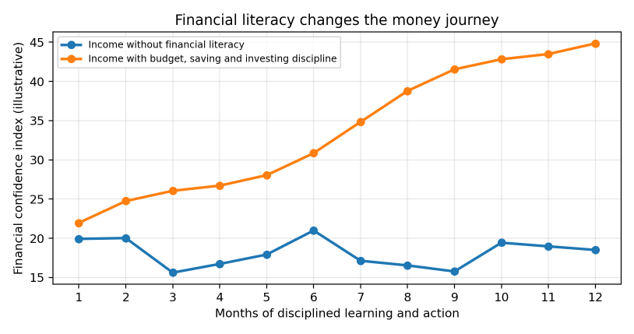
Illustrative chart: With financial literacy, discipline compounds. Without it, income can move in circles without creating progress.
The problem is not only income. It is direction.
Many people believe the only problem is that they do not earn enough. Sometimes that is true. Kenya has millions of hardworking people whose incomes are squeezed by the cost of living, school fees, rent, transport, food, medical bills and family responsibilities. But income alone cannot solve everything when money has no direction. A salary can grow and still disappear. A business can make sales and still remain broke. A household can receive money every week and still live under constant pressure.
Financial literacy teaches direction. It shows a person how to separate needs from wants, urgent costs from important goals, and productive debt from destructive debt. It teaches the discipline of writing down income, tracking expenses, building a reserve, planning purchases, and investing consistently instead of waiting for a perfect moment that may never come.
When people become financially literate, they stop treating money like an accident. They start treating it like a tool. That small shift changes everything. A tool can build a home. A tool can grow a business. A tool can educate children. A tool can create peace. But only when the person holding it knows what to do with it.
Why financial literacy must be practical, not theoretical
The best financial education is simple enough to use immediately. A person should leave a lesson knowing what to do with their next salary, their next business sale, their next loan offer, their next investment opportunity and their next emergency. That is why practical financial literacy matters more than complicated lectures.
A practical learner asks clear questions. How much do I earn? How much do I spend? What must I cut? What debt is draining me? What should I save first? Which investment matches my goal? How do I avoid fake opportunities? What is my plan for the next 12 months? What is my long-term wealth strategy? These are not academic questions. These are life questions.
This is also where a structured learning platform becomes valuable. Many people want to improve but do not know where to begin. They need someone to break down budgeting, debt management, emergency funds, taxes, money market funds, SACCOs, Treasury Bills, Treasury Bonds, stocks, business analysis and long-term planning in language they can understand and apply.
Why Abojani fits this moment
Abojani has positioned itself around personal finance and investment education, helping learners connect money decisions to life goals. Its public materials present learning on budgeting, debt management, investing, taxation, unit trusts, stocks, company analysis, government securities, SACCOs, and personal financial planning. That matters because these are the exact areas where many ordinary people need clarity.
The value of Abojani is not just that it speaks about money. It is that it tries to simplify money. The ordinary person does not need more fear around finance. They need calm explanation. They need examples. They need structure. They need confidence. They need to know that one can begin from where they are, not from where they wish they were.
According to information on Abojani’s official website, the platform reports more than 20,000 masterclass graduates, more than 2,000 1MilliChallenge participants, and more than 800 people guided in creating personalised financial plans worth over KSh 2 billion. Its website also describes its masterclass as covering budgeting, debt management, taxation, unit trusts, stock market investing, business analysis, financial analysis, valuation, Treasury Bills and Bonds, and SACCO savings.

Selected public milestones from Abojani’s official website, presented to show scale of learning community and reported impact.
The five money habits every Kenyan should build
First, every person needs a budget. A budget is not a punishment; it is a map. It tells your money where to go before pressure decides for you. Without a budget, money follows noise. With a budget, money follows priorities.
Second, every person needs an emergency fund. Life will always bring surprises: sickness, job loss, school needs, business shocks, transport problems and family emergencies. An emergency fund is not idle money. It is peace stored in advance.
Third, every person must understand debt. Debt is not automatically evil, but careless debt is dangerous. Borrowing to consume, impress or survive repeatedly can become a trap. Borrowing to build, expand productive capacity or solve a short-term timing gap can be useful when it is planned and affordable.
Fourth, every person needs to learn investing. Saving protects money; investing grows it. But investing without knowledge can become speculation. Financial literacy helps people understand risk, time, returns, diversification and the difference between real opportunities and sweet stories.
Fifth, every person needs a long-term plan. Money should be connected to goals: education, home ownership, business growth, retirement, family security, health, asset building and freedom from constant financial anxiety. A plan gives money a destination.
Why financial literacy strengthens families and businesses
A financially literate household is calmer because decisions are clearer. Couples can talk about money with less blame and more structure. Parents can teach children early. Young people can avoid lifestyle traps. Families can plan school fees, medical needs and investments with more discipline.
A financially literate entrepreneur is also stronger. Many businesses collapse not because the idea was bad, but because cash flow was poorly managed. Sales are confused with profit. Loans are taken without repayment plans. Stock is bought without records. Taxes arrive as a shock. Personal expenses eat business capital. Financial literacy helps business owners separate business money from personal money, read their numbers, price better, manage cash flow and make decisions based on facts.
For Kenya, this is bigger than individuals. A financially literate population saves better, invests better, borrows more responsibly, builds stronger SMEs, demands better financial products and makes better public policy choices. When people understand money, they are harder to manipulate with empty promises. They begin to ask better questions about taxes, debt, budgets, jobs, business credit and the cost of bad governance.
The practical call: learn before life forces you to learn painfully
The best time to become financially literate is before a crisis. Before the loan becomes unbearable. Before the business runs out of cash. Before a fake investment wipes out savings. Before retirement arrives with regret. Before school fees panic becomes a yearly emergency. Learning early is cheaper than repairing avoidable damage later.
That is why signing up with Abojani is a practical step for anyone serious about improving their relationship with money. Do not wait until you have millions to learn how to manage money. Learn now so that when more money comes, it finds a prepared mind, a disciplined system and a clear plan.
Financial literacy does not promise instant riches. It offers something better: control, clarity, confidence and direction. It helps people stop guessing and start planning. It turns money from a source of fear into a tool for building.

Illustrative path: financial confidence grows when budgeting, saving, debt control and investing are learned together.
A simple starter plan for anyone signing up
| Step | What to do | Why it matters |
| 1 | List all income and all expenses for the last 30 days. | You cannot fix what you have not measured. |
| 2 | Identify the top three money leaks. | Small leaks become big losses when repeated every month. |
| 3 | Write down every loan, interest cost and repayment date. | Debt becomes less frightening when it is visible and planned. |
| 4 | Start or rebuild an emergency fund, even with small amounts. | A reserve reduces panic borrowing when life happens. |
| 5 | Learn one investment option at a time before committing money. | Knowledge reduces avoidable risk and emotional decisions. |
| 6 | Connect money decisions to life goals. | Goals turn discipline into purpose. |
The message is simple: we must stop treating financial literacy as something for bankers, accountants and wealthy people. It is for the mama mboga, the boda rider, the young professional, the farmer, the teacher, the student, the SME owner, the parent, the creative, the pastor, the employee, the investor and the dreamer. Everyone who touches money needs to understand money.
Kenya does not only need more income. Kenya needs more financially literate citizens. People who can budget without shame, save with discipline, borrow with wisdom, invest with patience and build with a long-term view. That is how households become stable. That is how businesses survive. That is how communities build wealth. That is how a country changes from financial pressure to financial power.
Abojani gives people a practical place to start. Sign up, learn, ask questions, build your plan and begin again with knowledge. The future will not reward those who merely earn money. It will reward those who understand money, respect it, direct it and make it work.
About Steve Biko Wafula
Steve Biko is the CEO OF Soko Directory and the founder of Hidalgo Group of Companies. Steve is currently developing his career in law, finance, entrepreneurship and digital consultancy; and has been implementing consultancy assignments for client organizations comprising of trainings besides capacity building in entrepreneurial matters.He can be reached on: +254 20 510 1124 or Email: info@sokodirectory.com
- January 2026 (220)
- February 2026 (248)
- March 2026 (287)
- April 2026 (208)
- May 2026 (191)
- June 2026 (88)
- January 2025 (119)
- February 2025 (191)
- March 2025 (212)
- April 2025 (193)
- May 2025 (161)
- June 2025 (157)
- July 2025 (227)
- August 2025 (211)
- September 2025 (270)
- October 2025 (297)
- November 2025 (230)
- December 2025 (220)
- January 2024 (238)
- February 2024 (227)
- March 2024 (190)
- April 2024 (133)
- May 2024 (157)
- June 2024 (145)
- July 2024 (136)
- August 2024 (154)
- September 2024 (212)
- October 2024 (255)
- November 2024 (196)
- December 2024 (143)
- January 2023 (182)
- February 2023 (203)
- March 2023 (322)
- April 2023 (297)
- May 2023 (267)
- June 2023 (214)
- July 2023 (212)
- August 2023 (257)
- September 2023 (237)
- October 2023 (264)
- November 2023 (286)
- December 2023 (177)
- January 2022 (293)
- February 2022 (329)
- March 2022 (358)
- April 2022 (292)
- May 2022 (271)
- June 2022 (232)
- July 2022 (278)
- August 2022 (253)
- September 2022 (246)
- October 2022 (196)
- November 2022 (232)
- December 2022 (167)
- January 2021 (182)
- February 2021 (227)
- March 2021 (325)
- April 2021 (259)
- May 2021 (285)
- June 2021 (272)
- July 2021 (277)
- August 2021 (232)
- September 2021 (271)
- October 2021 (304)
- November 2021 (364)
- December 2021 (249)
- January 2020 (272)
- February 2020 (310)
- March 2020 (390)
- April 2020 (321)
- May 2020 (335)
- June 2020 (327)
- July 2020 (333)
- August 2020 (276)
- September 2020 (214)
- October 2020 (233)
- November 2020 (242)
- December 2020 (187)
- January 2019 (251)
- February 2019 (215)
- March 2019 (283)
- April 2019 (254)
- May 2019 (269)
- June 2019 (249)
- July 2019 (335)
- August 2019 (292)
- September 2019 (306)
- October 2019 (313)
- November 2019 (362)
- December 2019 (318)
- January 2018 (291)
- February 2018 (213)
- March 2018 (275)
- April 2018 (223)
- May 2018 (235)
- June 2018 (176)
- July 2018 (256)
- August 2018 (247)
- September 2018 (255)
- October 2018 (282)
- November 2018 (282)
- December 2018 (184)
- January 2017 (183)
- February 2017 (194)
- March 2017 (207)
- April 2017 (104)
- May 2017 (169)
- June 2017 (205)
- July 2017 (189)
- August 2017 (195)
- September 2017 (186)
- October 2017 (235)
- November 2017 (253)
- December 2017 (266)
- January 2016 (164)
- February 2016 (165)
- March 2016 (189)
- April 2016 (143)
- May 2016 (245)
- June 2016 (182)
- July 2016 (271)
- August 2016 (247)
- September 2016 (233)
- October 2016 (191)
- November 2016 (243)
- December 2016 (153)
- January 2015 (1)
- February 2015 (4)
- March 2015 (164)
- April 2015 (107)
- May 2015 (116)
- June 2015 (119)
- July 2015 (145)
- August 2015 (157)
- September 2015 (186)
- October 2015 (169)
- November 2015 (173)
- December 2015 (205)
- March 2014 (2)
- March 2013 (10)
- June 2013 (1)
- March 2012 (7)
- April 2012 (15)
- May 2012 (1)
- July 2012 (1)
- August 2012 (4)
- October 2012 (2)
- November 2012 (2)
- December 2012 (1)
