Skip to content
Entrepreneur's Corner

Why NCBA’s Visible Auctions Are Evidence of Scale and Transparency—Not a Broken Credit Model

BY Steve Biko Wafula · June 25, 2026 09:06 am

A repossessed vehicle is never just metal in an auction yard. It may represent a transport business that lost a contract, a contractor who completed public work but was not paid, a family whose income collapsed, or an entrepreneur whose most ambitious investment met a harsher economy than the one described in the original business plan. The pain is real. The public anger that follows is understandable. What is not analytically sound is to turn that pain into a verdict against an entire bank without first examining the size of the lender’s portfolio, the quality of its loan book, the recovery process, and the economic conditions surrounding the borrower.

That distinction matters especially in the case of NCBA. The bank has built a public philosophy around what it calls “Banking on Belief”: the idea that a customer should not be judged only by the limitations of the present, but also by the ambition, enterprise and future potential that the customer carries. In practical banking terms, this is not charity and it is not blind optimism. It is a forward-looking credit posture that considers whether a business idea, an income-generating asset or an expansion plan can become viable when capital is placed behind it—while still applying normal underwriting, security, affordability and risk controls.

The philosophy is powerful because many Kenyan businesses would never grow if banks financed only what already existed. A truck, bus, delivery van, construction machine or manufacturing asset is often purchased before the future income it is expected to generate has fully materialised. Credit therefore converts a forecast into productive capacity. NCBA takes a view on that future and, where the case meets its lending standards, finances the belief into an asset that can work, employ people and generate cash.

You cannot celebrate a bank for financing ambition and then treat every ambition that encounters an economic shock as proof that the lender should never have believed.

The paradox is that the very willingness to back future potential can later be framed as a flaw when the expected cash flow fails to arrive. A borrower may have had a credible plan when the facility was approved. The bank may have financed a real asset for a real business. Yet taxes can rise, fuel and repair costs can accelerate, customers can delay payment, political uncertainty can freeze demand, or government pending bills can trap working capital for months. A loan that was reasonable at approval can become unaffordable after the operating environment changes.

Scale Creates Visibility—And Visibility Is Being Misread

The first rule of serious credit analysis is to look beyond the numerator. Thirty or fifty repossessed vehicles may appear alarming in isolation. But the figure is meaningless until it is compared with the total number and value of assets financed. A lender with a much larger portfolio can record more recoveries in absolute terms and still have a lower default ratio than a smaller competitor.

NCBA reported a 30 per cent share of Kenya’s asset-finance market in FY2025 and says it has maintained at least 30 per cent since 2020. Its disclosed share moved between 30 and 36 per cent over the six years to 2025. In plain language, about one in every three shillings deployed in Kenya’s asset-finance market is connected to NCBA. Its name will therefore appear frequently at the point of purchase, on financed logbooks, in dealership partnerships, across fleet transactions—and, inevitably, in the small proportion of cases that end in enforcement.
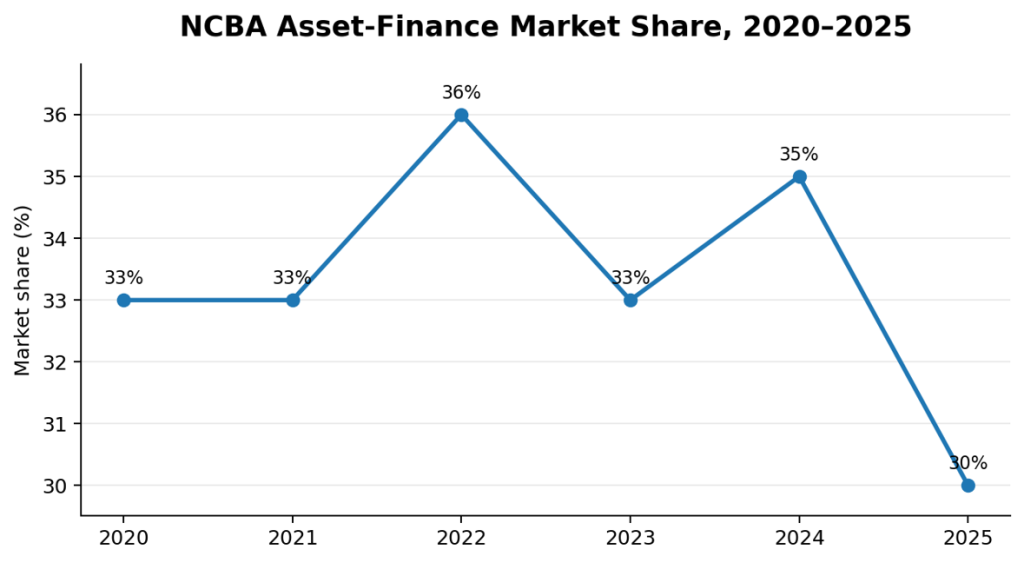
Figure 1: NCBA has remained Kenya’s asset-finance market leader, 2020–2025.
Source: NCBA Group FY2025 Investor Deck, March 2026. Chart: Soko Directory Research Team.

The value of the book makes the scale effect even clearer. NCBA’s asset-finance gross lending increased from KES 36 billion in 2020 to KES 52 billion in 2025, a rise of about 44 per cent in five years. That expansion represents more vehicles, machinery and equipment placed into productive use. It also means that when a fraction of borrowers fail, the absolute number of visible assets will be larger than at institutions that financed fewer assets in the first place.
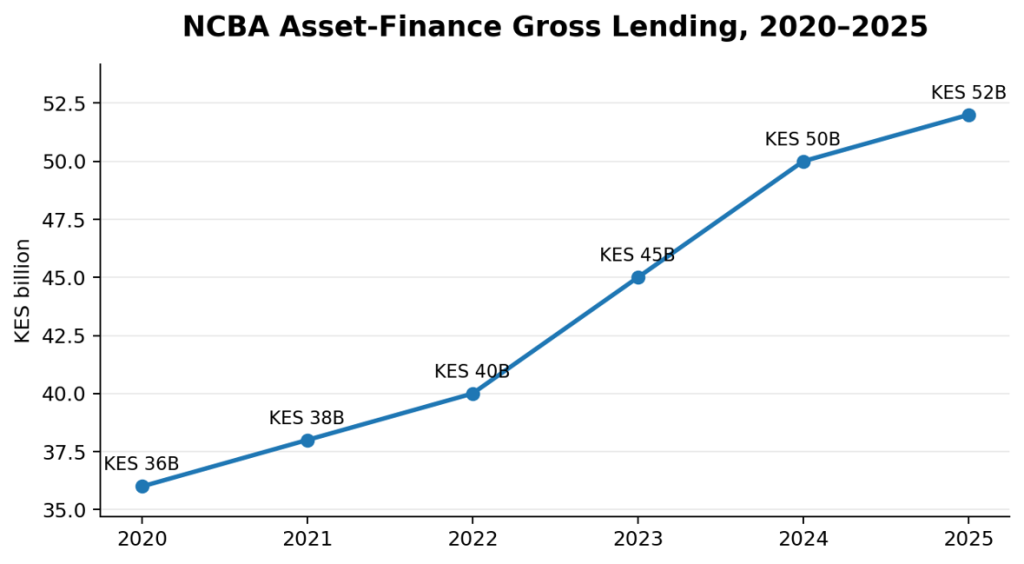
Figure 2: NCBA asset-finance gross lending expanded from KES 36 billion to KES 52 billion.
Source: NCBA Group FY2025 Investor Deck, March 2026. Chart: Soko Directory Research Team.

This is the denominator problem that public debate often ignores. Auction notices count recovery events; they do not reveal the percentage of the entire financed portfolio that failed. They do not show how many customers completed repayment, how many loans were restructured successfully, how many assets are still producing income, or how many borrowers were supported through temporary distress. To use auction frequency as a bank rating is to replace portfolio analysis with a visual impression.

The Transparency Paradox: Why Openness Is Being Punished

NCBA’s repossessed assets are not hidden in a private back room. Auction notices are published, assets are identifiable and reserve prices are often disclosed. That visibility allows borrowers, buyers, journalists, regulators and the public to see that a recovery process is taking place. It also exposes the bank to criticism because the evidence is easy to find, photograph and circulate.

The absence of similarly visible notices elsewhere does not prove the absence of distressed assets. Across the market, some recoveries and disposals may occur through less public internal channels, negotiated sales or private arrangements. A quieter process can create the impression that another lender has fewer problems even when the difference is partly one of disclosure. The market should be careful not to reward opacity and punish the institution whose process is easier to observe.

Internal oversight over recoveries and asset disposal is also not an unusual NCBA invention. Regulated banks are expected to operate through credit committees, valuation controls, audit trails, approval thresholds, external agents, legal documentation and reconciliation procedures. These controls exist because repossessed assets can be vulnerable to undervaluation, insider dealing, conflicts of interest and abuse. The proper question is whether those controls worked in a specific case—not whether the existence of internal oversight is itself suspicious.

Transparency should create a higher standard of accountability. It should not be converted into evidence of guilt merely because the public can see the process.

None of these places NCBA beyond scrutiny. A customer who alleges an inaccurate balance, a flawed valuation, an unlawful recovery, an abusive agent or an unfair disposal deserves a documented answer and an evidence-based investigation. Public disclosure is valuable precisely because it makes such scrutiny possible. But allegations must remain case-specific. The existence of visible auctions cannot honestly be stretched into a blanket conclusion that the bank’s entire credit model is defective.

The Correct Test Is Asset Quality, Not Auction Frequency

A repossession is an individual recovery event. A non-performing-loan ratio measures the proportion of a lender’s loan book that has stopped performing. That is the more relevant test of whether a bank is unusually reckless or overwhelmed by bad credit. On this measure, the available data do not support the claim that NCBA is uniquely troubled.

NCBA Group’s NPL ratio declined from 15.6 per cent in 2021 to 10.2 per cent in 2025. The FY2025 investor presentation placed the 10.2 per cent figure below the 15.5 per cent Kenya industry average cited in the same document. The direction is important: while auction notices remained publicly visible, the Group’s overall bad-loan ratio was falling.

Figure 3: NCBA Group’s NPL ratio declined steadily between 2021 and 2025.
Source: NCBA Group FY2025 Investor Deck, March 2026. Chart: Soko Directory Research Team.The 

Central Bank of Kenya bank-level data point in the same direction. At December 2024, NCBA Bank Kenya had approximately KES 289.96 billion in gross loans and KES 35.51 billion in gross non-performing loans, producing an author-calculated ratio of about 12.2 per cent. The banking-sector ratio was 17.1 per cent. Some large banks performed better and others worse, but NCBA was below the system average.

This evidence does not mean every NCBA customer has received perfect treatment. A portfolio ratio cannot settle an individual dispute. It does, however, establish an essential analytical boundary: visible auctions are not proof that the bank’s overall asset quality is worse than the market. In fact, the disclosed ratios indicate the opposite.

Read Also: NCBA Strengthens Lease Financing Partnership With 24-Vehicle Handover To Rubis Energy Kenya

An auction poster is evidence that one credit path failed. It is not an audited rating of the entire bank.

The Bigger Story Is Kenya’s Cash-Flow Crisis

The deeper issue is not confined to NCBA. Kenya’s gross non-performing loans rose from KES 336.6 billion in 2019 to KES 697.3 billion in December 2024. They reached KES 728.5 billion in June 2025 before easing to KES 674.4 billion in December 2025 after repayments and write-offs. The sector NPL ratio was still 15.6 per cent in March 2026. This is system-wide stress moving through households, small businesses, transport operators, property developers, manufacturers and government suppliers.

Figure 4: Kenya’s banking-sector NPL ratio rose sharply after 2022 and remains elevated.
Source: CBK Bank Supervision reports, Monetary Policy Statements and March 2026 Credit Officer Survey. Chart: Soko Directory Research Team.

Kenya can record positive GDP growth while many borrowers experience a liquidity recession. Output may rise in the national accounts, yet cash may not arrive in the borrower’s account on the day an instalment falls due. A contractor can complete a project but wait months for payment. A matatu or truck can generate revenue while fuel, tyres, insurance, maintenance and repairs consume the margin. A retailer can sell more units while earning less on each one. A salaried family can remain employed while taxes, deductions, school fees, food and rent leave less disposable income for debt service.

By March 2026, the National Treasury reported KES 471.7 billion in national-government pending bills. An unpaid public invoice rarely remains isolated. It becomes an unpaid supplier, a delayed salary, a postponed tax obligation, a missed insurance premium and eventually an unpaid bank instalment. The bank sees the final arrears, but the failure often began months earlier in a payment chain outside the lender’s control.

CBK surveys of bank executives during 2025 repeatedly identified the high cost of doing business, increased taxation, reduced consumer demand, political uncertainty and pending bills as constraints on firms. These factors do not excuse every default, but they explain why a viable enterprise can slip from one missed payment into arrears, penalties, asset deterioration and eventual enforcement.

Credit Is Becoming Cheaper—But It Is Not Yet Cheap

Average commercial-bank lending rates eased from 15.17 per cent in August 2025 to 14.69 per cent in April 2026. The decline is welcome, but a borrowing cost close to 15 per cent remains heavy for a business with volatile revenue and narrow margins. When an income-generating asset earns less than the combined cost of fuel, maintenance, insurance, taxes and loan repayment, the asset can be busy and still fail financially.

Figure 5: Lending rates eased, but borrowing remained costly through April 2026.
Source: Central Bank of Kenya, Commercial Banks Weighted Average Rates. Chart: Soko Directory Research Team.

This is why “Banking on Belief” must never be misunderstood as a promise that every financed dream will succeed. Credit is a disciplined wager on future cash flow. The bank believes, the borrower executes, and the economy provides—or denies—the environment in which the plan must work. When any of those three elements fails, the loan comes under pressure.

Repossession Is Usually the End of a Failed Journey, Not the Beginning

A bank ordinarily earns more from a performing loan, or a successfully restructured one, than from repossessing a depreciating vehicle. Recovery requires agents, storage, security, valuation, legal work, notices, auction costs and administrative time. The asset may sell below the outstanding balance, leaving the borrower without the vehicle and still owing a residual debt. The bank loses a customer relationship and may crystallise a financial loss.

Commercial logic therefore favours a credible cure where one exists. But a regulated bank cannot carry a non-performing secured facility indefinitely. It holds depositors’ money, must comply with capital and provisioning rules, owes duties to shareholders, and has a responsibility to the stability of the financial system. When restructuring cannot restore affordability, enforcement becomes a prudential obligation rather than an act of punishment.

The decisive window is often the period before the loan collapses completely. A borrower who approaches the lender early, provides honest statements, explains the shock, presents a realistic cash-flow forecast and proposes a payment that can actually be maintained creates room for discussion. Depending on the facts and the bank’s approval, possible remedies may include extending the tenor, rescheduling arrears, changing payment dates, refinancing, a short moratorium, partial settlement or a controlled voluntary sale. None is automatic, but silence usually destroys options.

What NCBA Must Continue to Prove

A strong slogan is not enough. “Banking on Belief” must remain visible in accessible restructuring channels, timely decisions, respectful recovery conduct and transparent account reconciliation. Borrowers should receive clear statements, notices, valuation information and an explanation of the balance after an asset is sold. Recovery agents should operate lawfully and with dignity. Where a viable customer can be restored without creating a larger loss, restructuring should be pursued seriously.

NCBA’s FY2025 financial statements state that external agents may be used, in the ordinary course of business, to recover value from repossessed assets, generally through auction, and that any surplus is returned to the customer or obligor. That disclosure confirms that the process sits within a regulated collateral-realisation framework. It does not prove that every individual case is perfect, which is why auditability, complaint resolution and case-level evidence remain essential.

The Responsibility Is Shared

BorrowersBanksGovernment
Use conservative cash-flow assumptions; maintain repayment and maintenance reserves; insure the asset; keep proper records; engage the lender before arrears become unmanageable.Assess future potential without abandoning affordability; restructure viable cases; document decisions; ensure lawful and respectful recoveries; disclose valuations, sale proceeds and residual balances clearly.Clear verified pending bills; stop creating new arrears; reduce tax and regulatory unpredictability; protect political stability; and improve the transmission of lower policy rates into affordable commercial credit.


The public and the media also have a responsibility: compare like with like. Ask for the denominator. Separate market share from default rate. Distinguish a recovery notice from a bank-wide asset-quality measure. Investigate individual misconduct where evidence exists, but do not convert the visibility of a regulated process into a general accusation.

NCBA Is a Mirror of the Economy, Not Its Villain

NCBA appears frequently in asset-finance auction notices because it finances more assets than its competitors and because its recovery process is publicly visible. Scale creates visibility in success and in failure. When transporters, farmers, contractors, traders and salaried households are thriving, the bank’s financed assets remain productive and loans perform. When income weakens, public payments are delayed and operating costs rise, those same assets become one of the first places where economic distress can be seen.

The data demand a disciplined conclusion. NCBA held a 30 per cent asset-finance market share and KES 52 billion in gross asset-finance lending in FY2025. Its Group NPL ratio fell to 10.2 per cent, below the 15.5 per cent Kenya industry figure cited in its presentation. CBK’s December 2024 data also placed NCBA Bank Kenya below the sector’s gross NPL ratio. Meanwhile, system-wide bad loans remained elevated, lending rates were still close to 15 per cent, pending bills blocked hundreds of billions of shillings, and businesses continued to report pressure from taxation, weak demand, high costs and political uncertainty.

A repossessed car is painful, but it is not proof that an entire bank has failed its customers. It is proof that one credit arrangement could not be restored before enforcement. The right response is not to demonise the institution financing the largest share of productive assets. It is to make restructuring faster, recoveries more transparent, borrowing more responsible and economic policy less hostile to cash flow.

Kenya should read the auction yard correctly: it is not merely where vehicles are sold. It is where the country’s liquidity failures become impossible to hide.

“Banking on Belief” is therefore not NCBA’s weakness. It is the reason many ambitions acquire wheels, machinery, and productive capacity in the first place. The philosophy should be judged by whether the bank continues to combine belief with disciplined underwriting, early restructuring, transparent recovery, and respect for customers. When it does so, openness should be recognised as governance, not mistaken for guilt.

Read Also: Mwalimu Sacco, NCBA Launch Salo Xpress to Streamline Payroll Processing

Steve Biko is the CEO OF Soko Directory and the founder of Hidalgo Group of Companies. Steve is currently developing his career in law, finance, entrepreneurship and digital consultancy; and has been implementing consultancy assignments for client organizations comprising of trainings besides capacity building in entrepreneurial matters.He can be reached on: +254 20 510 1124 or Email: info@sokodirectory.com

Trending Stories
Related Articles
Explore Soko Directory
Soko Directory Archives