
Why Tax Securitisation Must Be Stopped Before It Becomes The Next Debt Trap

The numbers Kenyans must not ignore
| Item | Number | Why it matters |
| Road Maintenance Levy-backed financing | KSh 175 billion | Reported financing raised or targeted using part of the fuel/road levy stream. |
| Road levy stream reportedly committed | KSh 7 out of every KSh 25 | About 28% of the levy stream is tied to investors before future budgets are written. |
| Reported total tax-backed financing | At least KSh 335 billion | Reported across fuel levy, sports levy, import duties and airport passenger charges. |
| FY2025/26 fiscal deficit | KSh 940 billion | Tax-backed financing equal to KSh335bn would be about 35.6% of this gap. |
| Public debt, June 2025 | KSh 11.814 trillion | Treasury data shows debt at 67.8% of GDP, before any hidden liabilities are debated. |
| Domestic maturities, June 2026 | KSh 189 billion | SIB data shows the cash pressure Treasury already faces in the domestic market. |
A government that securitises taxes is not simply borrowing money. It is doing something more dangerous: it is pledging tomorrow’s public revenue to solve today’s cash crisis. It is taking taxes that future citizens have not yet paid, assigning them to financiers today, and then pretending this is innovation. It is not innovation. It is fiscal surrender dressed in technical language.
In plain English, tax securitisation means the State identifies a future revenue stream – for example the fuel levy, a sports levy, import duty, or passenger charges – and uses that expected income to raise money upfront. Investors are paid from that future stream. The danger is that the next budget, the next Parliament, the next county allocation, and the next government may find that money already spoken for before elected leaders even debate national priorities.
That is why Kenyans must say no. Taxes are not private assets. They are not political property. They are not Treasury’s family inheritance. Taxes are public money collected under the Constitution to finance public services, equal development, social protection and national obligations. Once future taxes are pledged away, the country loses budget flexibility. Hospitals, schools, road maintenance, counties and youth programmes begin competing against contracts already signed in the shadows of previous fiscal decisions.

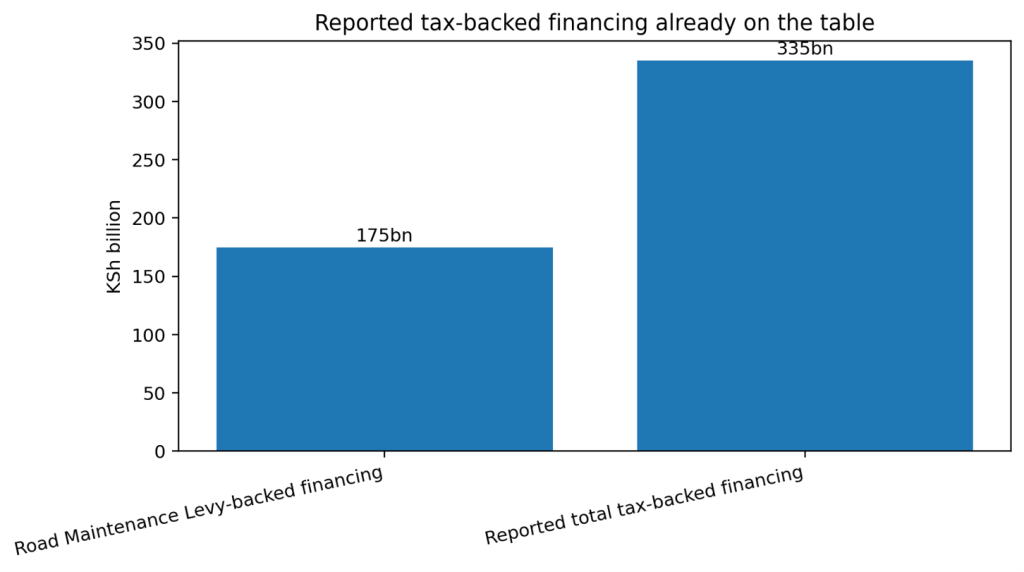
Chart 1: The KSh175bn road levy transaction is not additive to the wider KSh335bn figure; the larger figure is reported as total tax-backed financing across several revenue streams. Sources: Reuters, Kenyan Wall Street/BondBloX and IEA Kenya.
What has already been securitised or pledged?
The clearest public example is the Road Maintenance Levy-linked structure. Reuters reported that Kenya secured USD 600 million in short-term financing from commercial banks for road construction, backed by fuel levy collections. Reuters also reported that the government was pursuing a bigger transaction of up to USD 1.5 billion. Separately, Kenyan Wall Street reported that Roads and Transport Cabinet Secretary Davis Chirchir confirmed the government securitised part of the fuel levy to raise KSh 175 billion for road bills and projects.
The structure matters because the fuel levy is not a luxury tax sitting idle. It is money collected from motorists to maintain and develop roads. IEA Kenya noted that the Kenya Roads Board securitised a portion of the Road Maintenance Levy Fund, committing KSh 7 out of every KSh 25 collected. That is roughly 28% of the levy stream tied to financing commitments before normal public budgeting can freely allocate it.

Chart 2: If KSh7 out of every KSh25 is committed, nearly one-third of the stream is effectively pre-allocated.
The concern does not stop at roads. Kenyan Wall Street and BondBloX reported that the IMF pushed Kenya to classify about KSh 335 billion in tax-backed infrastructure financing as public debt. The reported revenue streams include fuel taxes for roads, a sports levy for the Talanta Sports City/Stadium, import duty collections linked to railway expansion, and passenger charges for airport upgrades. The precise project-by-project breakdown has not been fully published in one transparent public schedule, and that lack of clarity is exactly the problem.
If this KSh 335 billion sits outside the visible debt register, then the country is understating the true burden on taxpayers. If it is counted properly, it increases reported debt and squeezes borrowing space. Either way, the taxpayer pays. The only difference is whether Kenyans are told the truth today or surprised by the bill tomorrow.
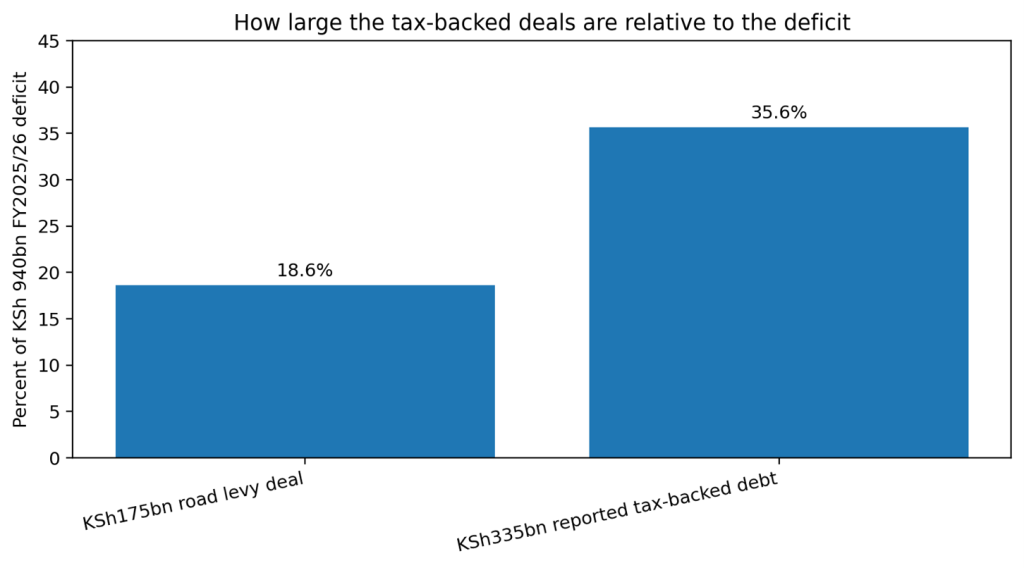
Chart 3: Using Treasury’s KSh940bn FY2025/26 deficit projection, KSh335bn is about 35.6% of the gap. The number is too large to be hidden in technical language.
Why is this constitutionally dangerous?
Kenya’s Constitution does not treat public finance as a private playground. Article 201 requires openness, accountability and public participation in financial matters. It also says the burdens and benefits of public borrowing must be shared equitably between present and future generations, public money must be used prudently and responsibly, and fiscal reporting must be clear. A financing structure that quietly locks future taxes into today’s obligations offends the spirit of those principles.
Article 206 requires money raised or received on behalf of the national government to be paid into the Consolidated Fund unless it is lawfully excluded or retained under an Act of Parliament. Article 211 gives Parliament power to prescribe terms on which the national government may borrow and impose reporting requirements. Therefore, the legal issue is not merely whether Treasury can create clever structures. The deeper question is whether such structures are being used to bypass Parliament, avoid full disclosure, and disguise debt as something else.
To be accurate, securitisation is not automatically illegal in every possible form. A transparent, fully authorised, properly reported structure can exist in law. But tax-backed securitisation becomes unconstitutional in substance where it mortgages public revenue without full parliamentary scrutiny, hides liabilities from the debt register, weakens public participation, or unfairly shifts today’s fiscal failure onto future citizens.
The real scandal is not that Kenya needs infrastructure. The scandal is that a government can pledge future taxes while refusing to show Kenyans the full repayment map.
Why Kenyans must say no
First, securitising taxes reduces the freedom of future governments. A new administration may win a mandate to fix hospitals, revive manufacturing, fund schools or increase county allocations, only to discover that a portion of tax revenue is already contractually reserved for past financing arrangements. That is how democracy is weakened through finance: elections change leaders, but locked revenue structures continue ruling from behind the scenes.
Second, it turns essential service money into collateral. When road levies are pledged to investors, the risk is not abstract. Less flexible funding may remain for actual road maintenance, emergency repairs, county roads and public transport infrastructure. Kenyans will still pay the levy at the pump, but the first claim may no longer be the road outside their homes; it may be the financier holding the future cash flow.
Third, it encourages lazy fiscal management. A serious Treasury cuts waste, stops corruption, reforms procurement, improves project selection, expands the productive economy and collects taxes fairly. A lazy Treasury sells tomorrow. It avoids the hard work of discipline by converting expected future collections into immediate cash. That path rewards incompetence today and punishes citizens tomorrow.
Fourth, it can hide the true size of public debt. The IMF position reported in the market is simple: if future taxes are pledged to raise money today, the liability should be recognised as debt under international statistical standards. Calling it off-balance-sheet financing does not change the economic substance. If taxpayers are obligated, taxpayers are indebted.
Fifth, it violates intergenerational fairness. Article 201 is clear that the burdens and benefits of public borrowing must be shared equitably between present and future generations. Securitisation fails that test when today’s leaders enjoy upfront money while future citizens inherit reduced revenue space, higher user charges, lower services or new taxes to fill the gap.
The wider fiscal picture makes the danger worse
Kenya is not securitising taxes from a position of strength. The National Treasury’s Annual Public Debt Report for 2024/25 put public and publicly guaranteed debt at KSh 11.814 trillion, or 67.8% of GDP, by June 2025. Treasury’s 2026 Medium Term Debt Management Strategy also states that Kenya’s debt remains sustainable but carries a high risk of debt distress.
The 2026 Budget Policy Statement projected the FY2025/26 fiscal deficit at KSh 940 billion, equivalent to 4.5% of GDP. Independent budget analysis by Cytonn placed total borrowing for FY2025/26 at KSh 923.2 billion, with KSh 635.5 billion expected from domestic borrowing and KSh 287.7 billion from foreign borrowing. In such an environment, any off-balance-sheet tax-backed obligation is not a footnote. It is a major fiscal risk.
Standard Investment Bank’s 8 June 2026 Fixed Income Weekly Report also shows the pressure inside the domestic market. June 2026 domestic debt maturities were placed at KSh 189 billion compared with KSh 279 billion in May. The same report noted that the June Treasury bond auction accepted KSh 34.4 billion against a KSh 40 billion target and that government borrowing pressure was likely to keep upward pressure on local yields. In other words, the State already needs cash, already faces maturities, and already competes heavily in the domestic market. Securitisation does not remove that pressure; it merely moves it into the future.
What must be done now
Kenyans should demand a full public register of every securitisation, guarantee, PPP, special purpose vehicle, escrow arrangement and revenue-backed financing signed by the national government or any state entity. The register should show the revenue stream pledged, the amount raised, the interest or investor return, the maturity, the fees, the arranger, the legal authority used, and the annual revenue expected to be diverted.
Parliament must stop behaving like a spectator. Any tax-backed financing should come before Parliament as public borrowing, be debated openly, and be subjected to the same debt sustainability tests as ordinary loans. If the taxpayer is ultimately responsible, then the transaction belongs in the public debt conversation.
The Controller of Budget, Auditor-General, Commission on Revenue Allocation and Parliament’s public debt committees should jointly audit all revenue-backed obligations. Kenyans need to know whether counties, roads, infrastructure funds, aviation charges and special levies have already been committed to financiers. The audit should also identify whether any arrangement violates Article 201, Article 206, Article 211, the Public Finance Management Act, or approved budget limits.
Finally, Treasury must return to honest fiscal discipline. Cut waste. Stop inflated procurement. Pay pending bills transparently. Grow production. Support SMEs. Protect taxpayers. Strengthen exports. Stop using financial engineering to conceal the cost of bad governance. Kenya does not need a cleverer way to mortgage tomorrow. Kenya needs a braver way to govern today.
Read Also: Reasons Why Finance Bill 2026 Proposal on Non-Resident Landlords Is a Step Towards Tax Equity

About Steve Biko Wafula
Steve Biko is the CEO OF Soko Directory and the founder of Hidalgo Group of Companies. Steve is currently developing his career in law, finance, entrepreneurship and digital consultancy; and has been implementing consultancy assignments for client organizations comprising of trainings besides capacity building in entrepreneurial matters.He can be reached on: +254 20 510 1124 or Email: info@sokodirectory.com

- January 2026 (220)
- February 2026 (248)
- March 2026 (287)
- April 2026 (207)
- May 2026 (192)
- June 2026 (238)
- July 2026 (279)
- August 2026 (206)
- January 2025 (119)
- February 2025 (191)
- March 2025 (212)
- April 2025 (193)
- May 2025 (161)
- June 2025 (157)
- July 2025 (227)
- August 2025 (211)
- September 2025 (267)
- October 2025 (297)
- November 2025 (230)
- December 2025 (220)
- January 2024 (238)
- February 2024 (227)
- March 2024 (190)
- April 2024 (133)
- May 2024 (157)
- June 2024 (145)
- July 2024 (136)
- August 2024 (154)
- September 2024 (212)
- October 2024 (255)
- November 2024 (196)
- December 2024 (143)
- January 2023 (182)
- February 2023 (203)
- March 2023 (322)
- April 2023 (297)
- May 2023 (267)
- June 2023 (214)
- July 2023 (212)
- August 2023 (257)
- September 2023 (237)
- October 2023 (264)
- November 2023 (286)
- December 2023 (177)
- January 2022 (293)
- February 2022 (329)
- March 2022 (358)
- April 2022 (292)
- May 2022 (271)
- June 2022 (232)
- July 2022 (278)
- August 2022 (253)
- September 2022 (246)
- October 2022 (196)
- November 2022 (232)
- December 2022 (167)
- January 2021 (182)
- February 2021 (227)
- March 2021 (325)
- April 2021 (259)
- May 2021 (285)
- June 2021 (272)
- July 2021 (277)
- August 2021 (232)
- September 2021 (271)
- October 2021 (303)
- November 2021 (364)
- December 2021 (249)
- January 2020 (272)
- February 2020 (310)
- March 2020 (390)
- April 2020 (321)
- May 2020 (335)
- June 2020 (327)
- July 2020 (333)
- August 2020 (276)
- September 2020 (214)
- October 2020 (233)
- November 2020 (242)
- December 2020 (187)
- January 2019 (251)
- February 2019 (215)
- March 2019 (283)
- April 2019 (254)
- May 2019 (269)
- June 2019 (249)
- July 2019 (335)
- August 2019 (292)
- September 2019 (306)
- October 2019 (313)
- November 2019 (362)
- December 2019 (318)
- January 2018 (291)
- February 2018 (213)
- March 2018 (275)
- April 2018 (223)
- May 2018 (235)
- June 2018 (176)
- July 2018 (256)
- August 2018 (247)
- September 2018 (255)
- October 2018 (282)
- November 2018 (282)
- December 2018 (184)
- January 2017 (183)
- February 2017 (194)
- March 2017 (207)
- April 2017 (104)
- May 2017 (169)
- June 2017 (205)
- July 2017 (189)
- August 2017 (195)
- September 2017 (186)
- October 2017 (235)
- November 2017 (253)
- December 2017 (266)
- January 2016 (164)
- February 2016 (165)
- March 2016 (189)
- April 2016 (143)
- May 2016 (245)
- June 2016 (182)
- July 2016 (271)
- August 2016 (247)
- September 2016 (233)
- October 2016 (191)
- November 2016 (243)
- December 2016 (153)
- January 2015 (1)
- February 2015 (4)
- March 2015 (164)
- April 2015 (107)
- May 2015 (116)
- June 2015 (119)
- July 2015 (145)
- August 2015 (157)
- September 2015 (186)
- October 2015 (169)
- November 2015 (173)
- December 2015 (205)
- March 2014 (2)
- March 2013 (10)
- June 2013 (1)
- March 2012 (7)
- April 2012 (15)
- May 2012 (1)
- July 2012 (1)
- August 2012 (4)
- October 2012 (2)
- November 2012 (2)
- December 2012 (1)