



There are moments when a land dispute raises questions larger than the disagreement itself. The public-interest issue is not whether an online audience can declare a winner. It is whether the people involved can produce lawful authority, an authentic agreement, a transparent payment trail, informed consent and a process that respects every person with a legitimate interest in the property.
A family in the wider Mwea area of Kirinyaga County has supplied Soko Directory with an account of an alleged ten-year land arrangement said to involve KES 200,000. The family says some relatives were approached through intermediaries and that concerns exist about succession, authority to transact, the condition in which discussions occurred and the position of a widow who claims an interest in the land.
At this stage, those statements remain allegations supplied by one side. Soko Directory has not independently authenticated the alleged lease, the parcel number, the current official search, the title record, the succession file, the payment records, the identities and authority of the alleged signatories, or the response of the person said to benefit from the arrangement. The report therefore does not announce guilt. It identifies the questions that documents and lawful institutions must answer.


A family’s allegation: small money today, ten years of land tomorrow
According to the family’s account, the disputed arrangement was not preceded by a meeting involving every person said to have a legitimate interest in the property. The family alleges that discussions moved through intermediaries and relatives who may have focused on immediate cash rather than the long-term economic consequences of surrendering use or control of land for 120 months.
The allegation is serious because a ten-year lease is not a casual favour. Depending on its wording, it may affect possession, cultivation, income, improvements, access and the practical ability of a family to use the property for an entire decade. Yet seriousness does not convert an allegation into fact. The agreement itself must be produced, read in full and tested against the title and succession record.
The family also says succession may not have been completed and that a caution may exist over the parcel. Both assertions are objectively verifiable. An official land search, a copy of the register, the succession cause file and any grant of representation must replace rumour. Until those records are obtained, no responsible publication should state that the arrangement is invalid, criminal or fraudulent.
The Controversial Contract
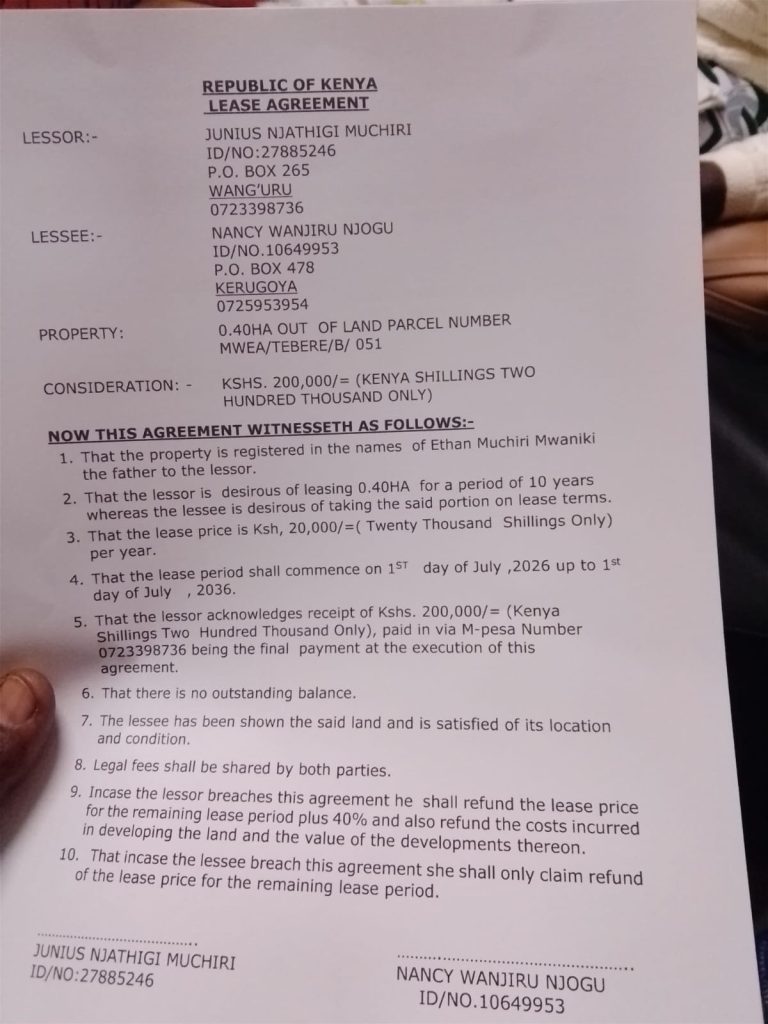

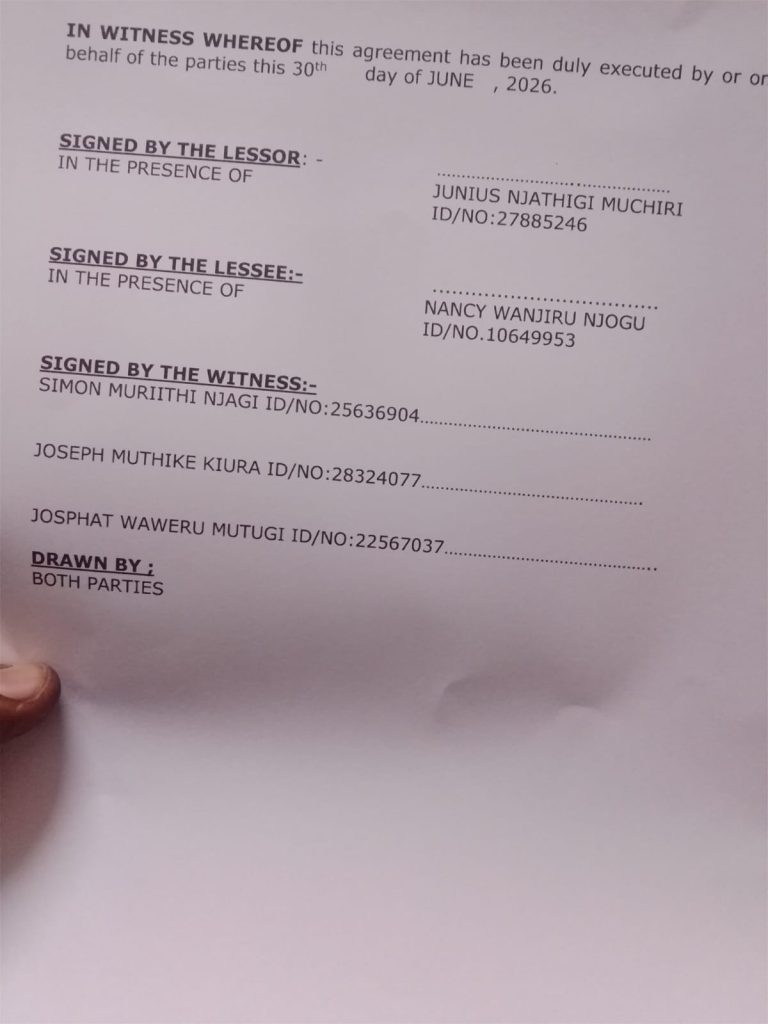
| THE REPORTING LINE The safe and accurate formulation is: “The family alleges X; Soko Directory has not yet verified X; the following records would confirm or disprove X.” Repeated use of words such as “alleged” does not cure a story whose overall message still presents guilt as settled. |
THE POWER IMBALANCE
The proper public-interest question is not whether a relative is poor, dependent, unemployed or struggling with alcohol. It is whether any person with greater information, money, influence or bargaining strength knowingly used a material disadvantage to secure a long-term benefit on terms that were not freely understood.
That question cannot be answered by anger. It requires evidence about who initiated contact, who drafted the document, whether independent advice was available, whether the terms were explained, whether the parties had time to reflect, whether the consideration reflected a valuation, and whether the people receiving money had legal authority to bind the land.
A low price is not, by itself, proof of illegality. A family disagreement is not, by itself, proof of exploitation. Equally, a signature is not always the end of the inquiry where authority, capacity, misrepresentation, undue pressure or unconscionable terms are credibly raised. These are matters for evidence and, where necessary, a court.
Alcohol dependence does not erase dignity—but alleged impairment requires evidence
The language around alcohol must be accurate and humane. A person who experiences alcohol dependence does not lose dignity, intelligence, legal rights or moral worth. The article must not diagnose anyone from family messages, photographs, reputation or community gossip.
The legally relevant issue is narrower: was any alleged signatory so impaired at the material time that the person could not understand the nature and consequences of the transaction, and did the other party know or deliberately take advantage of that condition? That is a fact-sensitive question. It requires dates, witnesses, communications, medical or treatment evidence where lawfully available, and proof of what occurred when the agreement or payment was made.
The publication should therefore avoid the claim that alcohol automatically invalidated the alleged arrangement. It should instead ask whether impairment, inducement, pressure, deception or a severe inequality of bargaining power affected genuine consent. Only a competent court can determine the legal effect after hearing the evidence.
The law protects estates from unauthorised dealing
Section 45 of Kenya’s Law of Succession Act prohibits a person, except where authorised by the Act, another written law or a grant of representation, from taking possession of, disposing of or otherwise intermeddling with the free property of a deceased person.
That provision is important, but it must be applied conditionally. Before describing a transaction as intermeddling, a reporter must establish that the property was the free property of a deceased person, identify the registered proprietor, confirm the death and estate status, establish whether a grant existed, identify who signed, and determine what the instrument actually did.
The Land Registration Act separately regulates cautions. While a caution remains registered, a disposition inconsistent with it should not be registered without the cautioner’s consent or a court order. A caution is a formal warning on the register; it is not, by itself, a final judgment on ownership, validity, fraud or criminal responsibility.
The prudent legal route is documentary preservation and urgent advice from a succession or land advocate. Where justified by the facts, affected parties may seek court orders preserving the property while the authority, ownership and validity of the alleged arrangement are determined.
| QUESTION | DOCUMENT NEEDED | SAFE EDITORIAL POSITION |
| Whose land is it? | Current official search, title/register copy, parcel map | Do not infer ownership from occupation or family history alone. |
| Is it estate property? | Death certificate, succession cause, petition, grant and confirmation status | Use section 45 only if the statutory facts are established. |
| Who had authority? | Grant of representation, power of attorney, court order or registered authority | A beneficiary is not automatically an administrator. |
| What was agreed? | Complete signed agreement, annexures, witness pages and advocate’s file | Do not describe a lease from summaries or WhatsApp messages. |
| Was payment made? | Bank, M-PESA, receipt, acknowledgment and recipient identity | State only the payment trace that can be authenticated. |
| Is there a caution? | Current official search and registry documents | A caution affects registration; it does not conclusively decide the dispute. |
The questions the person identified by the family must be allowed to answer
Fairness requires more than sending a vague message shortly before publication. The affected person should receive the material allegations, the intended publication date, a reasonable deadline, and a clear invitation to provide documents. The full response should be represented accurately, including information that weakens the family’s account.
- Did you enter, finance, witness or benefit from an agreement involving the disputed Kirinyaga parcel? Please provide the complete document.
- What is the parcel number, and who was the registered proprietor on the date of the alleged agreement?
- Who signed the agreement, and what evidence showed that each person had legal authority to bind the property or estate?
- Was there an active succession cause or grant of representation? Please provide the cause number and relevant orders.
- Were you aware of any caution, restriction, inhibition, objection or family dispute affecting the property?
- How was the alleged KES 200,000 consideration determined? Was an independent valuation obtained?
- How, when and to whom was any money paid? Please provide receipts, bank records, M-PESA records or advocate acknowledgements.
- Were intermediaries acting on your instructions? What was their role and were they paid?
- Were you aware of any concern that a signatory was intoxicated, impaired, pressured or unable to understand the transaction?
- Were the terms explained in a language understood by every signatory, and was independent legal advice available?
- Do you deny any allegation of threats, intimidation, harassment or improper influence? Please provide your account and supporting material.
- Are you willing to preserve the current position on the land while the title, succession, authority and consent issues are independently verified?
| RIGHT-OF-REPLY RECORD TO RETAIN Keep the exact questions sent, delivery evidence, dates and times, call logs, responses, attachments, follow-up attempts, the deadline given, and the editor’s reasons for any decision to publish before receiving a response. If a response arrives after publication, assess it promptly and update the article where necessary. |
TSC cannot convict through social media—but it cannot ignore a properly documented complaint
The earlier family account identified the person complained about as a teacher or school administrator. That occupational claim must be independently confirmed before publication. The school, learners, colleagues and institution should not be drawn into a private dispute without a demonstrable public-interest reason.
Kenya’s Teachers Service Commission framework permits written complaints alleging professional misconduct and provides for investigation. That does not mean every private land dispute involving a teacher is professional misconduct, and a media report cannot substitute for the Commission’s process.
A responsible complaint should identify the exact conduct alleged, attach authentic documents, explain the connection—if any—to professional ethics or use of public office, and invite a fair investigation. The safe public demand is not “punish the teacher.” It is: receive the evidence, protect confidentiality, hear the teacher, investigate lawfully and communicate the outcome permitted by law.
Police accountability: an OB number, evidence trail and written action
The family has also alleged that police reports did not produce adequate protection and has raised suspicions of improper influence. Suspicion is not evidence. The publication should not accuse an officer, station or commander of corruption or compromise unless there is reliable material capable of supporting that allegation.
The stronger approach is procedural: record the station, date and time of every report; obtain the Occurrence Book number; keep copies of statements; identify the investigating officer; preserve threatening messages or call records; and request a written update. Where the complaint concerns a possible offence, the family may seek review through the relevant supervisory police or investigative office and obtain legal advice.
A documented failure to act is reportable. A conclusion about why there was no action requires further proof. The article should distinguish clearly between “the family says no meaningful action followed” and “the police were bribed.” The first may be verified through the record; the second is a serious allegation requiring evidence.
A warning to Kirinyaga: do not let poverty, grief or addiction become an opening for exploitation
Land carries food, memory, inheritance, identity and economic security. That is why claims involving bereavement, internal family conflict, addiction or poverty deserve careful institutional attention. But the same seriousness that requires investigation also requires restraint.
This matter needs light, not a mob. If authentic records show that lawful owners gave informed consent, had authority, understood the terms and received the agreed value, that evidence must be reported with equal prominence. If the records instead show unauthorised dealings, deception, pressure, impaired consent or unlawful interference with estate property, the relevant court and institutions should act on proved facts.
The public demand is therefore exact: preserve the property, produce the agreement, identify lawful authority, trace payment, verify the register, hear every affected party and let the law determine the result. Accountability is not an online conviction. It is a disciplined insistence on evidence, fairness, lawful process and consequences where wrongdoing is proved.
Read Also: Ministry Land Grabbing Is Reversing The Purpose Of 2010 Constitution