Corruption Does Not Just Steal Money, It Kills People, Destroys Lives And Ruins Futures

Data anchors behind the argument
| Measure | What the number says | Source anchor |
| Kenya cancer burden, 2022 | 44,726 estimated new cancer cases and 29,317 estimated cancer deaths. | IARC/WHO GLOBOCAN 2022 Kenya fact sheet |
| Kenya corruption estimate | About KSh 608 billion lost annually, or roughly KSh 1.6 billion daily, according to the EACC figure cited publicly in 2024. | The Star report citing EACC/Prime CS statement |
| AfDB-reported leakage | Up to KSh 193.6 billion annually from corruption and illicit financial flows; Sh650B in public spending inefficiencies; Sh105B in tax incentives/exemptions. | African Economic Outlook Kenya Country Focus coverage |
| Everyday bribery | EACC 2024 survey: 52.1% witnessed bribery in public offices; 30.5% encountered bribery situations; 97.2% of incidents went unreported. | EACC National Ethics and Corruption Survey 2024 |
| Global scale | UN/World Bank-cited estimates: US$1T paid in bribes and US$2.6T stolen through corruption every year. | World Bank anticorruption/procurement page |
Corruption kills because it does not begin as a body in a hospital bed; it begins as a signature on a fake invoice, a tender inflated by insiders, a medicine bought at the wrong price, a road paid for twice, a job sold to the highest bidder, and a public office turned into a private shop. Cancer is terrifying because it attacks silently from inside the body. Corruption is even more socially lethal because it attacks silently from inside the State, then leaves ordinary families to carry the funeral, the hospital bill, the school dropout, the collapsed business and the empty promise.
In Kenya, cancer is already a national tragedy. The IARC/WHO GLOBOCAN 2022 estimates show 44,726 new cancer cases and 29,317 cancer deaths in one year. That is real pain, real mothers, real fathers, real children and real homes broken by disease. But corruption becomes more lethal than cancer in the life of a nation because it does not wait for diagnosis; it destroys diagnosis. It steals from screening, delays treatment, raises the cost of medicine, weakens hospitals and turns a survivable illness into a family catastrophe.

Cancer kills through abnormal cells. Corruption kills through abnormal systems. It puts unqualified people in sensitive offices. It rewards loyalty over competence. It makes procurement more important than patients, allowances more important than ambulances, connections more important than merit and political protection more important than public safety. A cancer patient can fight when the hospital has machines, drugs, nurses and honesty. But when corruption has already eaten those systems, even courage is forced to queue behind theft.
That is why corruption is not merely theft from government. Government has no child, no mother, no grave and no tears. The people do. When KSh 608 billion is said to disappear into corruption annually, that is not an accounting problem; it is a national wound. That is about KSh 1.6 billion every single day. Every day corruption survives, a hospital wing is not equipped, a classroom is not built, a road remains dangerous, a young person remains jobless and a small business dies while waiting for a payment that was diverted by greed.
The African Development Bank-linked figures are equally brutal: up to KSh 193.6 billion a year lost through corruption and illicit financial flows, KSh 650 billion in public spending inefficiencies and KSh 105 billion in revenue lost through tax incentives and exemptions. These numbers sound technical until you understand what they mean at household level. They mean fewer beds, fewer doctors, fewer vaccines, fewer bursaries, fewer factories, fewer roads, fewer police resources, fewer opportunities and more despair. Corruption is lethal because it converts public money into private comfort and public suffering into background noise.
Cancer is at least honest in its cruelty; it declares war on the body. Corruption is cowardly. It wears a suit. It quotes the law. It sits in committees. It hides behind procurement language, supplementary budgets, pending bills, confidential contracts and politically protected cartels. Then it tells the poor to be patient. A disease may kill the sick. Corruption kills the healthy future before it has a chance to be born.
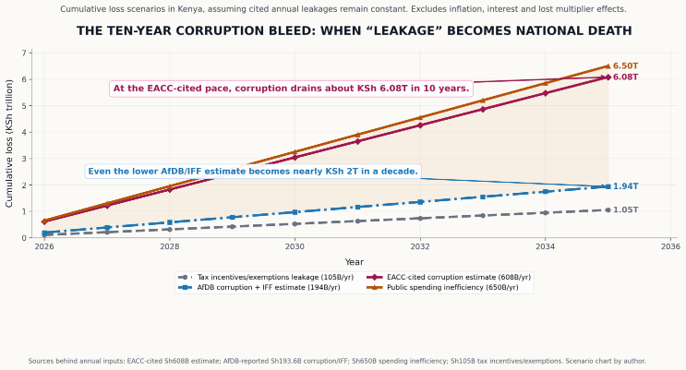
Graph: A constant annual leakage may look like a budget line today, but over ten years it becomes a national development graveyard. The chart is a scenario model using the cited annual estimates; it does not include inflation, interest costs or lost economic multiplier effects.
The graph is the simplest way to see why corruption is deadlier than the language used to describe it. A “leakage” of KSh 608 billion sounds like a scandal for one financial year. But if that bleeding continues for ten years, the country loses about KSh 6.08 trillion before counting interest, inflation or the businesses that never opened because money was stolen from roads, power, credit, water and security. Cancer may take one life at a time; corruption can rob an entire generation of the conditions required to live.
UNODC warns that corruption in health undermines the effectiveness, quality and accessibility of health-care services while driving up costs and depriving communities of essential services and resources. That sentence should make every Kenyan angry because it explains why corruption is not an abstract sin. When oxygen is missing, corruption is in the room. When a patient is told to buy medicine outside a public hospital, corruption is in the room. When a mother travels from one facility to another because a basic service failed, corruption is in the room.
Cancer can be fought with early detection. Corruption survives by destroying early detection in society. It weakens audit offices, intimidates whistle-blowers, frustrates investigators, buys silence and teaches citizens that reporting is useless. The EACC 2024 survey said 97.2% of bribery incidents went unreported. That is how a country becomes sick without a medical chart. People stop complaining because they believe nothing will happen. The silence becomes the oxygen of the disease.
Corruption is lethal because it punishes honesty. It tells the student that talent is not enough unless a bribe is paid. It tells the entrepreneur that quality is not enough unless a tender is negotiated in darkness. It tells the graduate that merit is weaker than connections. It tells the farmer that inputs, subsidies and markets can be captured by middlemen. Cancer attacks cells; corruption attacks hope. And when hope dies in young people, a nation begins to decay long before economists admit it.
In business, corruption is a hidden tax that honest entrepreneurs pay with their margins, time and dignity. It raises the cost of licences, permits, transport, inspections, justice and public procurement. It gives an unfair advantage to those who can pay, not those who can deliver. That is why corruption kills enterprise. It turns competition into extortion, innovation into survival and ambition into exhaustion. A country cannot build a serious private sector when corruption is allowed to sit at the gate of every opportunity.
In public works, corruption is not just expensive; it is dangerous. The World Bank notes that corruption in procurement leads to inflated prices, work not performed, reduced quality and inferior materials, and that 10% to 30% of investment in publicly funded construction projects may be lost through mismanagement and corruption. This is where corruption becomes physical. It appears as weak bridges, poor roads, unfinished dams, unsafe buildings and projects that collapse economically even when they remain standing physically.
Corruption is more lethal than cancer at the societal level because cancer does not ask for a bribe before treatment; corrupt systems do. Cancer does not inflate a tender for chemotherapy machines; corrupt systems can. Cancer does not divert money for doctors; corrupt systems do. Cancer does not fake a road inspection; corrupt systems do. Cancer is an enemy of health. Corruption is an enemy of health, education, justice, security, jobs, infrastructure and national trust at the same time.
The worst part is that corruption multiplies suffering. A stolen shilling is not only a stolen shilling. It is the interest paid on debt borrowed to replace it. It is the tax increase imposed on citizens to fill the hole. It is the delayed county payment that kills a supplier. It is the hospital bill pushed onto a family. It is the young person who gives up. It is the investor who walks away. Corruption is lethal because its damage compounds like a debt whose principal is theft and whose interest is human pain.
Kenya’s 2024 CPI score of 32 out of 100, and ranking of 121 out of 180 countries, is not just an international embarrassment. It is a warning label on the investment climate, the justice system, the tax system and the future of our children. A score below 50 indicates serious public-sector corruption. For ordinary people, that score is not academic. It is the difference between being served and being delayed, between getting justice and being priced out of it, between believing in the State and fearing it.
A corrupt country does not only lose money; it loses moral authority. Citizens stop believing speeches. Workers stop believing effort. Entrepreneurs stop believing fairness. Young people stop believing education. Investors stop believing contracts. Patients stop believing hospitals. Voters stop believing promises. Once trust dies, everything becomes more expensive because every transaction needs suspicion, every institution needs pressure and every public service needs a personal connection. That is national death by a thousand invoices.
This is why the fight against corruption cannot be polite theatre. It must become a national survival agenda. Every inflated tender should be treated as a stolen hospital bed. Every ghost project should be treated as a stolen classroom. Every bribe demanded from a job seeker should be treated as theft from a family’s future. Every public officer who steals should face personal consequence, asset recovery, prosecution and permanent exclusion from public trust. Mercy for corruption is cruelty to citizens.
The country must stop calling corruption “eating.” Eating is what hungry children do. Corruption is not eating; it is taking food from the hungry. It is not “something small”; it is a system that makes life smaller for everyone else. It is not cleverness; it is cowardice protected by power. It is not politics; it is violence against the future without the honesty of a weapon. It kills slowly, legally, administratively and repeatedly.
If Kenya wants to live, corruption must become expensive for the corrupt, not for the citizen. Procurement must be open by default. Beneficial owners must be known. Lifestyle audits must have consequences. Whistle-blowers must be protected. Public officers must explain wealth that mocks their salaries. Pending bills must be transparent. Courts must move faster. Parliament must stop weakening accountability. Citizens must stop worshipping stolen wealth because every stolen mansion has a missing clinic hidden inside it.
Corruption kills. Corruption destroys lives. Corruption ruins futures. It is more socially lethal than cancer because it attacks the very systems that help society detect, treat and survive cancer. A country can fight disease when its institutions are alive. But when corruption captures those institutions, the nation becomes a patient lying on a public bed while thieves argue over the price of the bedsheet. If this is not addressed now, we will not merely lose money. We will lose the country one stolen budget line at a time.
Read Also: Corruption Is The Slow Murder Of A Nation, Not A Theft From Government
About Steve Biko Wafula
Steve Biko is the CEO OF Soko Directory and the founder of Hidalgo Group of Companies. Steve is currently developing his career in law, finance, entrepreneurship and digital consultancy; and has been implementing consultancy assignments for client organizations comprising of trainings besides capacity building in entrepreneurial matters.He can be reached on: +254 20 510 1124 or Email: info@sokodirectory.com
- January 2026 (220)
- February 2026 (248)
- March 2026 (287)
- April 2026 (208)
- May 2026 (191)
- June 2026 (236)
- July 2026 (34)
- January 2025 (119)
- February 2025 (191)
- March 2025 (212)
- April 2025 (193)
- May 2025 (161)
- June 2025 (157)
- July 2025 (227)
- August 2025 (211)
- September 2025 (270)
- October 2025 (297)
- November 2025 (230)
- December 2025 (220)
- January 2024 (238)
- February 2024 (227)
- March 2024 (190)
- April 2024 (133)
- May 2024 (157)
- June 2024 (145)
- July 2024 (136)
- August 2024 (154)
- September 2024 (212)
- October 2024 (255)
- November 2024 (196)
- December 2024 (143)
- January 2023 (182)
- February 2023 (203)
- March 2023 (322)
- April 2023 (297)
- May 2023 (267)
- June 2023 (214)
- July 2023 (212)
- August 2023 (257)
- September 2023 (237)
- October 2023 (264)
- November 2023 (286)
- December 2023 (177)
- January 2022 (293)
- February 2022 (329)
- March 2022 (358)
- April 2022 (292)
- May 2022 (271)
- June 2022 (232)
- July 2022 (278)
- August 2022 (253)
- September 2022 (246)
- October 2022 (196)
- November 2022 (232)
- December 2022 (167)
- January 2021 (182)
- February 2021 (227)
- March 2021 (325)
- April 2021 (259)
- May 2021 (285)
- June 2021 (272)
- July 2021 (277)
- August 2021 (232)
- September 2021 (271)
- October 2021 (304)
- November 2021 (364)
- December 2021 (249)
- January 2020 (272)
- February 2020 (310)
- March 2020 (390)
- April 2020 (321)
- May 2020 (335)
- June 2020 (327)
- July 2020 (333)
- August 2020 (276)
- September 2020 (214)
- October 2020 (233)
- November 2020 (242)
- December 2020 (187)
- January 2019 (251)
- February 2019 (215)
- March 2019 (283)
- April 2019 (254)
- May 2019 (269)
- June 2019 (249)
- July 2019 (335)
- August 2019 (292)
- September 2019 (306)
- October 2019 (313)
- November 2019 (362)
- December 2019 (318)
- January 2018 (291)
- February 2018 (213)
- March 2018 (275)
- April 2018 (223)
- May 2018 (235)
- June 2018 (176)
- July 2018 (256)
- August 2018 (247)
- September 2018 (255)
- October 2018 (282)
- November 2018 (282)
- December 2018 (184)
- January 2017 (183)
- February 2017 (194)
- March 2017 (207)
- April 2017 (104)
- May 2017 (169)
- June 2017 (205)
- July 2017 (189)
- August 2017 (195)
- September 2017 (186)
- October 2017 (235)
- November 2017 (253)
- December 2017 (266)
- January 2016 (164)
- February 2016 (165)
- March 2016 (189)
- April 2016 (143)
- May 2016 (245)
- June 2016 (182)
- July 2016 (271)
- August 2016 (247)
- September 2016 (233)
- October 2016 (191)
- November 2016 (243)
- December 2016 (153)
- January 2015 (1)
- February 2015 (4)
- March 2015 (164)
- April 2015 (107)
- May 2015 (116)
- June 2015 (119)
- July 2015 (145)
- August 2015 (157)
- September 2015 (186)
- October 2015 (169)
- November 2015 (173)
- December 2015 (205)
- March 2014 (2)
- March 2013 (10)
- June 2013 (1)
- March 2012 (7)
- April 2012 (15)
- May 2012 (1)
- July 2012 (1)
- August 2012 (4)
- October 2012 (2)
- November 2012 (2)
- December 2012 (1)
