
Corruption Is The Slow Murder Of A Nation, Not A Theft From Government

Money in Kenya is political long before it reaches your pocket. The price of unga, the tax on your payslip, the medicine missing from a public hospital, the loan your business cannot afford and the job your child cannot find are not random misfortunes. They are the consequences of choices made by people entrusted with public power.
That is why corruption must never be softened into polite language. It is not a ‘challenge’. It is not a ‘governance concern’. It is not a harmless culture of facilitation. Corruption is organised cruelty. It is the deliberate decision to make millions of people poorer so that a connected few can become obscenely richer.
Every stolen shilling already had a name. It was a teacher who would have entered an overcrowded classroom. It was a cancer drug that would have reached a county hospital. It was a bridge that would not collapse, a borehole that would not run dry, a laboratory that would have equipped a young scientist, or a small supplier who would have been paid on time.

When that money disappears, the damage does not remain inside an accounting book. It enters homes. It becomes a mother choosing between food and medicine. It becomes a graduate sending applications for years until hope turns into anger. It becomes a business closing after government refuses to pay while politically protected contractors are paid overnight.
Corruption does not merely steal money. It steals time. It forces citizens to spend hours in queues because systems were never modernised. It steals years from children learning in broken schools. It steals decades from communities waiting for roads, water, electricity and markets that were promised during every election and abandoned after every oath of office.
The most offensive part is the insult that follows the theft. Citizens are told to tighten their belts while leaders expand convoys, offices, allowances and vanity projects. Workers are taxed more because public money was wasted. Businesses are squeezed because revenue was looted. Families are ordered to sacrifice for a country whose political elite repeatedly refuses to sacrifice anything.
Kenya’s 2025 Corruption Perceptions Index score was 30 out of 100, placing the country 130th out of 182 countries. That number is not merely an international ranking. It is a warning that the institutions meant to protect the public interest are still being overwhelmed by impunity, patronage and weak accountability.
For fourteen years, the score has moved up and down within a narrow, deeply troubling range. We celebrate tiny improvements, mourn small reversals and then return to business as usual. A nation cannot defeat corruption through annual speeches, ceremonial arrests and files that disappear when suspects become politically useful.
“A stolen shilling is not missing money. It is a missing service, a broken life and a future deliberately delayed.”
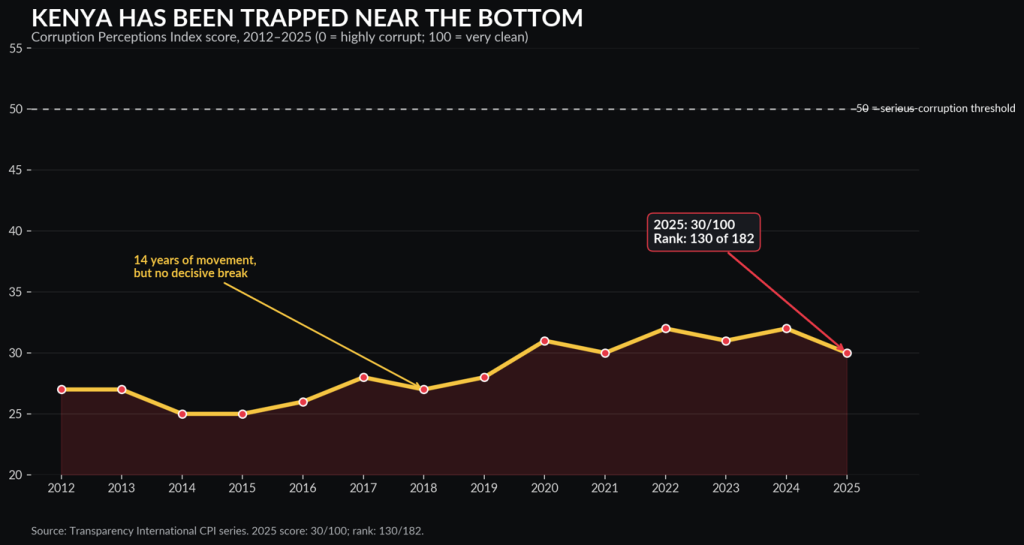
Figure 1: Kenya’s public-sector corruption score has remained persistently weak. A score below 50 signals serious corruption concerns.
Corruption survives because it has been tribalised, normalised and defended. A thief is condemned when he belongs to the other side and celebrated when he speaks our language, funds our faction or attacks our political enemy. That hypocrisy is the oxygen of impunity. We cannot demand justice for one scandal while manufacturing excuses for another.
There is no patriotic corruption. There is no tribal corruption that benefits a community. When a leader steals in your name, the money does not enter your household. Your school remains poor. Your hospital remains empty. Your road remains impassable. Only the thief’s family, financiers and political brokers become secure.
Unchecked corruption also destroys honest enterprise. The business that offers quality, pays taxes and employs young people loses tenders to a shell company with political connections. The entrepreneur learns that competence is less valuable than access. Investors learn that rules can be rewritten. Citizens learn that effort does not matter. That is how a country kills ambition without firing a single bullet.
It also poisons public debt. When borrowed money builds useful infrastructure, expands production and raises future revenue, debt can create value. When borrowed money is inflated, diverted or poured into projects chosen for kickbacks rather than national need, citizens inherit the repayment while thieves retain the benefit. We borrow publicly and enrich privately.
The World Bank has warned that corruption and weak governance hurt job creation, poverty reduction and Kenya’s business environment. It has also noted that high interest payments consume almost a third of total revenues and grants. In such a country, waste is not an inconvenience. It is an attack on national survival.
The arithmetic is brutal. A corrupt payment today is not only the amount stolen. It is the road that fails to open a market, the factory that is never connected to power, the taxes that factory never pays, the jobs it never creates and the household incomes that never circulate. Corruption compounds just as surely as investment compounds, but it compounds misery instead of wealth.
Imagine a development envelope of KSh 500 billion each year. If only 15 percent is lost annually and the lost value could otherwise have generated an 8 percent return, the damage after ten years is far greater than the visible leakage. This is an illustration, not an estimate of Kenya’s actual losses, but it reveals the mechanism: repeated theft becomes a widening national wound.
This is how unchecked corruption kills without appearing at a crime scene. It weakens hospitals until preventable illness becomes fatal. It hollows out policing until insecurity becomes normal. It degrades roads until accidents multiply. It underfunds disaster preparedness until floods become funerals. It leaves young people idle until despair becomes social instability.
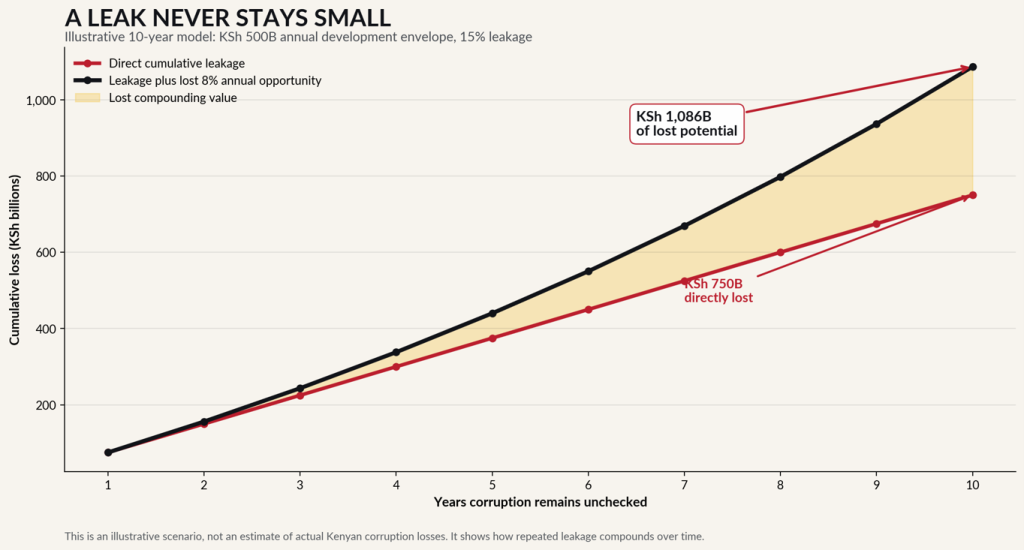
Figure 2: Illustrative compounding model. Repeated leakage creates both direct loss and a larger loss of future economic and social value.
We must therefore stop treating corruption as entertainment. A scandal trends for two days, politicians trade accusations, citizens make jokes, and then the country moves on to the next outrage. That cycle protects thieves. Public anger without memory is politically harmless. Accountability requires citizens who record names, contracts, promises, audit findings and voting records.
The corrupt political class depends on exhaustion. It wants citizens to believe that everyone steals, nothing can change and resistance is useless. That lie is more valuable to corruption than any bribe. The moment people accept hopelessness, thieves no longer need to hide. They only need to divide the public and wait for outrage to fade.
The 2027 election must not become another festival of slogans, tribal arithmetic, cash handouts and recycled personalities. A person who buys your vote is not generous. They are making an advance payment for permission to steal from you for five years. The money handed out at a rally is often a tiny refund from a system that has already taken far more from your family.
We must interrogate every candidate with the seriousness of an employer hiring someone to manage trillions of shillings and millions of lives. What is their record? Who finances them? What do they own, and can they explain it? Will they publish procurement information? Will they protect auditors, journalists and whistleblowers? Will they prosecute allies with the same energy used against opponents?
Kenya does not need leaders who merely speak angrily about corruption. It needs leaders willing to build systems that make theft difficult, detection immediate and punishment unavoidable. Public contracts must be transparent. Beneficial owners must be known. Projects must be tracked from budget to completion. Audit queries must trigger action. Stolen assets must be recovered. Convictions must carry real consequences.
Institutions must be stronger than personalities. The fight against corruption cannot depend on whether a president likes or dislikes a suspect. Prosecutors, investigators, auditors, courts, Parliament, county assemblies and the media must be protected from political capture. When oversight institutions become servants of power, corruption becomes government policy by another name.
Citizens also carry a responsibility. We must reject the small corruption we excuse in daily life, but we must never allow that conversation to be used to equalise a desperate bribe at a service desk with the grand theft of billions by powerful officials. Both are wrong, but power creates greater responsibility, greater opportunity for harm and a greater duty to account.
We must refuse to be divided when demanding accountability. Hunger has no tribe. A closed business has no tribe. A hospital without medicine has no tribe. Debt collectors do not ask how you voted. Corruption unites citizens in suffering; the fight against it must unite citizens in purpose.
The alternative is not chaos. The alternative is disciplined democratic action: registering to vote, examining candidates, attending public participation meetings, demanding documents, supporting independent journalism, reporting wrongdoing, following court cases and refusing to praise unexplained wealth. A republic is defended through persistent civic work, not only through anger at election time.
A better Kenya is possible because corruption is not weather. It is designed by people, protected by people and can be dismantled by people. Countries improve when citizens raise the political cost of theft, when institutions enforce the law and when leaders understand that public office is a trust rather than a licence to accumulate.
But change will require moral clarity. We must call theft theft. We must stop applauding looters because they donate a fraction of stolen wealth to churches, funerals, schools or political campaigns. Charity cannot launder public theft. A thief who returns crumbs is still a thief, and a society that celebrates the crumbs helps conceal the missing loaf.
The question before Kenya is no longer whether corruption is hurting us. The evidence is in our taxes, debts, hospitals, schools, businesses and unemployed youth. The real question is how much more pain we are willing to tolerate before we stop rewarding the people who create it.
Come 2027, we must choose more than a new set of faces. We must choose a new standard. We must reject leaders who weaponise tribe, purchase loyalty, protect thieves and treat citizens as an audience rather than employers. We must elect people prepared to account for every shilling, answer every question and face the law when they betray the public trust.
Corruption has stolen enough money. It has stolen enough years. It has buried enough dreams. It has converted too many citizens into beggars before the very government their taxes sustain. The country cannot continue paying for the luxury of its destroyers.
Our politics must change because our lives depend on it. Our voting must change because our children will inherit the consequences. Our silence must end because silence is the safest hiding place corruption has ever known.
Kenya does not lack money, talent or courage. It lacks a political culture that fears the citizen and respects the law. We can build that culture, but only when accountability becomes stronger than tribe, memory becomes longer than propaganda and the ballot becomes a verdict on performance rather than a reward for manipulation.
The nation is not poor by accident. Too often, it is made poor by design. In 2027, citizens must peacefully, lawfully and decisively withdraw power from those who have treated the Republic as private property and entrust it to leaders who understand one simple truth: public money belongs to the public, and stealing it is stealing life itself.
“The nation is not poor by accident. Too often, it is made poor by design.”

About Steve Biko Wafula
Steve Biko is the CEO OF Soko Directory and the founder of Hidalgo Group of Companies. Steve is currently developing his career in law, finance, entrepreneurship and digital consultancy; and has been implementing consultancy assignments for client organizations comprising of trainings besides capacity building in entrepreneurial matters.He can be reached on: +254 20 510 1124 or Email: info@sokodirectory.com

- January 2026 (220)
- February 2026 (248)
- March 2026 (287)
- April 2026 (207)
- May 2026 (192)
- June 2026 (238)
- July 2026 (279)
- August 2026 (224)
- September 2026 (29)
- January 2025 (119)
- February 2025 (191)
- March 2025 (212)
- April 2025 (193)
- May 2025 (161)
- June 2025 (157)
- July 2025 (227)
- August 2025 (211)
- September 2025 (267)
- October 2025 (297)
- November 2025 (230)
- December 2025 (220)
- January 2024 (238)
- February 2024 (227)
- March 2024 (190)
- April 2024 (133)
- May 2024 (157)
- June 2024 (145)
- July 2024 (136)
- August 2024 (154)
- September 2024 (212)
- October 2024 (255)
- November 2024 (196)
- December 2024 (143)
- January 2023 (182)
- February 2023 (203)
- March 2023 (322)
- April 2023 (297)
- May 2023 (267)
- June 2023 (214)
- July 2023 (212)
- August 2023 (257)
- September 2023 (237)
- October 2023 (264)
- November 2023 (286)
- December 2023 (177)
- January 2022 (293)
- February 2022 (329)
- March 2022 (358)
- April 2022 (292)
- May 2022 (271)
- June 2022 (232)
- July 2022 (278)
- August 2022 (253)
- September 2022 (246)
- October 2022 (196)
- November 2022 (232)
- December 2022 (167)
- January 2021 (182)
- February 2021 (227)
- March 2021 (325)
- April 2021 (259)
- May 2021 (285)
- June 2021 (272)
- July 2021 (277)
- August 2021 (232)
- September 2021 (271)
- October 2021 (303)
- November 2021 (364)
- December 2021 (249)
- January 2020 (272)
- February 2020 (310)
- March 2020 (390)
- April 2020 (321)
- May 2020 (335)
- June 2020 (327)
- July 2020 (333)
- August 2020 (276)
- September 2020 (214)
- October 2020 (233)
- November 2020 (242)
- December 2020 (187)
- January 2019 (251)
- February 2019 (215)
- March 2019 (283)
- April 2019 (254)
- May 2019 (269)
- June 2019 (249)
- July 2019 (335)
- August 2019 (292)
- September 2019 (306)
- October 2019 (313)
- November 2019 (362)
- December 2019 (318)
- January 2018 (291)
- February 2018 (213)
- March 2018 (275)
- April 2018 (223)
- May 2018 (235)
- June 2018 (176)
- July 2018 (256)
- August 2018 (247)
- September 2018 (255)
- October 2018 (282)
- November 2018 (282)
- December 2018 (184)
- January 2017 (183)
- February 2017 (194)
- March 2017 (207)
- April 2017 (104)
- May 2017 (169)
- June 2017 (205)
- July 2017 (189)
- August 2017 (195)
- September 2017 (186)
- October 2017 (235)
- November 2017 (253)
- December 2017 (266)
- January 2016 (164)
- February 2016 (165)
- March 2016 (189)
- April 2016 (143)
- May 2016 (245)
- June 2016 (182)
- July 2016 (271)
- August 2016 (247)
- September 2016 (233)
- October 2016 (191)
- November 2016 (243)
- December 2016 (153)
- January 2015 (1)
- February 2015 (4)
- March 2015 (164)
- April 2015 (107)
- May 2015 (116)
- June 2015 (119)
- July 2015 (145)
- August 2015 (157)
- September 2015 (186)
- October 2015 (169)
- November 2015 (173)
- December 2015 (205)
- March 2014 (2)
- March 2013 (10)
- June 2013 (1)
- March 2012 (7)
- April 2012 (15)
- May 2012 (1)
- July 2012 (1)
- August 2012 (4)
- October 2012 (2)
- November 2012 (2)
- December 2012 (1)