
Corruption Is The Slow Murder Of A Nation, Not A Theft From Government

Money in Kenya is political long before it reaches your pocket. The price of unga, the tax on your payslip, the medicine missing from a public hospital, the loan your business cannot afford and the job your child cannot find are not random misfortunes. They are the consequences of choices made by people entrusted with public power.
That is why corruption must never be softened into polite language. It is not a ‘challenge’. It is not a ‘governance concern’. It is not a harmless culture of facilitation. Corruption is organised cruelty. It is the deliberate decision to make millions of people poorer so that a connected few can become obscenely richer.
Every stolen shilling already had a name. It was a teacher who would have entered an overcrowded classroom. It was a cancer drug that would have reached a county hospital. It was a bridge that would not collapse, a borehole that would not run dry, a laboratory that would have equipped a young scientist, or a small supplier who would have been paid on time.

When that money disappears, the damage does not remain inside an accounting book. It enters homes. It becomes a mother choosing between food and medicine. It becomes a graduate sending applications for years until hope turns into anger. It becomes a business closing after government refuses to pay while politically protected contractors are paid overnight.
Corruption does not merely steal money. It steals time. It forces citizens to spend hours in queues because systems were never modernised. It steals years from children learning in broken schools. It steals decades from communities waiting for roads, water, electricity and markets that were promised during every election and abandoned after every oath of office.
The most offensive part is the insult that follows the theft. Citizens are told to tighten their belts while leaders expand convoys, offices, allowances and vanity projects. Workers are taxed more because public money was wasted. Businesses are squeezed because revenue was looted. Families are ordered to sacrifice for a country whose political elite repeatedly refuses to sacrifice anything.
Kenya’s 2025 Corruption Perceptions Index score was 30 out of 100, placing the country 130th out of 182 countries. That number is not merely an international ranking. It is a warning that the institutions meant to protect the public interest are still being overwhelmed by impunity, patronage and weak accountability.
For fourteen years, the score has moved up and down within a narrow, deeply troubling range. We celebrate tiny improvements, mourn small reversals and then return to business as usual. A nation cannot defeat corruption through annual speeches, ceremonial arrests and files that disappear when suspects become politically useful.
“A stolen shilling is not missing money. It is a missing service, a broken life and a future deliberately delayed.”
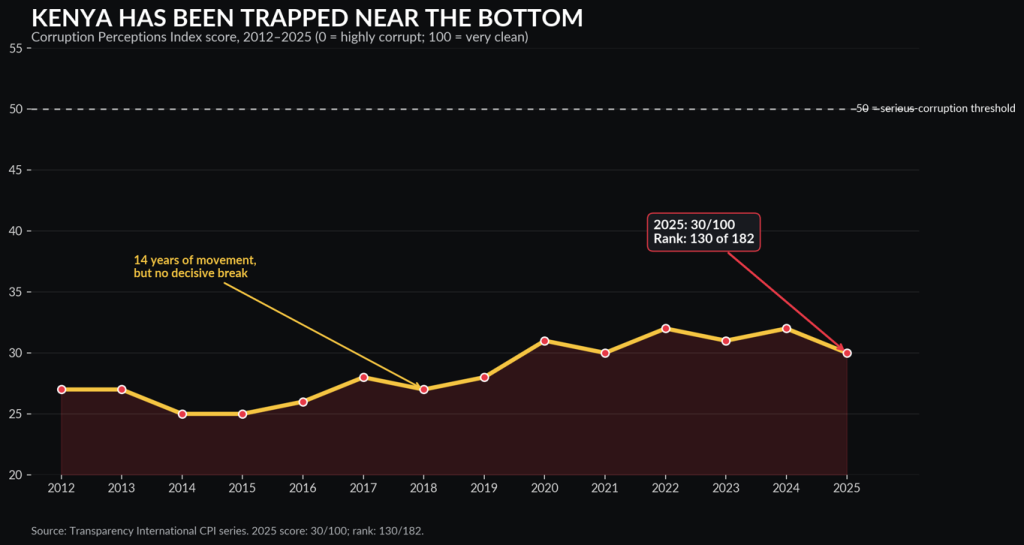
Figure 1: Kenya’s public-sector corruption score has remained persistently weak. A score below 50 signals serious corruption concerns.
Corruption survives because it has been tribalised, normalised and defended. A thief is condemned when he belongs to the other side and celebrated when he speaks our language, funds our faction or attacks our political enemy. That hypocrisy is the oxygen of impunity. We cannot demand justice for one scandal while manufacturing excuses for another.
There is no patriotic corruption. There is no tribal corruption that benefits a community. When a leader steals in your name, the money does not enter your household. Your school remains poor. Your hospital remains empty. Your road remains impassable. Only the thief’s family, financiers and political brokers become secure.
Unchecked corruption also destroys honest enterprise. The business that offers quality, pays taxes and employs young people loses tenders to a shell company with political connections. The entrepreneur learns that competence is less valuable than access. Investors learn that rules can be rewritten. Citizens learn that effort does not matter. That is how a country kills ambition without firing a single bullet.
It also poisons public debt. When borrowed money builds useful infrastructure, expands production and raises future revenue, debt can create value. When borrowed money is inflated, diverted or poured into projects chosen for kickbacks rather than national need, citizens inherit the repayment while thieves retain the benefit. We borrow p