


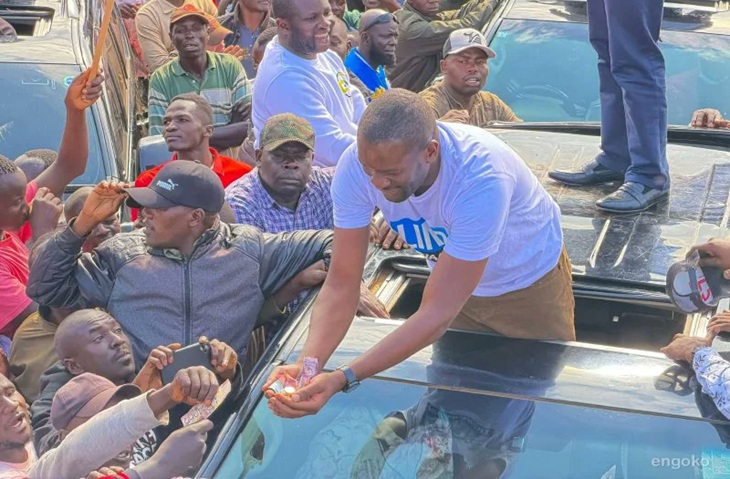
For years, Kenya’s political establishment has treated elections as an auction. The language may be democratic, the rallies may be loud and the ballot may be secret, but behind the performance sits a brutal calculation: whoever controls the deepest war chest believes they can control the outcome.
That is the hidden card Kenya Kwanza has always expected to play in 2027—financial muscle. The assumption is simple: flood the ground with money, overwhelm opponents with logistics, turn hardship into a marketplace, and reduce citizens from sovereign voters into desperate recipients of temporary favours.
But Edwin Sifuna’s emerging campaign model threatens to change that equation. Not because money will suddenly cease to matter, but because the ownership of that money can change. A campaign financed directly by ordinary citizens is fundamentally different from one sustained by a handful of wealthy benefactors. One creates a public mandate. The other creates private obligations.


| “Citizen funding does not remove money from campaigns. It removes the power of money to own the candidate.” |
The Hidden Card: Politics by Financial Exhaustion
The most powerful political machines do not always win by persuasion. Often, they win by exhausting everyone else. They make campaigns so expensive that only the state-connected, the corruption-enabled or the privately sponsored can remain competitive. They convert transport, media visibility, mobilisation, polling agents and basic organising into barriers that keep credible but independent candidates outside the arena.
This is why campaign finance is not a technical footnote. It is the architecture of political power. The person who pays for the campaign often expects to influence the government that follows. A candidate funded by contractors, tenderpreneurs, monopolists or shadowy intermediaries may enter office carrying a debt that no voter can see. The election is won publicly, but the repayment begins privately.
That hidden debt is one of the reasons public resources are so often redirected away from citizens and toward networks of influence. The campaign financier does not necessarily ask for a thank-you note. They may ask for a contract, a policy concession, regulatory protection, an appointment, privileged access or silence when accountability is required. In that system, the voter casts the ballot—but the financier writes the terms.
A Citizen-Funded Campaign Changes Who Holds the Receipt
A citizen-funded Sifuna campaign would reverse that relationship. Thousands of ordinary contributions—small, transparent and voluntary—would do more than pay for posters, transport, digital organising and agents. They would distribute political ownership across the country.
When a teacher contributes KSh 200, a boda boda rider contributes KSh 100, a trader contributes KSh 500 and a professional contributes KSh 2,000, the campaign stops belonging to a boardroom. It becomes a public trust. Each contribution says: we are not waiting to be purchased; we are investing in the leadership we want.
That is what makes citizen funding more frightening to an entrenched political machine than any chant at a rally. A chant expresses anger for a moment. A contribution creates commitment. A supporter who has invested—even modestly—is more likely to attend meetings, defend the vote, question propaganda, recruit others, monitor results and demand accountability after victory.
The campaign then acquires something money alone cannot buy: organised belief. Bribery can rent a crowd. It cannot easily defeat a citizen who has become a shareholder in a political cause.
From Spectators to Shareholders in Democracy
Kenyan citizens are too often invited into politics only at the final stage: the rally, the handout and the ballot. Decisions about strategy, financing, messaging and priorities remain locked inside small circles. Citizen funding changes that psychology because contribution creates participation.
A voter who funds a campaign directly begins to see the election differently. The vote is no longer an isolated act performed once every five years. It becomes part of a wider duty: protect the campaign, understand the issues, challenge misinformation, watch the polling station, demand clean tallying, and remain engaged after the swearing-in ceremony.
This is how democratic engagement becomes real. Citizens do not protect what feels distant. They protect what they have built. They do not easily surrender a vote connected to their own sacrifice. And they are less vulnerable to the insulting logic of electoral bribery because they have already chosen to be investors in change rather than customers in a political marketplace.
In practical terms, this is how Sifuna’s candidacy can remove money from the equation—not by pretending campaigns cost nothing, but by denying concentrated wealth the power to determine who can compete, what can be said and whose interests must be served afterward. The cost remains. The control changes.
THE COST REMAINS. THE CONTROL CHANGES.
Why This Model Fits Edwin Sifuna
Sifuna’s political appeal has never depended on appearing detached, overly polished or protected by elite consensus. His strength is rooted in directness: the willingness to speak plainly, confront power publicly and remain accessible to citizens who feel ignored by the formal architecture of government.
That political identity is naturally strengthened by a financing model that mirrors it. A people-facing candidate should be people-funded. A campaign built on public courage should not be privately mortgaged. A candidacy that promises to confront entrenched interests must not depend on those same interests for survival.
This is also where credibility is tested. Citizen funding must be transparent, auditable and disciplined. Contributors should be able to see how much is raised, where it comes from within lawful limits, and what it supports. Regular reporting would turn campaign finance from a secretive weapon into a democratic education. It would prove that integrity is not merely a speech delivered against corruption; it is a system designed to prevent capture before power is won.
Done properly, Sifuna would not simply be asking Kenyans to finance a presidential bid. He would be inviting them to build a new political institution—one in which leadership is accountable downward to citizens rather than upward to financiers.
The Real Threat to the Politics of Bribery
A government confident in its popularity would not fear small contributions from citizens to an opponent. But a system dependent on money as its final advantage would understand the danger immediately. Once ordinary people learn that they can collectively finance viable political competition, the wealthy’s monopoly begins to break down.
The arithmetic is powerful. One billionaire may fund a campaign and expect influence. One million citizens may fund a campaign and expect service. The first relationship concentrates power. The second disperses it. The first creates a gatekeeper. The second creates a constituency.
That is why citizen funding is bigger than fundraising. It is political organising measured in contributions. It identifies committed supporters, builds networks, creates recurring contact, tests the depth of public belief and turns passive approval into measurable action. Every contribution becomes both a resource and a declaration: my vote is not for sale because I have already invested in the alternative.
Bribery thrives where politics feels transactional and hopeless. Citizen funding introduces dignity. It tells people that even a small amount can help construct national leadership. It replaces the humiliation of waiting for a handout with the pride of helping finance a cause.
A New Covenant Between Candidate and Citizen
The deepest promise of a citizen-funded campaign is moral, not financial. It creates a covenant. The citizen says: I will not sell my vote. The candidate says: I will not sell my government. The citizen says: I will participate beyond the rally. The candidate says: I will remain accountable beyond the election.
Such a model would also change the meaning of victory. A win delivered by enormous private financing can be interpreted as the triumph of machinery. A win built from thousands or millions of direct contributions would be unmistakably different. It would represent a national act of ownership—a public decision to finance its own political transition.
This is the opportunity before Edwin Sifuna. His candidacy can become more than a contest against Kenya Kwanza. It can become a referendum on how political power itself is funded, owned and protected. It can demonstrate that the greatest campaign war chest is not held in one vault; it is held in the collective commitment of citizens who refuse to be bought.
They believed 2027 would be won through sheer financial power. They believed economic hardship could be converted into political obedience. They believed every conviction had a price.
But a citizen-funded Sifuna campaign would expose the weakness in that strategy. Money is powerful only when it is concentrated in the hands of a few. When citizens contribute directly, money becomes participation. Participation becomes vigilance. Vigilance protects the vote. And a protected vote becomes genuine democratic power.
The campaign they fear most is not necessarily the richest. It is the one owned by the people—because what the people finance, the people will defend.
Read Also: The Weight of Emergence: Why Edwin Sifuna Represents a Leadership Moment Kenya Cannot Ignore